Development, Sovereignty, Contested Leadership, and the African Future
African Institute of Washington (AIW)
Abstract
The presidency of John Pombe Magufuli remains one of the most consequential and contested periods in contemporary Tanzanian political history. President from 2015 until his death in March 2021, Magufuli became internationally known as the Bulldozer because of his forceful approach to public administration, infrastructure development, government spending, and the management of natural resources. His supporters viewed him as a nationalist leader committed to public discipline, self-reliance, and development, while human-rights organizations documented serious restrictions on political opposition, media freedom, civil society, and freedom of expression during his presidency.
This article examines the Magufuli phenomenon without reducing it either to praise or condemnation. It considers his development agenda, economic policies, approach to natural resources, infrastructure projects, public administration, democratic governance, and COVID-19 policies. It then examines the Tanzanian diaspora in the United States as an important transnational community capable of contributing knowledge, investment, professional expertise, cultural exchange, and constructive dialogue between Tanzania and the United States. The article argues that the enduring lesson of the Magufuli era is the need to reconcile development, national sovereignty, institutional accountability, human rights, and citizen participation.
Keywords: John Magufuli, Tanzania, Julius Nyerere, African leadership, self-reliance, development, sovereignty, democracy, Tanzanian diaspora, United States, Pan-Africanism.
1. Introduction
John Pombe Magufuli became President of the United Republic of Tanzania in 2015 and remained in office until his death on March 17, 2021. He was subsequently succeeded by Vice President Samia Suluhu Hassan, who became Tanzania’s first woman president.
Magufuli’s political identity was built around a simple but powerful message: government must work, public resources must be protected, and national development must produce visible results.
His supporters frequently associated him with the ideals of Tanzania’s founding president, Julius Nyerere, particularly the concepts of self-reliance, national dignity, public service, and resistance to excessive foreign dependency.
His nickname, the Bulldozer, captured both sides of his presidency. To supporters, the metaphor represented determination: a leader willing to remove bureaucratic obstacles and challenge established interests. To critics, it represented the concentration of power and an administration that frequently treated political opposition and criticism as obstacles to be removed.
Human Rights Watch documented a significant deterioration in freedom of expression, political pluralism, media freedom, and civic space during Magufuli’s presidency.
The Magufuli phenomenon therefore deserves neither simple glorification nor simple dismissal.
It deserves historical examination.
2. Magufuli and the Idea of Self-Reliant Development
One of the most important dimensions of Magufuli’s political appeal was his emphasis on Tanzanian self-reliance.
This idea has deep roots in the political philosophy of Julius Nyerere. Nyerere’s Ujamaa philosophy emphasized national independence, collective responsibility, rural development, education, and self-reliance.
Magufuli did not simply reproduce Nyerere’s political system. Instead, he adapted elements of the self-reliance philosophy to a contemporary development agenda.
His administration emphasized:
- infrastructure;
- government discipline;
- reduction of waste;
- increased domestic revenue;
- investment in public services;
- natural-resource governance;
- national ownership of development priorities.
Tanzania reached lower-middle-income status in July 2020, according to the World Bank. This achievement was the result of longer-term economic growth and structural changes extending beyond Magufuli’s presidency alone, so it should not be attributed exclusively to his administration.
Nevertheless, the achievement occurred during his presidency and became an important part of the political narrative surrounding his government.
3. Public Administration and the Fight Against Waste
Magufuli became famous for his highly visible campaign against government waste.
His administration emphasized reducing unnecessary government expenditure, increasing accountability among public officials, and strengthening discipline within the public service.
For many Tanzanians, these measures symbolized something larger than administrative reform.
They represented the idea that public office should serve the public rather than become a mechanism for personal enrichment.
This message resonated particularly strongly in a continent where citizens frequently express frustration with corruption, bureaucratic inefficiency, and the misuse of public resources.
However, administrative efficiency must ultimately be institutionalized.
A sustainable state cannot depend exclusively on the personality of a president who personally disciplines officials. Sustainable governance requires:
- transparent procurement;
- independent auditing;
- professional civil service institutions;
- parliamentary oversight;
- judicial independence;
- anti-corruption mechanisms;
- freedom of information;
- and accountable leadership.
The important question is therefore not simply whether a president can impose discipline.
It is whether institutions can maintain discipline after the president is gone.
4. Infrastructure and National Development
Infrastructure became one of the defining features of the Magufuli era.
The government promoted major projects including:
- the Standard Gauge Railway;
- the Julius Nyerere Hydropower Project, formerly associated with the Stiegler’s Gorge project;
- roads and bridges;
- electricity expansion;
- schools and health facilities.
Infrastructure development reflected a broader philosophy: Tanzania could not achieve industrialization without modern transportation, reliable energy, and improved public services.
The World Bank has documented Tanzania’s broader progress in infrastructure, including major improvements in electricity access and transportation.
The significance of these projects extends beyond physical construction.
Infrastructure can become the foundation for:
agricultural productivity → industrialization → employment → regional trade → improved living standards.
The challenge, however, is ensuring that major infrastructure projects remain economically productive, financially sustainable, environmentally responsible, and beneficial to ordinary citizens.
5. Natural Resources and Economic Sovereignty
Tanzania’s natural resources have long been central to debates about national development.
During Magufuli’s presidency, the government adopted a more assertive approach toward mining companies and natural-resource contracts.
The underlying argument was straightforward:
Tanzania should receive a greater share of the economic value generated by Tanzanian natural resources.
This reflects a broader African debate about resource sovereignty.
Across Africa, countries possess enormous quantities of minerals, oil, gas, agricultural land, and other resources. Yet the ownership and processing of those resources frequently involve foreign companies, international capital, and global supply chains.
The strategic question is therefore not simply:
“Who owns the mineral?”
It is:
“Who extracts it, who processes it, who receives the value, and where are the jobs and industries created?”
This question remains highly relevant to Tanzania and the African continent.
6. The Limits and Risks of Economic Nationalism
Magufuli’s approach also generated concerns among investors and private-sector actors.
A government seeking greater national control over natural resources must balance several objectives:
- protecting national interests;
- attracting investment;
- ensuring predictable regulation;
- protecting workers;
- collecting appropriate taxes;
- maintaining investor confidence;
- and developing domestic industries.
Economic sovereignty does not necessarily require isolation from international investment.
Rather, the objective can be to move from dependency toward partnership.
A sovereign development strategy should therefore seek investment that contributes to technology transfer, employment, infrastructure, local manufacturing, skills development, and long-term national capacity.
7. Democracy, Human Rights, and the Magufuli Contradiction
Perhaps the greatest controversy surrounding Magufuli’s presidency concerns the relationship between development and democratic governance.
Human Rights Watch documented restrictions on political opposition, journalists, civil-society organizations, and freedom of expression. It also reported arrests and prosecutions involving government critics and opposition figures.
Ahead of the 2020 elections, Human Rights Watch documented restrictions on opposition parties, media organizations, civil society and communications.
This creates an important philosophical question:
Can economic development compensate for restrictions on political freedom?
The answer requires distinguishing two different concepts.
Development concerns improvements in material and social conditions.
Democracy and human rights concern participation, political equality, freedom of expression, accountability, and protection from arbitrary government power.
A country should not have to choose between them.
The long-term African development challenge is to build states capable of delivering both development and freedom.
8. COVID-19 and the Magufuli Legacy
COVID-19 became another highly controversial dimension of Magufuli’s presidency.
His government’s handling of the pandemic attracted international criticism, particularly concerning transparency and public communication about the disease. Human Rights Watch documented restrictions on media organizations reporting on COVID-19 and noted Magufuli’s declaration in 2020 that Tanzania was free of COVID-19.
This episode illustrates the importance of scientific institutions and transparent public-health communication.
National sovereignty should not mean rejecting international scientific cooperation.
A sovereign African state can simultaneously:
- make its own policy decisions;
- strengthen its own scientific institutions;
- cooperate with international organizations;
- publish reliable public-health data;
- and protect the public’s right to accurate information.
The lesson is particularly important for future African leadership.
9. The Magufuli Legacy: Two Tanzanian Perspectives
Magufuli’s legacy continues to be interpreted differently.
The favorable interpretation
Supporters remember him as a leader who:
- challenged corruption;
- demanded discipline from public officials;
- prioritized infrastructure;
- emphasized national resources;
- promoted self-reliance;
- reduced visible government extravagance;
- and restored a sense of national pride.
For this constituency, Magufuli demonstrated that an African government could pursue ambitious development without simply following external prescriptions.
The critical interpretation
Critics emphasize:
- restrictions on opposition;
- pressure on independent media;
- restrictions on civil society;
- limitations on freedom of expression;
- concentration of executive authority;
- and the government’s handling of COVID-19.
Human Rights Watch described a substantial deterioration in Tanzania’s human-rights environment during Magufuli’s presidency.
Both dimensions are important to understanding the historical record.
10. The Tanzanian Diaspora in the United States
The story of Tanzania does not end at Tanzania’s borders.
Thousands of Tanzanians and Tanzanian Americans live, study, work, and raise families in the United States.
The U.S. Census Bureau’s American Community Survey maintains specific data on people born in Tanzania, allowing the community to be studied through official demographic statistics.
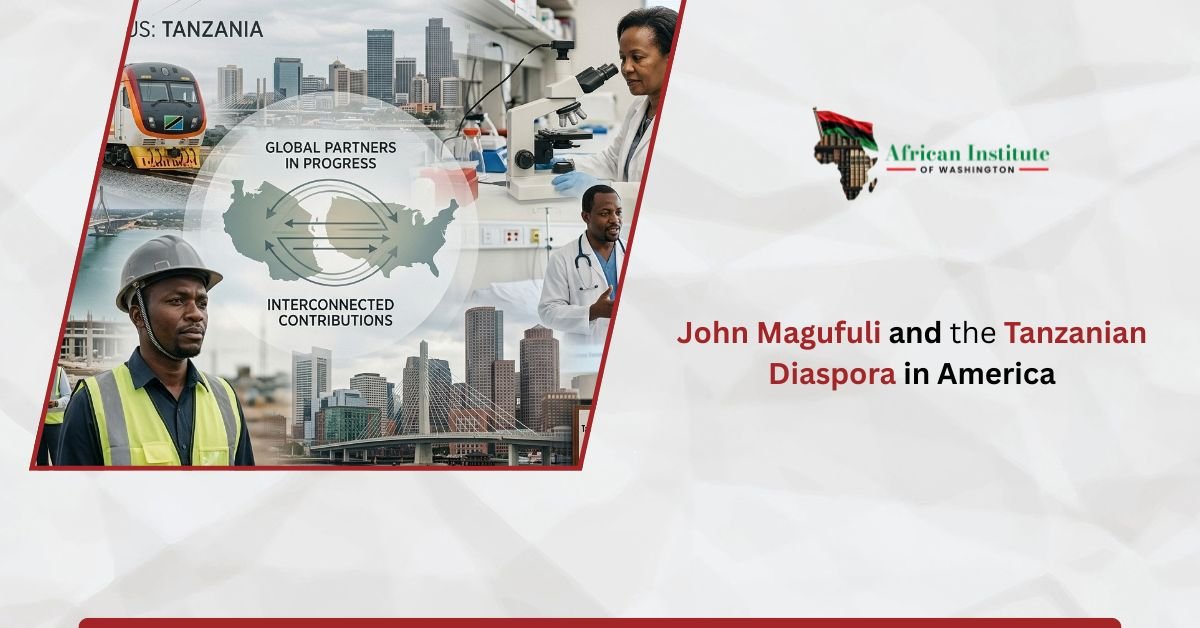
Rather than viewing the diaspora simply as people who have left Tanzania, it is more productive to view it as a transnational community connecting two societies.
Tanzanian Americans contribute to American society in areas including:
- medicine;
- education;
- science;
- business;
- technology;
- public administration;
- faith communities;
- culture;
- and professional services.
One of the best exa
At the same time, many maintain economic, cultural and family relationships with Tanzania.
11. DICOTA and the Organization of the Diaspora
One important institution is the Diaspora Council of Tanzanians in America (DICOTA).
DICOTA describes itself as an independent, nonpartisan and nonsectarian nonprofit organization whose mission is to enhance the economic, health and social well-being of Tanzanians in America and at home. The organization traces its origins to a 2008 gathering of Tanzanian diaspora members in Houston.
Its activities illustrate the potential of diaspora organization.
The diaspora can provide:
- professional networks;
- investment;
- mentorship;
- educational partnerships;
- healthcare expertise;
- entrepreneurship;
- cultural preservation;
- technology transfer;
- and connections between American and Tanzanian institutions.
The Tanzanian Embassy in Washington, D.C., has also documented diaspora conferences and engagement involving DICOTA.
12. From Remittances to Knowledge Transfer
The contribution of the diaspora should not be measured only by money sent home.
Financial remittances are important, but the most strategic contribution may be knowledge transfer.
Consider a Tanzanian physician practicing in the United States.
That person can contribute to Tanzania not only by sending money, but by:
- establishing medical partnerships;
- training Tanzanian health professionals;
- donating or facilitating medical equipment;
- supporting telemedicine;
- developing research collaborations;
- creating specialist training programs.
The same principle applies to engineers, educators, lawyers, scientists, entrepreneurs, information-technology professionals, economists, and public administrators.
The diaspora therefore represents a potentially powerful human-capital bridge.
A Tanzanian-American Contribution to the United States: Dr. Hamida Majili
The contribution of the Tanzanian diaspora to the United States can be seen not only through remittances and financial investment, but also through professional excellence, entrepreneurship, healthcare, education, and community service.
A compelling example is Dr. Hamida Majili, a Tanzanian-American healthcare professional serving the Metropolitan Washington, D.C., area through her own psychiatric mental-health practice. Her professional journey illustrates how members of the Tanzanian diaspora can transform their education, experience, and cultural background into services that benefit the wider American society.
Dr. Majili is a Board-Certified Psychiatric Mental Health Nurse Practitioner (PMHNP-BC) with more than 14 years of experience in healthcare. She holds a Doctor of Nursing Practice (DNP) degree and has developed her professional practice around person-centered, evidence-based, and holistic mental-health care.
Her approach emphasizes compassion, cultural sensitivity, respect, and collaboration. She seeks to create an environment in which patients can feel safe, heard, respected, and understood. Her practice serves individuals from diverse backgrounds and welcomes patients regardless of diagnosis, gender, religion, race, or ethnicity.
Dr. Majili’s example illustrates an important dimension of the Tanzanian-American experience. Diaspora contribution is not limited to money sent home to Tanzania. It also includes the knowledge, professional expertise, entrepreneurship, and public service that Tanzanian immigrants contribute to the societies in which they live.
Through her medical profession and independent practice, Dr. Majili contributes to the American healthcare system while also demonstrating the potential of African-born and African-descended professionals to establish institutions, create employment, serve diverse communities, and become leaders in their fields.
Her story also points toward a broader opportunity for Tanzania. Professionals such as Dr. Majili possess knowledge and experience that can potentially be shared with Tanzania through professional exchanges, mentorship, academic partnerships, telehealth initiatives, training programs, and other forms of diaspora engagement.
The Tanzanian diaspora therefore represents more than a community living outside the homeland. It represents a reservoir of human capital connecting Tanzania with the United States and the wider world.
Dr. Hamida Majili’s journey provides a concrete example of this principle: a Tanzanian-American can contribute to the development of the United States while simultaneously serving as a potential bridge for knowledge, professional collaboration, and development between America and Tanzania.
13. The Diaspora and Tanzania’s Next Development Phase
The next generation of Tanzanian development will require more than roads and buildings.
It will require:
Human capital
Universities, research institutions, scientific laboratories, vocational education and professional training.
Technology
Digital infrastructure, artificial intelligence, biotechnology, renewable energy and modern agricultural technologies.
Industrialization
Tanzania needs greater domestic processing of agricultural products and natural resources.
Entrepreneurship
Young Tanzanians need access to capital, mentorship, technology and markets.
Good governance
Development requires institutions that are transparent, predictable and accountable.
Global partnerships
Tanzania can cooperate with the United States and other countries while maintaining its own national development priorities.
This is where the diaspora can become a strategic partner.
14. What Can the United States and Tanzania Learn From Each Other?
The relationship between Tanzania and the United States should not be understood simply as donor and recipient.
It can also be understood as a relationship between partners.
Tanzania brings:
- its culture;
- its natural resources;
- its geographic position;
- its young population;
- its entrepreneurial potential;
- its African experience.
The Tanzanian diaspora brings:
- professional expertise;
- international networks;
- American educational experience;
- technological knowledge;
- investment capacity;
- and transnational connections.
The United States provides access to:
- universities;
- research institutions;
- financial markets;
- technology;
- professional networks;
- and global business connections.
A mature diaspora relationship should therefore move beyond remittances toward co-development.
15. A Pan-African Lesson
The Magufuli phenomenon raises a larger African question.
What kind of leadership does Africa need in the twenty-first century?
Africa needs leaders who can defend national interests without isolating their countries.
It needs leaders who can fight corruption without weakening institutional checks and balances.
It needs leaders who can pursue economic sovereignty while attracting productive investment.
It needs leaders who can build infrastructure while protecting human rights.
It needs leaders who understand that national sovereignty and democratic accountability are not necessarily enemies.
And Africa needs citizens — including its diaspora — who participate actively in building institutions rather than simply waiting for political leaders to solve every problem.
16. The Tanzanian-American Diaspora as a Strategic Asset
The Tanzanian diaspora in the United States can become a major contributor to Tanzania’s future if it is organized around long-term development rather than only social activities.
A strategic diaspora program could establish partnerships in:
- Education — scholarships, university partnerships and faculty exchanges.
- Healthcare — specialist training, telemedicine and medical missions.
- Technology — digital transformation and technology entrepreneurship.
- Agriculture — modern farming, food processing and agribusiness.
- Investment — diaspora investment funds and business partnerships.
- Youth development — mentorship and leadership programs.
- Women’s empowerment — entrepreneurship and professional networks.
- Research — joint Tanzania–U.S. research initiatives.
- Governance — professional exchanges and institutional capacity building.
- Culture — preservation and transmission of Tanzanian identity among younger generations.
Such initiatives would transform the diaspora from a community primarily defined by geographic distance into a development network spanning two countries.
Conclusion
John Pombe Magufuli left Tanzania with a complicated legacy.
His presidency demonstrated the political power of a development message centered on discipline, infrastructure, public spending, national resources and self-reliance. Tanzania’s transition to lower-middle-income status in 2020 occurred during his presidency, although that achievement reflected economic trends and reforms extending over many years.
At the same time, documented restrictions on political opposition, media, civil society and freedom of expression represent an important part of the historical record.
The most useful lesson is therefore not to ask whether Magufuli was simply a hero or a failure.
The more important question is:
What should Africa learn from the Magufuli experience?
The answer may lie in combining what development-oriented leadership sought to achieve with what strong democratic institutions are designed to protect.
Africa needs development without dependency, sovereignty without isolation, leadership without personal rule, and democracy without paralysis.
For Tanzania, the diaspora in the United States offers an important resource in achieving that balance.
Tanzanians living abroad should not be regarded merely as emigrants or remittance senders. They are teachers, doctors, engineers, entrepreneurs, researchers, professionals, parents, students and community leaders who can help connect Tanzania to global knowledge and opportunity.
Organizations such as DICOTA demonstrate that this connection can be organized institutionally.
The future relationship between Tanzania and its diaspora should therefore move from:
remittances → investment → knowledge → innovation → institutional partnership → national development.
That is perhaps the broader Pan-African lesson.
Africa’s diaspora is not outside Africa’s development story. It is part of the African story.
And Tanzania’s experience under John Magufuli provides an important case study in the continuing search for a development model that combines national dignity, economic transformation, accountable leadership and human freedom.
Selected References
Human Rights Watch. (2021). Tanzania: Human rights priorities for Tanzania’s new president.
Human Rights Watch. (2021). Tanzania: President Magufuli’s death should open new chapter.
Human Rights Watch. (2021). World Report 2022: Tanzania.
World Bank. (2020). What does Tanzania’s move to lower-middle income status mean?
World Bank. (2021). Tanzania Economic Update: What will it take for Tanzania to become a successful middle-income country?
World Bank. (2023). Infrastructure investments are improving lives and livelihoods in Tanzania.
U.S. Census Bureau. (2022). American Community Survey: Place of birth for the foreign-born population in the United States.
Diaspora Council of Tanzanians in America. Who We Are and Mission.
Dr Hamida Mijili, My care Clinic, Sandy Spring Road Laurel MD
Psychology today( Psychiatrists) , My Care Clinic, LlC
Prof Claude Kisuka
African Institute of Washigton
African Studies
