From Kigali to Tabora, from Saïo to Burma: The Congo’s Military Legacy and Strategic Lessons for the FARDC
Author: Claude Kisuka
Abstract
The military history of the Democratic Republic of the Congo did not begin with independence in 1960 or with the creation of the Armed Forces of the Democratic Republic of the Congo (FARDC). It has a much longer history, marked particularly by the participation of the Congolese Force Publique in both world wars. During World War I, Congolese soldiers fought German colonial forces in Cameroon and German East Africa, particularly in territories corresponding to present-day Rwanda, Burundi, and Tanzania. The capture of Kigali, Bujumbura, and Tabora contributed to the defeat of German positions in the region and to Belgium’s subsequent administration of Rwanda-Urundi under the League of Nations mandate system. During World War II, the Belgian Congo remained on the Allied side after Belgium’s capitulation in May 1940. The Force Publique participated in the East African campaign, particularly in the victory at Saïo in July 1941, while Congolese medical personnel also served in other theaters, including Madagascar and Burma. Yet these contributions came at a considerable human cost, including coercive recruitment, disease, exhaustion, and inadequate recognition. This article examines that military legacy and draws lessons for today’s FARDC, which faces persistent challenges involving command, cohesion, logistics, discipline, and institutional accountability. It argues that remembering past victories cannot replace comprehensive reform. Instead, that memory should inspire the development of a professional, properly equipped, adequately compensated, and accountable national army committed to protecting the population and defending the country’s territorial integrity.
Keywords: Congolese soldiers, Force Publique, World War I, World War II, Battle of Tabora, Battle of Saïo, African carriers, military history, FARDC, Congolese military reform, national sovereignty.
INTRODUCTION: A CONGOLESE MILITARY HISTORY THAT DESERVES RECOGNITION
When major African military victories of the twentieth century are discussed, European, American, and British armies frequently occupy a prominent place in historical accounts. Yet African soldiers contributed decisively to several campaigns during the two world wars.
Among them, soldiers of the Belgian Congo’s Force Publique hold a distinctive place.
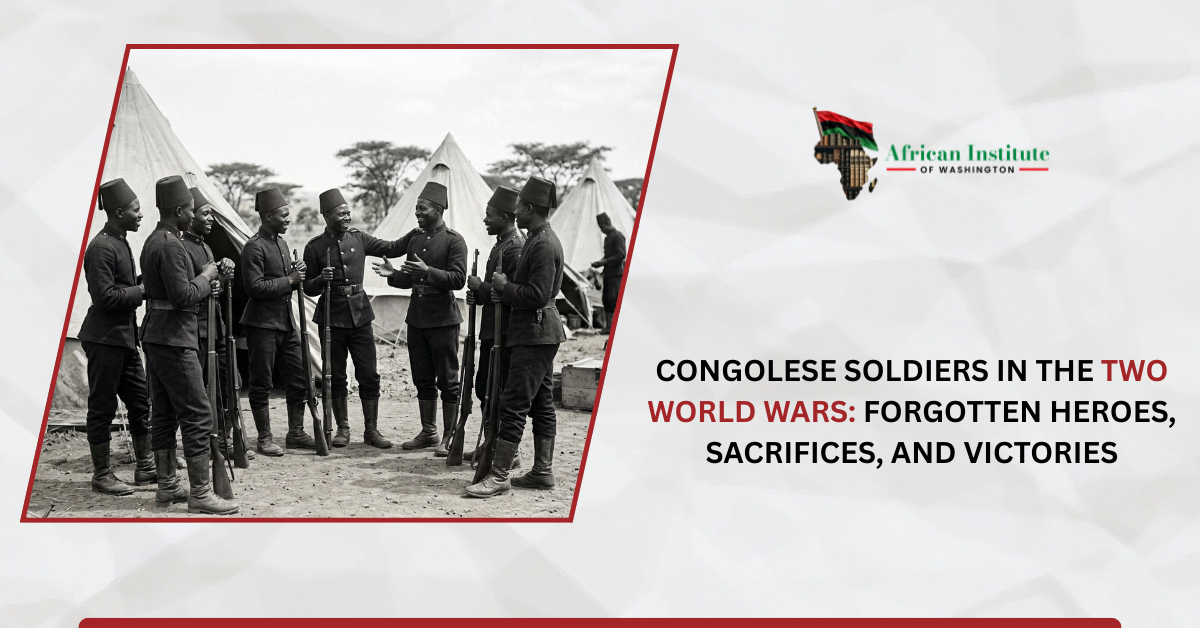
Between 1914 and 1918, they participated in military operations against German colonial forces in Central and East Africa. They fought under difficult conditions, crossed challenging terrain, and contributed to the capture of strategically important positions. In 1941, their successors fought the Italian colonial army in East Africa. Congolese medical personnel also supported Allied operations as far away as Asia.
These soldiers were not simply men recruited to reinforce European armies. They were combatants whose endurance, organization, and discipline were tested during demanding military campaigns.
Their history, however, contains a fundamental contradiction: Congolese soldiers helped defend the military interests of the Allied powers while their own country remained under colonial rule.
Their contributions raise two essential questions.
First, what was the actual military significance of Congolese soldiers in the two world wars?
Second, why does an army whose predecessors participated in victorious campaigns face such serious difficulties today in effectively defending the territorial integrity of the Democratic Republic of the Congo?
These questions should not lead us to romanticize the past or condemn contemporary soldiers indiscriminately. Historical circumstances, political objectives, available resources, and the nature of opposing forces have changed considerably.
Nevertheless, this history offers important lessons about command, operational preparation, logistics, troop cohesion, leadership accountability, and the relationship between the military and the nation.
This article therefore has two objectives: to restore Congolese soldiers to their rightful place in the history of the two world wars and to demonstrate how their legacy can inform the reconstruction of the contemporary FARDC.
I. WORLD WAR I: THE CONGOLESE FORCE PUBLIQUE ON MULTIPLE FRONTS
1. The Belgian Congo Enters the War
When World War I began in August 1914, the Congo was administered by Belgium. The Force Publique, which had developed from the military apparatus of the Congo Free State and had subsequently been reorganized under Belgian colonial administration, performed military and policing functions.
At the beginning of the conflict, the force numbered approximately 17,000 men, most of whom were assigned to garrisons. It was gradually transformed into a force capable of conducting military operations against neighboring German possessions.
The fighting did not take place exclusively on the European continent. European empires controlled colonial territories, infrastructure, and military forces. The European war consequently expanded into Africa.
The Congolese Force Publique participated in several campaigns, including operations in German Cameroon and German East Africa, particularly in territories corresponding to present-day Rwanda, Burundi, and Tanzania.
The proximity of these territories to the Belgian Congo created military concerns for the Belgian administration. Force Publique operations gradually acquired an offensive dimension.
The archives of the Royal Museum for Central Africa document the Force Publique’s participation in the campaigns of 1914–1918, including operations around Lakes Kivu and Tanganyika, the capture of Tabora, and the offensive toward Mahenge.
2. The Cameroon Campaign
German Cameroon was one of the African territories targeted by Allied forces at the beginning of the war.
French, British, and Belgian troops participated in operations against German positions. Historical accounts of the Congo indicate that a detachment of approximately 600 Congolese soldiers, accompanied by Belgian officers, contributed to operations in Cameroon in 1914.
The Cameroon campaign must be understood within the broader context of colonial warfare in Africa. European powers mobilized African soldiers and auxiliaries to defeat German garrisons and gain control of enemy territories.
Although Cameroon was not the principal theater of Congolese military operations, the campaign demonstrates that the Congo’s military contribution extended beyond its immediate borders.
It is important, however, to distinguish these operations from the larger campaigns in East Africa, where the Force Publique committed substantial forces and achieved several important strategic victories.
3. Rwanda and Burundi: The Capture of Kigali and Bujumbura
In East Africa, German colonial forces controlled Rwanda, Burundi, and the territory corresponding to present-day mainland Tanzania.
The proximity of these territories to the Belgian Congo created military risks for Belgian positions. Force Publique operations gradually developed into an offensive campaign.
In 1916, under the command of General Charles Tombeur and other Belgian officers, Congolese troops advanced against German positions.
Kigali was captured on May 6, 1916. The Belgian-Congolese forces continued their advance through Rwanda and Burundi. Bujumbura, then known as Usumbura, was occupied in June 1916.
These operations helped eliminate German military control over Rwanda and Burundi.
However, military victory must be distinguished from its political consequences. Belgium did not automatically receive these territories as an immediate reward for battlefield success. After the war, the League of Nations mandate system placed Rwanda and Burundi under Belgian administration as the territory of Ruanda-Urundi.
The Force Publique’s victories therefore contributed to changing the regional balance of power, while postwar diplomatic decisions determined the international status of the territories concerned.
4. The Battle of Tabora: A Major Strategic Victory
One of the most important military operations of World War I in Africa was the campaign to capture Tabora, in present-day Tanzania.
Tabora was an important administrative and railway center in German East Africa. Control of the town could disrupt German communications and strengthen the Allied position in the region.
After capturing intermediate positions, the Force Publique advanced toward Tabora. Allied forces occupied the town on September 19, 1916, following weeks of operations and fighting.
The victory weakened German military control in the western part of German East Africa.
Operations continued toward Mahenge in 1917. Congolese troops contributed to the capture of this position in October, increasing pressure on German forces.
The campaign from the territories near Lake Tanganyika to Tabora and then toward Mahenge illustrates the importance of the Force Publique’s contribution to the Allied war effort.
These victories demonstrate that the Force Publique could conduct prolonged operations, move over considerable distances, and fight under demanding conditions.
They also remind us that military victory depends on more than individual courage. It requires preparation, intelligence, coordination, supplies, and a command structure capable of sustaining an effective fighting force.
5. Military Strength and the Human Cost of War
Figures concerning the Force Publique’s strength and casualties vary according to the period, campaign, and categories of personnel included.
For the East African campaign, some historical summaries identify approximately 11,700 Congolese soldiers serving in the principal combat formations. Other figures describe the force’s expansion over the course of the conflict.
The campaigns also depended on enormous numbers of African carriers. Historian David Van Reybrouck discusses the use of approximately 260,000 carriers over the course of the war. This figure refers to cumulative mobilization and should not be interpreted as the number of people present on the front at any one time.
Reported casualties included approximately 1,895 Congolese soldiers killed and thousands of African carriers who died. One summary of the East African campaigns gives a figure of 7,124 carrier deaths. Such figures should not be treated as a single, comprehensive casualty total covering every African theater of the war.
Carriers transported ammunition, food, medical supplies, and other essential materials. In regions where roads and railways were inadequate, their labor was a critical component of military operations.
Their contribution, however, came at a terrible human cost. Disease, exhaustion, food shortages, and difficult journeys caused many deaths.
The military history of the Congo therefore cannot be written solely through the names of generals and captured cities. It must also recognize the ordinary soldiers, carriers, and auxiliaries whose work enabled military formations to continue operating.
6. The Limits of Colonial Recognition
The Force Publique’s victories did not mean that Congolese people enjoyed political equality with Belgians.
The colonial system continued to distinguish European officers from African soldiers, particularly in command authority, compensation, promotion, and social status.
The war demonstrated that Congolese soldiers could play a major military role. It did not grant them political sovereignty.
This contradiction is one of the fundamental legacies of World War I in Africa: colonial powers depended on African subjects to defend their interests while maintaining an unequal political system.
II. WORLD WAR II: THE CONGO ON THE SIDE OF THE ALLIES
1. After Belgium’s Capitulation in 1940
In May 1940, Nazi Germany invaded Belgium, which capitulated on May 28.
The Belgian Congo found itself in a distinctive strategic position. Although Belgium was occupied, the colonial administration and forces in the Congo continued to participate in the Allied war effort.
The Force Publique was mobilized against the Axis powers, particularly Fascist Italy, whose possessions in East Africa threatened Allied positions.
The Congo also contributed strategic minerals and agricultural products to the war economy. Copper, rubber, tin, gold, and especially uranium played important roles in wartime production.
Uranium from the Shinkolobwe mine in Katanga became particularly important to the American nuclear program. This economic and material contribution should be distinguished from the military operations conducted by Congolese soldiers, although both formed part of the wider Allied war effort.
The Congo was therefore more than a source of raw materials. It also provided military personnel, combat units, and medical services.
2. The Abyssinian Campaign: The Offensive Against Italian Forces
One of the most remarkable episodes in Congolese military history during World War II was the Abyssinian Campaign, the name commonly used at the time for Ethiopia.
Fascist Italy had invaded Ethiopia in 1935 and occupied the country. When the war expanded into East Africa, Italian forces confronted British armies and their allies, including the Congolese Force Publique.
Congolese units had to advance over long distances through difficult terrain, facing supply problems and significant health risks.
They participated in several engagements and contributed to the Allied advance into Ethiopian territory.
The campaign required coordination among combat units, transport services, communications personnel, medical services, and military commanders.
These operations demonstrated the importance of an organization capable of sustaining its effectiveness despite the distance separating its units from their supply bases.
3. The Battle of Saïo, July 3, 1941
The Battle of Saïo is one of the best-known episodes in Congolese military history.
After several operations against Italian forces, units of the Force Publique helped isolate Italian troops around Saïo, in western Ethiopia.
On July 3, 1941, the Italian forces agreed to cease hostilities. The capitulation marked the end of the first major phase of the Force Publique’s participation in the East African campaign.
Historical accounts report that thousands of Italian military personnel surrendered during the broader Ethiopian campaign. Some summaries cite approximately 15,000 Italian colonial troops captured during the campaign, along with nine generals and hundreds of senior officers. This figure concerns the campaign as a whole and should not be attributed exclusively to the Battle of Saïo.
The Saïo capitulation marked a major achievement for the Congolese forces. The campaign also involved considerable losses among Congolese soldiers and African carriers, particularly because of disease and exhaustion.
This victory demonstrates that Congolese soldiers could contribute to the defeat of an enemy colonial army and to the liberation of occupied territory.
It deserves a more prominent place in the teaching of Congolese history.
4. From Nigeria to Egypt and Palestine
Following the Ethiopian campaign, elements of the Force Publique were deployed to other Allied positions in Africa.
Troops were stationed in Nigeria, while other units were sent to Egypt and Palestine, then under British administration.
These deployments reflected Allied strategic requirements. The Allies needed to protect their positions and maintain forces available across several regions.
However, it is important to distinguish units that engaged in combat from those assigned to garrison duties, operational preparation, or other support missions.
Not every Congolese soldier deployed abroad necessarily participated in direct combat. Nevertheless, their contribution to the war effort should be assessed according to the missions they actually performed.
5. Madagascar and Burma: Congolese Medical Service in Asia
Congolese participation in World War II was not confined to Africa.
A Congolese medical unit, known as the 10th Belgian Congo Casualty Clearing Station, was established in 1943. It served alongside British forces and participated in medical support during campaigns that included Madagascar and Burma.
Historical summaries describe the unit as having approximately 350 African personnel and 20 European personnel.
Its mission was to provide medical care to wounded or sick soldiers, support military medical operations, and help maintain essential health services under difficult conditions.
Medical service required professional competence, discipline, and the ability to work in environments where tropical diseases, battlefield injuries, and supply difficulties posed constant challenges.
The Congolese experience in Burma demonstrates that the Congo’s contribution to the war extended beyond Africa. It also included medical functions essential to Allied operations in Asia.
6. Albert Kunyuku: A Last Witness to a Generation of Soldiers
The memory of this contribution is embodied in Corporal Albert Kunyuku Ngoma, a Congolese veteran of World War II.
Born in 1922, he was recruited into the Force Publique at the age of 18. He participated in wartime mobilization and became associated with Congolese deployments in North Africa and Asia.
He died in Kinshasa on November 25, 2022, at the age of 100. In June 2022, King Philippe of Belgium awarded him the title of Commander of the Order of the Crown during his visit to the Democratic Republic of the Congo.
In interviews reported by Radio Okapi, Kunyuku also spoke about the difficulties veterans encountered after returning home, including insufficient recognition and inadequate support.
His life reminds us that major historical events are also experienced by individuals whose memories, suffering, and expectations deserve to be documented before they disappear.
His story also reinforces the principle that a nation must care for its veterans long after hostilities have ended.
III. THE CONGO’S RESOURCES AND THE ALLIED VICTORY
The Congo’s contribution to World War II cannot be fully understood without examining its strategic resources.
Copper, rubber, tin, and other raw materials were essential to industrial and military production. Uranium from Shinkolobwe acquired particular importance in the development of the American nuclear program.
These resources contributed to the material power of the Allies. Their strategic importance, however, contrasted with the political circumstances of the Congolese population, which had not yet achieved independence.
This contradiction raises a fundamental historical question: How can a territory contribute to major international victories while remaining deprived of full political and economic control over its own resources?
The Congo’s independence, proclaimed on June 30, 1960, opened a new chapter, but it did not automatically resolve problems of governance, development, resource management, and security.
The contemporary lesson is that natural wealth alone does not create national power. It must be accompanied by institutions capable of managing, protecting, and transforming that wealth into lasting national capabilities.
The same principle applies to the military. Having courageous soldiers is not enough if command, logistics, intelligence, maintenance, and governance cannot translate their efforts into strategic results.
IV. CONGOLESE MEMORY: BATTLES PRESERVED IN STREET NAMES
In Kinshasa and other Congolese cities, streets and avenues bear names associated with military campaigns or territories where Congolese soldiers served.
Names such as Saïo, Asosa, and Burma recall a history that extends beyond the country’s borders.
These names constitute a form of public memory. They can help younger generations discover the role their predecessors played in global conflicts.
However, a street sign cannot convey the full depth of a military experience.
Understanding this history requires learning about the men who fought, the carriers who transported supplies, the medical personnel who treated the wounded, and the families who endured the consequences of their relatives’ absence or death.
It also requires explaining the colonial context in which these operations took place.
Historical memory should not become a simple glorification of military achievement. It should serve as a means of education, recognition, and reflection on the relationship between the state and those who serve under its authority.
A Personal Testimony: Sergeant Songata in Gungu
National history is also constructed from memories transmitted within families and communities.
In the town of Gungu, in the Fund d’Avance neighborhood, the author remembers Sergeant Songata, a neighbor of his grandfather. Songata was a veteran whose endurance and pride in his military service remained remarkable even at an advanced age.
This personal memory gives a human dimension to the history of Congolese soldiers.
Behind the names of battles, troop statistics, and military reports were men who devoted part of their lives to military service, accepting its physical demands, personal sacrifices, and responsibilities.
Sergeant Songata represents a generation whose experiences deserve to be recorded and passed on.
His memory reminds us that Congolese military history exists not only in official archives but also in family accounts, neighborhood conversations, and the recollections of those who knew veterans personally.
These testimonies do not replace historical documents, but they give those documents a human face. When collected carefully, they can enrich our understanding of the social and military history of the Congo.
V. FROM THE FORCE PUBLIQUE TO THE FARDC: A LEGACY TO REBUILD
The colonial Force Publique and today’s FARDC are not identical institutions. They differ in political status, official mission, strategic environment, and historical significance.
It would therefore be incorrect to treat colonial military victories as proof that the contemporary FARDC should automatically achieve the same results.
Congolese soldiers in the two world wars operated within particular command structures, often under European officers, with objectives determined by colonial powers and their allies.
The FARDC, by contrast, is the army of an independent state. Its responsibility is to defend national territory, protect the population, and uphold the Constitution.
Nevertheless, important military lessons can be drawn from the history of the Force Publique.
The first concerns organizational capacity. The campaigns of Tabora and Saïo demonstrate the importance of coherent planning, effective coordination among units, and logistics adapted to the realities of the terrain.
The second concerns cohesion. An army must be able to rely on soldiers whose responsibilities, missions, and rules of engagement are clearly established.
The third concerns military welfare. A force cannot sustain its effectiveness if soldiers are not paid regularly, their families are neglected, or wounded personnel and veterans are denied appropriate support.
The fourth concerns political accountability. Military reform cannot be achieved through technical decisions alone. The quality of command also depends on governance, the fight against corruption, and the ability of civilian authorities to exercise lawful oversight of the armed forces.
VI. WHAT LESSONS CAN BE LEARNED FOR A CONGOLESE ARMY THAT MUST REGAIN ITS DEFENSIVE CAPACITY?
The persistence of conflicts in the eastern Democratic Republic of the Congo for nearly three decades raises a major strategic question: How can the FARDC be transformed into a force capable of sustainably defending the country’s territory and protecting its population?
There is no single answer. Conflicts in eastern Congo involve armed groups, regional disputes, economic interests, political factors, and institutional weaknesses. Military reform alone cannot resolve every cause of war.
Nevertheless, diplomatic, economic, and political efforts remain vulnerable without professional and accountable armed forces.
The following lessons identify priorities for reform.
1. Restore Integrity in the Chain of Command
The victories at Tabora and Saïo demonstrate the importance of coherence between political objectives, operational orders, and available capabilities.
A modern army must have a clear chain of command, identifiable responsibilities, and mechanisms for evaluating results.
Appointments to leadership positions should prioritize professional competence, relevant experience, integrity, and leadership ability.
Promotions should not depend on political connections, personal relationships, or the ability to protect private interests.
Professional commanders must also accept evaluation. Failures should be examined through institutional reviews designed to identify mistakes, correct weaknesses, and prevent their recurrence.
2. Ensure Transparency in Military Payroll and Personnel Strength
An army cannot operate effectively if its actual personnel strength, expenditures, and military payroll are not properly controlled.
The Congo should continue developing reliable systems for identifying military personnel, verifying personnel records, and paying salaries directly.
Biometric verification can help reduce fictitious personnel and financial diversion, provided that it is accompanied by verification procedures, data protection, and appeal mechanisms for soldiers whose records contain errors.
Regular military pay is not merely a social issue. It directly affects discipline, confidence in leadership, and the ability of units to carry out their missions.
Savings generated through better administration should be reinvested in genuine military requirements, including equipment, health care, training, transportation, communications, and family support.
3. Make Logistics a Strategic Priority
Historical campaigns demonstrate that military operations depend on more than weapons and courage.
Soldiers must be able to move, communicate, receive supplies, evacuate the wounded, and maintain their equipment.
FARDC reform should therefore establish a transparent logistics system with clearly defined responsibilities for inventory management, procurement, transportation, maintenance, and equipment distribution.
Vehicles, communications systems, and other equipment should be maintained through regular procedures.
Medical supplies and evacuation capabilities must be available when units need them.
Priority should be given to reliable support rather than the acquisition of prestigious equipment that cannot be maintained or effectively used.
4. Strengthen Military Training and Professional Education
The campaigns of the Force Publique required the ability to operate in difficult environments. Today’s requirements are different, but preparation remains essential.
FARDC training should integrate military fundamentals, terrain awareness, communications, coordination among military units, operational medicine, international humanitarian law, and civilian protection.
Officer education should also strengthen leadership, decision-making, professional ethics, and command responsibility.
The objective is not simply to train soldiers who can execute orders. It is to develop an institution that understands its missions, applies the law, and learns from experience.
International partnerships can contribute to this training, but they should be organized to strengthen national capabilities over the long term.
5. Reduce Corruption and Strengthen Oversight
Corruption in military procurement, personnel management, or equipment distribution can undermine operational effectiveness.
Oversight mechanisms must therefore be sufficiently independent to verify the use of public resources.
Contracts should be subject to appropriate transparency and auditing procedures while protecting information that is genuinely sensitive to national security.
Irregularities should be investigated credibly and, when wrongdoing is established, sanctioned in accordance with the law.
Accountability must apply at every level of the hierarchy.
Sustainable reform cannot depend solely on speeches against corruption. It requires control procedures, audits, a functioning justice system, and protection for individuals who report suspected wrongdoing in good faith.
6. Improve Intelligence and Institutional Coordination
Contemporary conflicts are complex. They involve mobile armed groups, economic networks, difficult-to-monitor borders, and regional actors.
An army needs reliable information to understand the environment in which it operates.
Intelligence must be professional, verified, and governed by applicable legal standards. It should help authorities distinguish genuine threats from rumors, manipulation, and unverified accusations.
Coordination among the FARDC, relevant civilian agencies, local authorities, and regional partners must respect the Congolese Constitution and the country’s international obligations.
External cooperation can be useful, but it cannot replace the responsibility of Congolese institutions.
7. Protect Civilians and Strengthen Public Trust
The mission of a national army is not limited to fighting an adversary. It must also protect the population and preserve territorial integrity in accordance with the law.
Human rights violations, abuses, and violence against civilians can undermine trust between the population and security forces.
The FARDC should therefore strengthen disciplinary procedures, complaint mechanisms, investigations into alleged abuses, and compliance with international humanitarian law.
Soldiers must receive clear instruction on civilian protection and the obligations that apply during armed conflict.
The legitimacy of the army also depends on how it treats the people it is entrusted to protect.
8. Improve Support for Wounded Soldiers, Veterans, and Military Families
Albert Kunyuku’s experience reminds us that military service can have consequences that extend far beyond the end of a war.
Wounded personnel, veterans, and the families of soldiers who have died or gone missing should have clear procedures for obtaining the medical care, pensions, and assistance to which they are entitled.
Military health services should be strengthened, including appropriate physical rehabilitation and psychological support.
Veterans should also be able to transmit their experience through oral-history projects, recognized veterans’ associations, and educational activities.
An army that takes care of its veterans demonstrates to serving personnel that their service will not be forgotten.
9. Develop a Military Doctrine Adapted to Congolese Realities
The Congo has an enormous territory, extensive borders, forested regions, mountainous areas, and unevenly developed transportation infrastructure.
Military doctrine must take these realities into account.
It should be based on a professional assessment of threats, available capabilities, and national defense objectives.
The historical experiences of Tabora and Saïo can inform this process, but they should not be copied mechanically. Technology, communications, political structures, and the nature of warfare have changed.
Military doctrine should be regularly evaluated through exercises, operational reviews, and independent analysis.
10. Build a National Army Rather Than an Instrument of Factions
A national army must serve the Constitution and the entire population.
It should not become an instrument of a political party, ethnic group, economic network, or private interest.
Military cohesion depends on common rules, fair recruitment, professional promotion, and consistently applied discipline.
Respect for the Congo’s diversity must be accompanied by a shared commitment to territorial integrity and the protection of all citizens.
Rebuilding the FARDC is therefore as much an institutional and political challenge as it is a military one.
VII. A PROPOSED FIVE-YEAR MILITARY REFORM PROGRAM
To translate these principles into concrete measures, the Congolese government could organize a five-year reform program under institutional oversight, evaluated through appropriate public indicators.
Year One: Audit and Assessment
Priorities would include personnel verification, examination of payroll systems, a logistics audit, and an assessment of training requirements.
An independent diagnostic process should identify major administrative and operational weaknesses without compromising sensitive information.
Year Two: Administrative and Financial Reform
Efforts would focus on reliable payroll systems, procurement oversight, equipment maintenance, and improved personnel management.
Military complaint and appeal procedures should also be strengthened.
Year Three: Training and Professionalization
Training programs for soldiers, noncommissioned officers, and officers would be revised to incorporate leadership, ethics, international humanitarian law, operational medicine, and lessons learned from previous operations.
National training institutions should be strengthened to reduce long-term dependence on external providers.
Year Four: Institutional Evaluation
Reform outcomes would be assessed through indicators concerning salary regularity, equipment availability, training, complaint handling, discipline, and care for wounded personnel.
Results should be published in a form compatible with national security requirements and respect for individuals.
Year Five: Consolidation and Democratic Oversight
The final phase would aim to institutionalize successful reforms, correct remaining deficiencies, and strengthen lawful civilian oversight of the armed forces.
Successful reform should not depend solely on one leader or government. It must be based on institutions capable of continuing the process through political transitions.
This proposal provides a framework for discussion. Implementation would require more detailed analysis of available resources, Congolese law, current threats, and priorities established by the competent authorities.
CONCLUSION: HONORING PAST VICTORIES BY REBUILDING THE ARMY OF TODAY
Congolese soldiers participated in important military operations during both world wars.
During World War I, they contributed to the Cameroon and East African campaigns, including the capture of Kigali, Bujumbura, and Tabora. During World War II, they participated in the Ethiopian campaign and the victory at Saïo, while Congolese medical personnel served in other theaters, including Burma.
These operations required courage, endurance, and a military organization capable of functioning under difficult conditions.
Yet this history must also be told with clarity. Congolese soldiers served a colonial power within a system that denied them political equality. Carriers and auxiliaries bore a considerable share of the suffering. Recognition of veterans was sometimes delayed or inadequate.
The memory of Corporal Albert Kunyuku and the personal recollection of Sergeant Songata illustrate the human dimension of this history. They remind us that military memory belongs as much to individuals and families as it does to institutions.
For today’s FARDC, the legacy of the two world wars does not guarantee victory. Rather, it invites us to study the conditions that make an army effective: professional command, preparation, logistics, cohesion, discipline, accountability, and support for military personnel.
The conflict that has affected eastern Congo for nearly three decades cannot be resolved through military reform alone. It also requires diplomacy, responsible governance, regional cooperation, and policies that protect civilians.
Nevertheless, without professional and accountable armed forces, territorial sovereignty will remain difficult to guarantee.
The Democratic Republic of the Congo possesses a military history that deserves to be taught and studied. Its soldiers participated in international campaigns, its resources contributed to the Allied war effort, and its veterans left a legacy that remains alive.
The best way to honor their sacrifice is not to celebrate the victories of 1916 or 1941 indefinitely. It is to build a national army capable of defending the country, protecting its citizens, respecting the law, and caring for those who serve.
The most meaningful tribute to Congolese soldiers of the two world wars will be a professional, accountable, well-administered Congolese army worthy of its people’s trust.
REFERENCES
AfricaMuseum Archives. (n.d.). Force Publique. Royal Museum for Central Africa.
Belgium in World War II. (n.d.). The Battle of Saïo. Centre for Historical Research and Documentation on War and Contemporary Society.
Killingray, D. (2012). Fighting for Britain: African soldiers in the Second World War. James Currey.
Lefèvre, J. (1964). La Force publique de sa naissance à 1960. Royal Museum for Central Africa. [Historical reference; edition details should be verified.]
Ministry of National Defence and Veterans Affairs of the Democratic Republic of the Congo. (n.d.). History of the FARDC.
Radio Okapi. (2022, November 26). RDC: Décès du caporal Albert Kunyuku [DRC: Death of Corporal Albert Kunyuku].
Radio Okapi. (2022, June 8). Kinshasa: Le caporal Albert Kunyuku décoré par le roi Philippe de Belgique [Kinshasa: Corporal Albert Kunyuku decorated by King Philippe of Belgium].
Strachan, H. (2001). The First World War: To arms. Oxford University Press.
Van Reybrouck, D. (2014). Congo: The epic history of a people. HarperCollins.
Vanthemsche, G. (2012). Belgium and the Congo, 1885–1980. Cambridge University Press.
Weller, G. (1942). The Belgian campaign in Ethiopia: A history of the Belgian Congo troops in the Ethiopian campaign. Belgian Information Center.
Additional Institutional and Documentary Sources
Presidency of the Democratic Republic of the Congo. (2023, January 6). Le président Tshisekedi rend un dernier hommage au caporal Kunyuku, dernier des anciens combattants congolais de la Deuxième Guerre mondiale [President Tshisekedi pays final tribute to Corporal Kunyuku, the last Congolese veteran of World War II].
AUTHOR BIOGRAPHY
Claude Kisuka is a retired United States military officer, educator, ethics instructor, and analyst whose professional interests include leadership, security, development, and human rights. His military experience includes three tours of duty in Iraq and Afghanistan, service in South Korea, and work with the North Atlantic Treaty Organization (NATO).
He is the founder of the African Development Association (ADA), a humanitarian and development initiative dedicated to supporting communities and expanding educational and social opportunities. He is also the founder and president of the African Institute of Washington (AIW), a Pan-African organization committed to education, development, and human rights.
His work focuses on Pan-Africanism, decolonization, African sovereignty, institutional reform, leadership, ethics, and relations between Africa and international powers. He is particularly interested in how institutions can strengthen human dignity, public accountability, and the capacity of African societies to determine their own futures.
Through his writing and educational initiatives, he encourages critical reflection on African history and on the conditions necessary to build professional, accountable national institutions that serve their populations.
AUTHOR’S NOTE
This article is part of a broader effort to preserve historical memory, examine military institutions, and reflect on Congolese sovereignty. It seeks to highlight the contributions of Congolese soldiers to both world wars while examining the lessons this history offers to contemporary military institutions.
The author approaches this subject from the perspective of a former United States Air Force officer who completed four tours of duty in Iraq and Afghanistan, served in South Korea, and worked with NATO. This experience informs his interest in leadership, operational readiness, logistics, military ethics, and institutional accountability.
The personal recollection of Sergeant Songata, a neighbor of the author’s grandfather in the Fund d’Avance neighborhood of Gungu, reminds us that military history cannot be reduced to campaigns and statistics. It is also transmitted through family memories, veterans’ experiences, and the recollections of local communities.
The author is also the founder of the African Development Association and the African Institute of Washington. His work in education, development, human rights, and ethics informs his approach to the relationship between military power, public responsibility, and human dignity.
Historical figures concerning personnel, carriers, and casualties during World War I vary according to sources and the scope of the records examined. The figures discussed in this article should therefore be understood as documentary estimates rather than a definitive and exhaustive accounting of every African campaign.
Similarly, the approximately 15,000 Italian military personnel cited in connection with the Ethiopian campaign refer to a broader campaign-level surrender figure, not exclusively to the Battle of Saïo. Congolese participation in Burma was primarily associated with medical service and support for Allied forces; it should not be confused with the participation of a large Congolese combat formation in every operation in the Asian theater.
Finally, the discussion of FARDC reform is an institutional analysis. It does not claim that the contemporary conflicts of the DRC have a single cause or that the world wars provide models that can be directly transferred to modern warfare. Political, technological, and strategic conditions have changed substantially.
The objective is to draw enduring lessons from history: professional military standards, integrity in command, responsible resource management, civilian protection, recognition of veterans, and institutional accountability to the nation.
Claude Kisuka
African Development Association
