
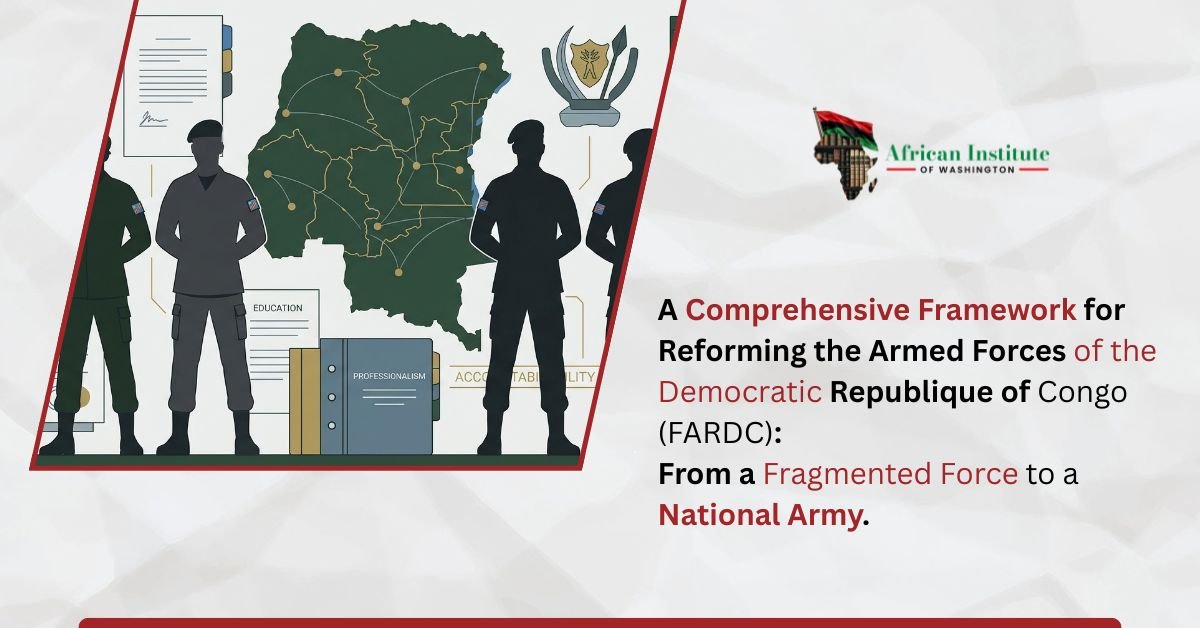
Professionalism, Accountability, National Unity, and Institutional Renewal in the Democratic Republic of the Congo
Introduction
The Democratic Republic of the Congo (DRC) possesses enormous territory, abundant natural resources, a large population, and a strategically important position in Central Africa. Yet the country has struggled for decades to build armed forces capable of consistently exercising effective state authority, protecting civilians, defending national territory, and maintaining professional military standards.
The problem cannot be explained simply by the courage or commitment of individual Congolese soldiers. Many FARDC personnel serve under extremely difficult conditions. The deeper problem is institutional: weaknesses in recruitment, professional education, command and control, logistics, personnel administration, financial management, military justice, political oversight, and accountability have repeatedly undermined the development of a unified professional army.
The United Nations itself has described security-sector reform as a process intended to create effective, accountable and inclusive security institutions that operate under the rule of law and serve citizens.
For the DRC, therefore, military reform should not be understood simply as purchasing more weapons or increasing the number of soldiers. The central question is how to transform the FARDC from a force affected by fragmentation and institutional weaknesses into a professional national army governed by competence, discipline, accountability and service to the Republic.
1. The Problem Is Institutional, Not Merely Military
The FARDC is not a new institution operating in an ordinary security environment. Its history is deeply connected to the successive political and military transformations of the Congo: the colonial Force Publique, the post-independence army, the Armed Forces of Zaire (FAZ), the forces associated with the wars of the 1990s, and the integration of former government and rebel forces into the contemporary FARDC.
That history matters.
The current army has inherited personnel, organizational cultures and command structures from different military and political traditions. Previous peace agreements frequently required former combatants to be incorporated into the national security institutions. While integration was intended to reduce conflict, it could also bring individuals with very different loyalties, levels of training and professional standards into the same institution.
International assessments have repeatedly identified the difficulty of creating a unified and professional Congolese security sector. A UN oversight assessment, for example, reported that inadequate progress in security-sector reform was associated with the absence of a sufficiently comprehensive reform strategy, weak institutional coordination, inadequate pay and difficult service conditions.
The lesson is important:
The DRC does not need merely a larger army. It needs a better organized, better educated, properly paid, professionally commanded and genuinely accountable national army.
2. Establish a National Military Reform Commission
The first step should be the creation of an independent National Commission for FARDC Reform and Professionalization.
This commission should not become another bureaucratic institution with no authority. It should have a clearly defined legal mandate, measurable objectives and a fixed implementation timetable.
Its membership could include:
- Ministry of Defense representatives;
- senior FARDC professionals;
- Parliament’s defense and security committees;
- military legal professionals;
- financial and auditing specialists;
- representatives of Congolese civil society;
- women with professional military and security experience;
- representatives of provinces affected by conflict;
- African Union representatives;
- selected international partners;
- United Nations technical advisers.
International assistance should support the process without replacing Congolese ownership. The UN’s own approach to security-sector reform emphasizes that reform should be nationally led, while international partners help provide technical expertise, coordination and capacity building.
The commission should publish an annual FARDC Reform Report explaining what has been accomplished, what has failed and what remains outstanding.
3. Conduct a Complete Personnel Census
One of the most fundamental reforms is to establish exactly who belongs to the FARDC.
The government should conduct a comprehensive personnel audit involving:
- biometric registration;
- verification of identity;
- verification of rank;
- verification of unit;
- verification of physical presence;
- verification of qualifications;
- verification of military service records;
- verification of salary entitlement;
- identification of retirees;
- identification of deceased or absent personnel.
This is not merely an administrative exercise.
It is an anti-corruption measure.
Earlier reform efforts demonstrate why. A World Bank account of the Congolese military payment reform reported that a biometric census identified approximately 120,000 soldiers compared with an official figure of 190,000 at the time. The resulting database and payroll reforms helped address problems associated with “ghost soldiers” and salary diversion.
The lesson should be incorporated into a new system:
No biometric identity, no verified personnel record; no verified personnel record, no military salary.
4. Reform the Military Payroll System
A soldier who does not receive his salary regularly is placed in a vulnerable position.
Delayed or diverted salaries can create incentives for:
- extortion;
- illegal taxation;
- theft;
- corruption;
- unauthorized checkpoints;
- exploitation of civilians;
- cooperation with armed groups;
- illegal participation in mineral extraction.
A UN oversight assessment specifically identified inadequate and untimely payment of wages and difficult service conditions as important factors associated with corruption and collusion involving security personnel.
The FARDC therefore needs a modern centralized military payroll system connected to verified biometric personnel records.
The chain should be:
National budget → Ministry of Defense → verified military account → individual soldier.
Intermediate commanders should not have discretionary control over soldiers’ salaries.
5. Build a Professional Officer Corps
One of the most important reforms must occur at the officer level.
A modern military cannot be built around political loyalty, personal relationships, ethnicity, wealth or wartime reputation.
Promotion must increasingly depend upon:
- education;
- demonstrated leadership;
- professional competence;
- operational experience;
- integrity;
- physical readiness;
- knowledge of military doctrine;
- knowledge of international humanitarian law;
- ability to plan and coordinate operations;
- demonstrated responsibility for subordinates.
The Congolese military education system should establish a professional career pathway:
Officer Candidate Training → Basic Officer Education → Command and Staff Education → Advanced Command Education → Strategic Leadership Education.
Promotion to senior ranks should require completion of appropriate professional military education.
6. Create a Serious Military Education System
Your observation that some officers may lack basic professional competencies should be treated as a training and personnel-management problem requiring verification, rather than generalized as a judgment about all FARDC officers.
A professional army requires officers who can:
- read military maps;
- understand terrain;
- interpret intelligence;
- prepare operational orders;
- manage logistics;
- understand communications;
- coordinate air and ground assets;
- protect civilians;
- manage personnel;
- understand military law;
- conduct after-action reviews;
- make decisions under pressure.
Map reading, navigation, communications, logistics and operational planning should therefore be tested—not assumed.
The DRC should establish a standardized FARDC Officer Competency Examination.
An officer who fails should receive additional education and retesting. Persistent inability to meet the requirements of the position should affect assignment and promotion.
This would replace patronage-based advancement with professional standards.
7. Reform the General Staff
The General Staff must become the intellectual and operational center of the armed forces.
A modern General Staff requires professional directorates for:
- operations;
- intelligence;
- personnel;
- logistics;
- planning;
- communications;
- training and doctrine;
- civil-military relations;
- legal affairs;
- medical services;
- financial management.
The objective should be to create an army in which the command system—not individual personalities—drives military operations.
The armed forces should also conduct regular command-post exercises and institutional exercises to test planning, communications, logistics and coordination.
The goal is not simply to have generals with high ranks. The goal is to have commanders who can translate national defense policy into coherent military plans.
8. End the Repeated Cycle of Integrating Armed Groups Without Adequate Vetting
The historical integration of former armed-group members into the national army has been one of the most difficult aspects of Congolese security-sector reform.
Integration can sometimes contribute to peace, but poorly managed integration can import armed-group networks into state institutions.
Human Rights Watch reported that former militia members have at times been integrated into security institutions without adequate vetting for previous abuses.
Future integration should therefore require:
Vetting
Candidates should be screened for:
- war crimes;
- crimes against humanity;
- serious human-rights violations;
- sexual violence;
- child recruitment;
- corruption;
- command responsibility for abuses.
Those credibly implicated in serious crimes should not automatically receive military rank.
They should be investigated and, where appropriate, prosecuted.
9. Stop Depending on Armed Auxiliaries as a Substitute for Military Reform
The use of auxiliary armed groups may appear to provide short-term manpower, but it creates a fundamental institutional problem: the state begins to outsource national defense to organizations it does not fully control.
Human Rights Watch has documented serious abuses involving army-backed Wazalendo forces and has called for an end to government support for abusive armed groups and for effective disarmament and reintegration programs.
The long-term objective should therefore be:
One national army + one chain of command + one military justice system + one national defense doctrine.
The state should progressively replace irregular armed formations with professionally recruited, trained and accountable security institutions.
10. Strengthen Military Justice
Military discipline cannot exist without credible military justice.
The FARDC should establish stronger mechanisms for:
- investigation;
- military prosecution;
- defense counsel;
- evidence preservation;
- witness protection;
- judicial independence;
- command responsibility;
- transparent disciplinary procedures.
This does not mean using military justice as a political weapon.
Quite the opposite.
Military courts must be sufficiently independent to investigate soldiers and commanders regardless of rank or political connections.
Congolese military courts have already accumulated important experience prosecuting international crimes, but Human Rights Watch reports continuing concerns about investigation quality, fair-trial guarantees and political interference.
The reform objective should therefore be professional military justice rather than politically controlled military justice.
11. Establish Real Command Accountability
A commander must be responsible for what happens under his or her command when the commander knew, or should have known, about serious abuses and failed to take reasonable action.
The system should distinguish between:
- an individual soldier’s misconduct;
- negligence by a commander;
- deliberate criminal conduct;
- systematic abuse;
- institutional failures.
Commanders who repeatedly tolerate corruption, abuse or unauthorized cooperation with armed groups should face administrative or criminal consequences according to law.
This is essential because otherwise transferring a commander simply moves the problem from one location to another.
12. Protect Soldiers From Economic Exploitation
Reform cannot succeed by demanding discipline from soldiers while ignoring their living conditions.
The state should establish minimum standards for:
- housing;
- food;
- medical care;
- uniforms;
- transportation;
- field allowances;
- family support;
- disability compensation;
- survivor benefits;
- pensions;
- psychological and social support.
A soldier should not have to choose between feeding his family and obeying military regulations.
The World Bank’s earlier analysis of military reform in the DRC illustrates the connection between military pay, personnel management and corruption.
13. Reform Military Logistics
A military can possess weapons and still be operationally weak if ammunition, fuel, food, spare parts and medical supplies do not reach units when required.
The FARDC should establish a computerized logistics system tracking:
Procurement → Warehouse → Transportation → Unit → Individual accountability.
Every major item should have an accountable chain.
Logistics officers should be professionally trained and periodically rotated.
Independent audits should examine:
- fuel consumption;
- ammunition inventories;
- vehicle fleets;
- aircraft maintenance;
- food contracts;
- uniforms;
- construction contracts;
- military procurement.
14. Create an Independent Military Inspector General
The FARDC needs a strong Inspector General of the Armed Forces with authority to conduct inspections without interference from individual commanders.
The Inspector General should investigate:
- corruption;
- ghost soldiers;
- payroll irregularities;
- missing equipment;
- illegal taxation;
- abuse of civilians;
- unauthorized mining activity;
- procurement irregularities;
- command failures.
Reports should go to the Minister of Defense and appropriate parliamentary oversight bodies.
Serious cases should be referred to prosecutors.
15. Strengthen Parliamentary and Civilian Oversight
A democratic military is subordinate to constitutional civilian authority.
Parliament should have meaningful oversight over:
- defense expenditures;
- military procurement;
- force structure;
- senior appointments;
- military deployments where constitutionally appropriate;
- defense policy;
- military justice;
- reform implementation.
Oversight does not mean civilian politicians should interfere with tactical military decisions.
It means that military institutions must operate within the law and within the national political system established by the Constitution.
Earlier World Bank reform recommendations similarly emphasized parliamentary and civil-society oversight of defense institutions and budgets.
16. Develop a National Defense Doctrine
The FARDC needs a clearly articulated National Defense Doctrine.
The doctrine should answer fundamental questions:
What is the mission of the FARDC?
- Defend the territorial integrity of the DRC.
- Protect the constitutional order.
- Protect the population.
- Defend national sovereignty.
- Secure national borders.
- Respond to external aggression.
- Support lawful civilian authorities during national emergencies.
- Participate in authorized regional and international peace operations.
The doctrine should also establish what the military must not do.
The army should not become an instrument for:
- partisan political competition;
- ethnic persecution;
- personal enrichment;
- unauthorized resource exploitation;
- political repression.
17. Improve Intelligence and Information Management
Military operations depend on reliable information.
The FARDC needs an integrated intelligence system capable of collecting and analyzing information concerning:
- armed groups;
- border movements;
- terrain;
- population displacement;
- illicit weapons networks;
- mineral-related armed activity;
- foreign military activity;
- emerging threats.
Intelligence must also be protected from political manipulation.
An intelligence report should describe what is known, what is probable and what remains uncertain.
This professional culture is essential for strategic decision-making.
18. Modernize Military Training Without Assuming Technology Solves Institutional Problems
The DRC does not necessarily need to begin by purchasing expensive advanced weapons.
Training and institutional capacity should come first.
Recent UN-supported training has included communications, GPS, drone operation, computer literacy, operational discipline, combat skills and international humanitarian law.
Such training should become part of a permanent FARDC professional-development system rather than isolated courses.
The principle should be:
Doctrine before equipment; training before technology; maintenance before procurement; accountability before expansion.
19. Establish a Merit-Based Promotion System
The rank structure should reflect professional competence.
Promotion boards should examine:
| Criterion | Importance |
|---|---|
| Professional education | Required |
| Leadership performance | Required |
| Operational competence | Required |
| Integrity | Required |
| Physical readiness | Required |
| Disciplinary record | Required |
| Human-rights record | Required |
| Ability to manage resources | Required |
| Intelligence/planning competence | Required |
A general should not become a general simply because of political connections or historical status.
Likewise, a competent captain or colonel should have a genuine opportunity to advance.
20. Establish a National Military Academy and Staff College System
The DRC should consider strengthening or restructuring its professional military education system around three institutions:
National Defense University
For strategic and national-security education.
Command and Staff College
For majors and lieutenant colonels preparing for command and staff responsibilities.
NCO Academy
For professional development of sergeants and other noncommissioned officers.
The NCO corps is particularly important.
A strong army cannot depend entirely upon generals and officers. Sergeants are responsible for much of the day-to-day discipline, training and leadership of soldiers.
21. Reform Recruitment
Recruitment should be national, transparent and competitive.
The FARDC should seek recruits based on:
- citizenship;
- physical fitness;
- education;
- integrity;
- professional aptitude;
- commitment to constitutional service.
Recruitment should deliberately avoid ethnic or regional exclusion.
A national army must look and feel like a national institution.
22. Develop a Five-Year FARDC Reform Plan
Reform should not be an endless declaration.
A five-year program could be organized as follows:
Year 1 — Audit and Stabilization
- biometric census;
- payroll verification;
- command review;
- equipment inventory;
- disciplinary review;
- financial audit;
- identification of personnel gaps;
- national defense review.
Year 2 — Professionalization
- officer education;
- NCO development;
- recruitment reform;
- standardized promotion;
- logistics reform;
- military justice reform.
Year 3 — Operational Transformation
- command-post exercises;
- communications modernization;
- intelligence reform;
- logistics integration;
- standardized operational doctrine;
- improved civilian-protection capabilities.
Year 4 — Institutional Consolidation
- parliamentary oversight;
- independent inspections;
- professional procurement;
- retirement system;
- veterans’ support;
- anti-corruption mechanisms.
Year 5 — Evaluation
An independent national and international review should determine:
- whether the reforms worked;
- where corruption remains;
- whether military salaries reach personnel;
- whether operational readiness improved;
- whether civilian abuses declined;
- whether the military has become more professional;
- what reforms require another five-year cycle.
23. International Assistance Should Support Reform—Not Replace It
The DRC has received international assistance for military and security-sector reform for many years.
The problem is therefore not simply a lack of international advisers.
The challenge is converting assistance into sustainable Congolese institutions.
The UN has continued to support FARDC professionalization and security-sector reform, including a results-based management initiative launched in 2025 to improve military program delivery and financing.
International partners should therefore coordinate their assistance around a single Congolese reform framework.
Instead of:
Donor A → Project A
Donor B → Project B
Donor C → Project C
the model should become:
DRC National Reform Strategy → coordinated international support → measurable national outcomes.
24. The Ultimate Measure of Reform
The success of military reform should not be measured primarily by:
- number of generals;
- number of soldiers;
- number of weapons;
- number of armored vehicles;
- size of the defense budget.
The real indicators should be:
Can the army defend the country?
Can it protect civilians?
Can it sustain its operations?
Do soldiers receive their salaries?
Are promotions based on competence?
Can commanders be held accountable?
Does military justice function independently?
Can Parliament scrutinize defense spending?
Does the army operate as one national institution?
Can citizens trust the national armed forces?
These are the measurements that matter.
Conclusion: Building an Army Worthy of the Congo
The Democratic Republic of the Congo does not lack brave soldiers. The central challenge is building the institutional environment in which those soldiers can become part of a professional national military.
The FARDC’s difficulties have accumulated over decades. They cannot be solved through one presidential decree, one foreign training mission, one new weapons purchase or one change of military leadership.
Reform requires a national project.
It requires political leaders willing to place national security above patronage. It requires commanders willing to accept professional accountability. It requires Parliament to exercise genuine oversight. It requires soldiers to receive their salaries and benefits. It requires military schools capable of producing competent officers and NCOs. It requires prosecutors and military judges capable of pursuing abuses regardless of rank. And it requires citizens to understand that a national army exists to protect the Republic and its people—not individual political interests.
Most importantly, reform must end the cycle in which armed conflict produces armed groups, armed groups are incorporated into state institutions, institutional weaknesses generate new grievances, and those grievances produce another generation of armed mobilization.
The objective should be neither an excessively large army nor an army equipped primarily for political display.
The objective should be a professional, disciplined, nationally representative, technologically competent, financially transparent and constitutionally accountable FARDC.
A strong Congolese army should ultimately be measured not by how many generals it possesses, but by whether a young Congolese soldier can say with confidence:
“I serve the Republic. I am properly trained. I am properly paid. I know my mission. I respect the law. My commanders are accountable. And my country trusts me because I protect its people.”
That is the foundation of a modern national defense institution.
Selected Bibliography and References
- Human Rights Watch. World Report 2026: Democratic Republic of Congo. New York: Human Rights Watch, 2026.
- Human Rights Watch. World Report 2025: Democratic Republic of Congo. New York: Human Rights Watch, 2025.
- Human Rights Watch. “A Call for Meaningful Action to Support Justice in the Democratic Republic of Congo.” September 23, 2025.
- Human Rights Watch. “DR Congo: Army-Backed Militias Abuse Civilians in South Kivu.” May 23, 2025.
- Human Rights Watch. “Death Was Everywhere”: Arbitrary Detention, Killings, and Forced Recruitment by the M23 and the Rwanda Defence Force. June 10, 2026.
- United Nations. Security Sector Reform. United Nations Security Sector Reform Resource Centre.
- United Nations Security Council. Letter dated 3 July 2025 from the Group of Experts on the Democratic Republic of the Congo addressed to the President of the Security Council, S/2025/446. New York: United Nations, 2025.
- United Nations Security Council. Security Sector Reform and Support for the Justice System and the Fight Against Impunity, S/2025/779. New York: United Nations, 2025.
- United Nations Office of Internal Oversight Services. Programme Managers Report: Security Sector Reform in the Democratic Republic of the Congo. United Nations, 2024.
- United Nations Peacekeeping. “Security Sector Reform.” United Nations Peacekeeping.
- United Nations Peacekeeping. “Ituri: 120 FARDC Soldiers Trained with MONUSCO Support to Enhance Civilian Protection.” October 13, 2025.
- United Nations Peacekeeping. “Ituri: Over 200 Congolese Soldiers Trained by MONUSCO to Better Protect Civilians.” November 7, 2025.
- World Bank. Securing Development: Public Finance and Security Sector Reform in the Democratic Republic of Congo. Washington, DC: World Bank. The report discusses the FARDC biometric census, military identification and chain-of-payments reform.
- World Bank. Democratic Republic of Congo Country Partnership Framework FY22–26. Washington, DC: World Bank. The framework identifies comprehensive security-sector reform, restructuring, training, retirement and institutional responsibilities as continuing priorities.
- Institute for Security Studies (ISS Africa). Boshoff, Henri, and Hans Hoebeke. Assessing Security Sector Reform and Its Impact on the Kivu Provinces. Pretoria: Institute for Security Studies.
