
African Studies – Development – Human Rights – Leadership – Sovereignty
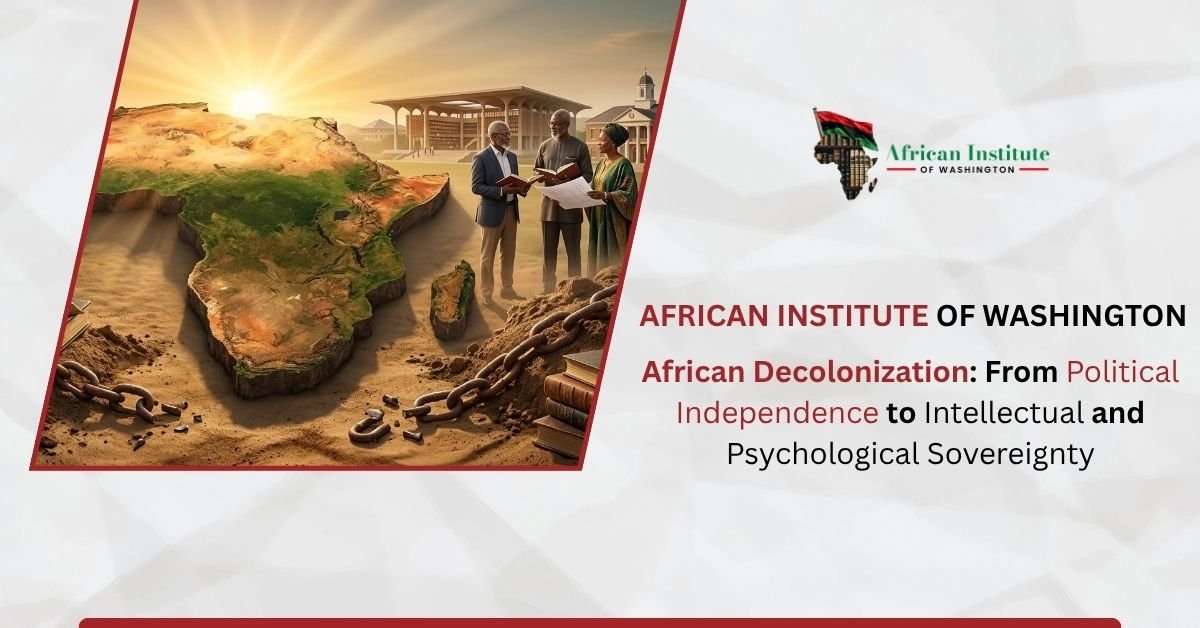
African Decolonization: From Political Independence to Intellectual and Psychological Sovereignty
Introduction
Decolonization is often understood primarily as the political process through which African territories achieved independence from European colonial rule during the twentieth century. Yet political independence represents only one dimension of a much broader historical transformation. The legacies of colonialism continue to influence economic structures, political institutions, cultural identities, systems of knowledge, languages, and perceptions of African societies.
The United Nations established the principle of self-determination as a central element of the international decolonization process. In 1960, the General Assembly adopted the Declaration on the Granting of Independence to Colonial Countries and Peoples, affirming the right of peoples to self-determination and calling for an end to colonialism in all its forms. The United Nations continues to treat decolonization as an international issue, and the current Fourth International Decade for the Eradication of Colonialism extends through 2030.
For Africa, however, the question is no longer limited to the transfer of political authority from European governments to African states. A deeper question concerns whether independence has produced sufficient economic autonomy, intellectual self-confidence, cultural dignity, and control over African resources and institutions.
The African Institute of Washington therefore approaches decolonization as an ongoing intellectual and institutional project: the continuing effort of African societies and peoples to determine their own political, economic, cultural, and intellectual futures.
1. Colonialism and the Historical Transformation of Africa
European expansion from the fifteenth century onward was driven by a combination of commercial, strategic, religious, technological, and political factors. European powers sought new trade routes, access to resources, commercial opportunities, and geopolitical influence. Over time, these processes developed into systems of territorial conquest and colonial administration across substantial parts of Africa and other regions of the world.
Colonial rule was not simply a political arrangement. It reorganized economic production, patterns of trade, systems of education, administrative institutions, and relationships between African societies and external markets.
The colonial experience also involved profound forms of cultural and social disruption. European powers frequently presented their own political and cultural institutions as models of modernity while characterizing African societies through hierarchical and racialized assumptions. The source material identifies this phenomenon as part of the ideological framework used to justify colonial domination.
A contemporary study of African development must therefore examine not only the formal end of colonial administration but also the structures and ideas that survived political independence.
2. From Political Independence to Effective Sovereignty
Political independence created sovereign African states, but sovereignty is multidimensional. A state may possess juridical independence while continuing to experience substantial external dependence in areas such as finance, technology, security, trade, education, and access to natural resources.
The principle of self-determination recognized by the United Nations includes the right of peoples to determine their political status and pursue their economic, social, and cultural development.
This principle provides an important framework for thinking about Africa after independence. Decolonization should not be interpreted as isolation from the international community. Rather, it raises the question of whether African states possess sufficient institutional capacity and policy autonomy to determine their development priorities while participating as equal partners in the international system.
Effective sovereignty therefore includes the ability to:
- formulate independent national and regional development strategies;
- manage natural resources in the public interest;
- develop productive and technological capacity;
- strengthen African educational and research institutions;
- preserve cultural and linguistic diversity;
- participate effectively in international decision-making; and
- protect the dignity and fundamental rights of African populations.
3. Psychological and Cultural Dimensions of Decolonization
One of the most significant contributions to the study of colonialism concerns its psychological dimension. The concept of psychological colonization describes the internalization of assumptions that place the culture, language, knowledge, or institutions of the colonizer above those of the colonized.
The source material describes this phenomenon through concepts such as colonial mentality, fractured identity, and the marginalization of indigenous systems of knowledge.
This question was examined particularly forcefully by Frantz Fanon, whose work connected colonial domination with psychological alienation, racial hierarchy, identity, and political struggle. His Black Skin, White Masks examined the psychological consequences of racism and colonial social structures, while The Wretched of the Earth developed a broader analysis of colonialism, liberation, political organization, and postcolonial state formation. The Stanford Encyclopedia of Philosophy identifies The Wretched of the Earth as a major work in Fanon’s development as a thinker of anticolonial struggle and postcolonial political thought.
Fanon’s work remains controversial in part because of his treatment of revolutionary violence. His discussion of violence must therefore be situated within the historical context of colonial domination and anticolonial struggles rather than reduced to a general endorsement of violence.
For contemporary Africa, the continuing significance of Fanon’s thought may be found not simply in revolutionary theory but in the broader question of human dignity and intellectual liberation.
4. Decolonizing Knowledge and Education
Political independence cannot be fully consolidated without intellectual independence. Education is consequently one of the central instruments of decolonization.
A decolonized educational system does not require the rejection of European or Western knowledge. Rather, it requires the recognition that African societies must also be producers of knowledge rather than merely consumers of knowledge developed elsewhere.
This involves strengthening African universities, research institutions, philosophical traditions, historical scholarship, scientific research, and locally grounded approaches to development.
It also requires examining the ways in which African history is taught. African students should encounter the history of colonialism, resistance, independence movements, African civilizations, intellectual traditions, and contemporary development challenges through rigorous scholarship rather than through narratives that portray Africa exclusively as a recipient of external intervention.
The objective is therefore not to replace one intellectual hierarchy with another. It is to create a plural and intellectually confident knowledge system in which African perspectives can participate fully in global scholarship.
5. Economic Decolonization and the Question of Resources
Economic sovereignty is another essential dimension of decolonization. Many African economies remain strongly connected to the export of primary commodities while importing significant quantities of manufactured goods, technology, and finished products.
The historical colonial economy often organized production around external demand and resource extraction. The contemporary challenge is to transform natural wealth into sustainable domestic development through industrialization, infrastructure, technological innovation, education, and regional economic integration.
Economic decolonization should therefore focus on value addition rather than extraction alone. African countries possessing minerals, agricultural resources, energy resources, forests, or other natural assets face the challenge of developing domestic and regional industries capable of processing these resources and creating employment and technological capacity.
This does not require rejecting international investment. Rather, the objective is to establish partnerships that are transparent, mutually beneficial, environmentally responsible, and consistent with national development priorities.
6. African Unity, Leadership, and Collective Sovereignty
The question of sovereignty also extends beyond individual nation-states. Africa’s political fragmentation was intensified during the colonial period, while contemporary African states continue to face challenges that transcend national borders.
Security, migration, climate change, trade, public health, infrastructure, technology, and natural-resource governance increasingly require regional and continental cooperation.
African integration can therefore be understood as one component of the broader decolonization project. Stronger African institutions and regional cooperation can provide states with greater negotiating capacity in the international system.
Such integration, however, must remain grounded in the interests and rights of African populations. Sovereignty cannot be reduced to the authority of governments alone. It must also encompass popular participation, accountable institutions, human rights, and the dignity of citizens.
7. The Responsibility of African Leadership
The source material raises a particularly important question concerning the role of African elites in the continuing process of decolonization. It argues that some African political and economic actors may reproduce external systems of domination rather than transforming them.
This question deserves careful academic treatment. The persistence of colonial legacies cannot be attributed exclusively to external actors. African governments, institutions, business leaders, intellectuals, and civil society organizations also have agency and responsibility.
The challenge is therefore to develop leadership that places public institutions, education, human dignity, economic transformation, and long-term national interests above narrow personal or political interests.
Decolonization ultimately requires both external independence and internal institutional responsibility.
Conclusion: Decolonization as an Ongoing African Project
African decolonization should not be understood simply as a historical event completed when colonial flags were lowered and independent governments assumed political authority. It is better understood as a continuing process involving political sovereignty, economic transformation, cultural confidence, intellectual freedom, and institutional development.
The United Nations framework establishes self-determination as a fundamental principle of decolonization. African intellectual traditions, including the work of Frantz Fanon, have expanded the discussion toward questions of psychological liberation, identity, dignity, and the transformation of postcolonial societies.
For the African Institute of Washington, the contemporary meaning of decolonization is therefore neither isolationism nor rejection of international cooperation. It is the pursuit of equal partnership, intellectual confidence, economic agency, accountable leadership, and the capacity of African peoples to shape their own future.
The next stage of African decolonization must consequently be measured not only by the absence of foreign political rule, but by the ability of African societies to generate knowledge, create wealth, protect human dignity, govern their resources responsibly, strengthen democratic and accountable institutions, and participate as equal partners in the global community.
Decolonization is not only about changing who governs Africa. It is also about strengthening Africa’s capacity to determine its own future.
References
- Césaire, A. (1955). Discours sur le colonialisme. Présence Africaine.
- Fanon, F. (1952). Peau noire, masques blancs. Éditions du Seuil.
- Fanon, F. (1961). Les damnés de la terre. Éditions François Maspero.
- Hountondji, P. J. (1996). African philosophy: Myth and reality (2nd ed.). Indiana University Press.
- Memmi, A. (1957). Portrait du colonisé, précédé du portrait du colonisateur. Corrêa.
- Nkrumah, K. (1965). Neo-colonialism: The last stage of imperialism. Thomas Nelson.
- Rodney, W. (1972). How Europe underdeveloped Africa. Bogle-L’Ouverture Publications.
- wa Thiong’o, N. (1986). Decolonising the mind: The politics of language in African literature. James Currey.
Professor Claude Kisuka
African Institute of Washington
African Studies – Development – Human Rights – Leadership – Sovereignty
