
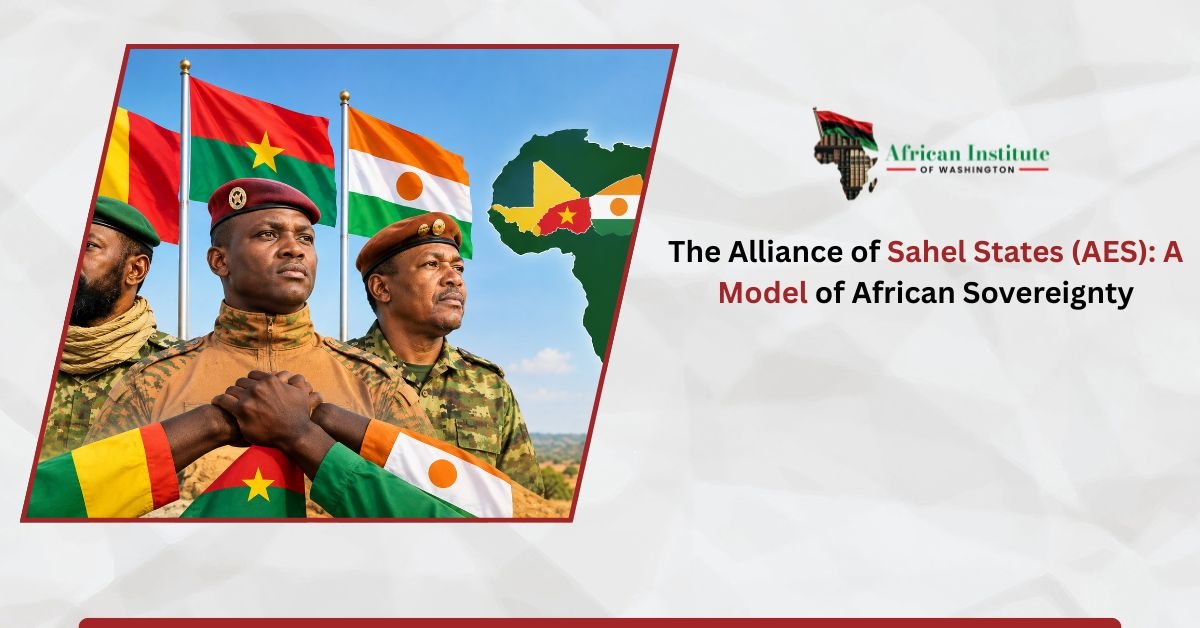
The Alliance of Sahel States (AES), which brings together Mali, Burkina Faso, and Niger, has become a symbol of an Africa moving toward what its supporters regard as the genuine liberation of the African continent. The Alliance places sovereignty at the center of its political, military, economic, and social restructuring.
In this process, the Alliance has become both a model and a call to Africa and its diaspora to unite for sovereignty and for genuine emancipation from external influences. The objective of the Alliance is to regain control over political, military, economic, and humanitarian affairs.
The independence achieved in the 1960s was merely a change in appearance. According to this perspective, the coups that followed independence were also power struggles orchestrated by colonial powers to continue controlling African nations from within through local proxies.
In the 21st century, the AES defines sovereignty as the supreme and independent authority of its member states to govern themselves without being subject to another authority. The following are presented as signs that the AES represents a popular revolution that has gained acceptance across much of Africa:
- The coups in these countries were intentionally peaceful and largely bloodless.
- The populations supported the revolutionaries.
- The revolutionaries had clearly defined objectives and goals.
- The Alliance challenged the presence of foreign military bases in Africa.
- It pursued the idea of an African currency.
- It created the Alliance as a symbol of a renewed awakening toward African unity.
These are presented as essential elements of African liberation: a united people, a clearly defined purpose, their own currency and military, and the collective will to exercise meaningful and substantial power.
The Meaning of State Sovereignty
State sovereignty is the supreme and unconditional authority that enables a state to govern itself, make and enforce its laws within its territory, and remain independent within the international order.
Sovereignty cannot be alienated or transferred; it resides ultimately in the general will of the people.
At the international level, a sovereign state should not be subordinate to another power or receive orders from another authority. This is known as external sovereignty. A sovereign state may freely enter into treaties or international organizations. Where obligations or constraints arise, they should derive from the state’s own initial consent.
The state holds exclusive public authority over its population and national territory. This constitutes internal sovereignty. The state possesses the legitimate authority to use public force—including through political and judicial institutions—to enforce the laws it establishes.
Supreme power belongs to the citizens as a whole, understood collectively as individuals. This is the principle of popular sovereignty.
Colonialism and the Question of African Sovereignty
Slavery, colonialism, neocolonialism, terrorism, and other mechanisms of instability used to control the African continent and its resources, together with what the text describes as a barely concealed contempt for Africans, are presented as violations of national and popular sovereignty and of the absolute and perpetual power of nations, in the sense associated with Jean Bodin.
One year before his assassination in April 2021, Chadian President Idriss Déby Itno denounced what he described as continued French influence over Africa, including alleged efforts to influence constitutional changes in Chad. According to this interpretation, he was also criticizing what he saw as externally influenced constitutional changes and the phenomenon of “third terms” in Africa in service of Western interests. In this context, he was quoted as saying, in substance, that “Africa is not sovereign.”
The presence of foreign military bases on African soil is cited as further evidence of this argument. The presence of terrorist groups in Africa, particularly in regions rich in strategic minerals, is also presented in the text as a factor that raises questions about foreign interests, although the text acknowledges that Western powers do not officially finance terrorist organizations.
Another concern regarding African sovereignty is the presence of foreign military bases on African soil. Western countries officially justify their military presence primarily in connection with the global fight against terrorism. Within this same counterterrorism context, Mali accused France of violating its airspace, conducting espionage, and providing intelligence, weapons, and ammunition to terrorist groups operating in the Sahel.
Africa and the Question of Liberation
How can Africa achieve liberation while relying on those whom this perspective identifies as having historically constrained Africa and who, according to this argument, continue to contribute to instability in different forms?
The position of the AES is therefore presented as a call for Africa to stand on its own feet—not simply as a struggle against neocolonialism, but because, according to this view, if Africa does not fight for its own liberation, others will continue to fight to keep Africa dependent.
As Patrice Lumumba famously stated:
“Without struggle, you will achieve nothing. Neither today nor ever.”
Professor Claude Kisuka
African Institute of Washington
African Studies, development, human rights, and sovereignty
