
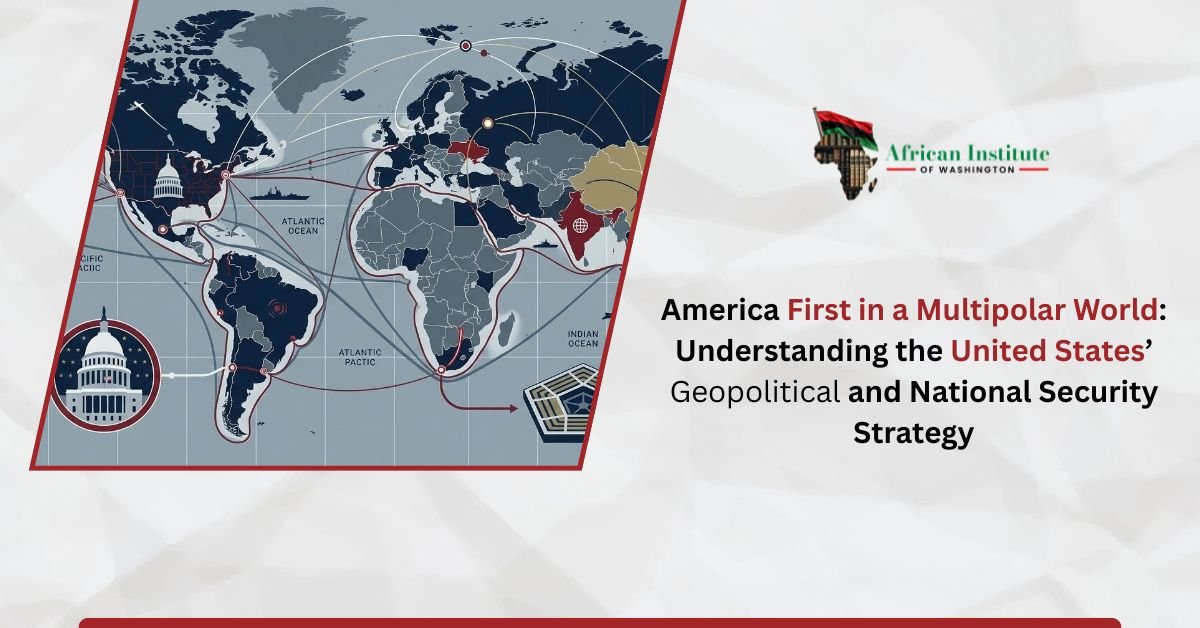
An analysis of U.S. grand strategy, national defense, economic security, alliances, technology, nuclear deterrence, and global cooperation in the twenty-first century
America First in a Multipolar World: Understanding the United States’ Geopolitical and National Security Strategy
Introduction
The geopolitical strategy of the United States is undergoing a significant transformation. The period following the end of the Cold War was characterized by an unusually strong position for the United States in international affairs, supported by its military capabilities, economic power, technological leadership, alliances, and influence over major international institutions.
The strategic environment of the twenty-first century is different. China has emerged as a major economic, technological, and military power; Russia remains a significant military and nuclear actor; India and other emerging powers are gaining influence; regional powers are increasingly asserting strategic autonomy; and global challenges such as cyberattacks, terrorism, artificial intelligence, climate-related instability, pandemics, nuclear proliferation, and transnational crime cannot be addressed by military power alone.
The current U.S. strategy under President Donald Trump places greater emphasis on “America First,” homeland security, economic strength, military power, burden-sharing with allies, and selective engagement abroad. The November 2025 National Security Strategy explicitly places the Western Hemisphere at the center of U.S. strategic attention, while the 2026 National Defense Strategy translates this orientation into defense priorities, including homeland defense, Western Hemisphere security, military modernization, nuclear deterrence, cyber defense, and rebuilding the U.S. defense-industrial base.
This does not necessarily mean American disengagement from the world. Rather, it represents an effort to redefine the conditions under which the United States exercises global leadership.
I. The Transformation of American Geopolitics
For much of the post-Cold War period, American strategy was frequently associated with maintaining a broad liberal international order, expanding alliances, promoting democratic governance, supporting international institutions, and preventing the emergence of a rival power capable of dominating a major region.
The current strategy is more explicitly national-interest driven.
The 2026 National Defense Strategy describes the approach as “America First,” “Peace Through Strength,” and a form of practical realism. It rejects what the document characterizes as excessive interventionism, nation-building, regime change, and prolonged military commitments that do not directly serve U.S. interests.
Outside analysts interpret this transformation differently. The Council on Foreign Relations describes the 2025 National Security Strategy as a substantial departure from previous U.S. strategic frameworks, particularly because it places economic interests at the center of the relationship with China and gives the Western Hemisphere an unusually prominent position.
The Stimson Center, meanwhile, has argued that the international system is increasingly multipolar and that U.S. strategy must reconcile American objectives with limited resources and a greater distribution of global power.
Thus, three concepts are particularly important for understanding contemporary American geopolitics:
- America First
- Strategic realism and burden-sharing
- Adaptation to a multipolar international system
II. The Western Hemisphere as a Strategic Priority
One of the most significant features of the current strategy is the elevation of the Western Hemisphere.
The 2025 National Security Strategy identifies the Western Hemisphere as the highest regional priority and presents a contemporary interpretation of the Monroe Doctrine. The 2026 National Defense Strategy explicitly refers to this as the “Trump Corollary to the Monroe Doctrine.” It calls for strengthening U.S. military dominance in the hemisphere, protecting the U.S. homeland and access to strategically important terrain, and preventing adversaries from establishing threatening military capabilities in the region.
The strategic logic extends beyond traditional military defense.
The Western Hemisphere contains:
- energy resources;
- agricultural resources;
- critical minerals;
- strategic waterways;
- important ports;
- major transportation routes;
- proximity to the United States;
- and increasingly important supply-chain opportunities.
The region is also connected to U.S. concerns about migration, organized crime, drug trafficking, border security, and foreign influence.
The geopolitical implication is significant: Washington increasingly views security in North and Latin America not simply as a regional matter, but as an essential component of homeland security and economic resilience.
III. From Global Ideology to Geoeconomics
Economic power has become one of the central instruments of American geopolitics.
The United States increasingly uses:
- tariffs;
- sanctions;
- export controls;
- investment screening;
- technology restrictions;
- industrial policy;
- supply-chain diversification;
- energy policy;
- trade agreements;
- and strategic investment
as instruments of national security.
The 2025 National Security Strategy places economics at the center of the U.S.–China relationship. According to the Council on Foreign Relations’ analysis, the strategy emphasizes economic competition, trade rebalancing, industrial overcapacity, and the pursuit of a mutually advantageous economic relationship with Beijing rather than framing the relationship primarily as an ideological struggle.
This represents the growing importance of geoeconomics—the use of economic instruments to achieve geopolitical objectives.
In the twenty-first century, control over semiconductors, artificial intelligence, critical minerals, energy infrastructure, telecommunications, financial systems, and advanced manufacturing can be as strategically significant as control over traditional military terrain.
IV. The United States and China
China is central to the future of American geopolitical strategy.
The competition is multidimensional:
Economic competition
The United States seeks to protect its industrial base, technological leadership, intellectual property, and strategic supply chains.
Technological competition
Artificial intelligence, semiconductors, quantum computing, telecommunications, biotechnology, space systems, and advanced manufacturing have become strategic domains.
Military competition
The Indo-Pacific, particularly the Taiwan Strait and the broader maritime environment, remains a major security concern.
Diplomatic competition
Washington and Beijing compete for influence throughout Asia, Africa, Latin America, the Middle East, and international institutions.
At the same time, complete economic separation between the world’s two largest economies presents substantial costs and risks. The current strategy therefore combines competition with selective economic engagement.
The 2025 NSS gives particular attention to deterring conflict over Taiwan while emphasizing the importance of maintaining sufficient military capabilities in the First Island Chain.
V. The Rise of Multipolarity
The United States no longer operates in a world dominated by a single unquestioned center of power.
The international system contains multiple influential actors:
- United States;
- China;
- European Union;
- Russia;
- India;
- Japan;
- Türkiye;
- Brazil;
- Gulf states;
- and increasingly influential African and Asian powers.
The Stimson Center describes this environment as a fragmented multipolar system in which different countries possess leadership in different regions and technological sectors.
This creates a strategic dilemma for Washington.
The United States remains extraordinarily powerful, but it cannot necessarily impose its preferences everywhere simultaneously.
Consequently, American strategy increasingly requires prioritization.
The central question becomes:
Where are U.S. interests vital, where are they important, and where can Washington accept greater risk?
This is a fundamental question of grand strategy.
VI. National Defense Strategy
The 2026 National Defense Strategy provides the military framework for the broader geopolitical approach.
Its major priorities include:
- Defending the U.S. homeland
- Strengthening the Western Hemisphere
- Deterring major military threats
- Modernizing nuclear forces
- Defending against cyber threats
- Rebuilding the defense-industrial base
- Increasing military readiness
- Strengthening selected alliances and partnerships
- Developing advanced technologies
- Maintaining the capability to conduct decisive military operations
The strategy also emphasizes rebuilding American industrial capacity so that the United States can produce defense equipment rapidly and at scale for itself and its allies. Artificial intelligence and technological innovation are specifically identified as important components of this effort.
This illustrates an important change in contemporary strategic thinking:
National security is increasingly understood as the combination of military power, industrial capacity, technological superiority, economic resilience, and secure supply chains.
VII. Strategic Priorities
The emerging U.S. geopolitical strategy can therefore be organized around several major priorities.
1. Homeland defense
Protecting the continental United States and its population is placed at the center of national security.
2. Western Hemisphere security
Washington seeks to prevent hostile external military or strategic influence from gaining significant positions in the Americas.
3. Indo-Pacific deterrence
The United States seeks to maintain sufficient military and diplomatic capabilities to prevent coercion or conflict involving China, particularly concerning Taiwan and the broader Western Pacific.
4. European security
The United States continues to regard NATO as important but is demanding greater European contributions to collective defense.
At the 2025 NATO Summit in The Hague, allies agreed to increase defense-related investment toward 5 percent of GDP annually by 2035, including at least 3.5 percent for core defense requirements.
5. Economic security
The United States seeks greater control over strategic supply chains, industrial capacity, advanced technologies, and critical resources.
6. Technological superiority
Artificial intelligence, cyber capabilities, space systems, quantum technologies, biotechnology, and advanced weapons are increasingly treated as strategic assets.
7. Nuclear deterrence
The United States seeks to maintain a credible nuclear deterrent while adapting its nuclear forces to an increasingly complex nuclear environment.
VIII. USA and NATO
NATO remains one of the most important instruments of American geopolitical influence.
However, the relationship is evolving.
The United States increasingly expects European allies to assume a larger share of conventional defense responsibilities. The 2025 NATO commitment to move toward 5 percent of GDP in defense and security-related investment by 2035 reflects this burden-sharing approach.
This creates both opportunities and challenges.
Greater European defense capacity could reduce the conventional military burden on the United States. At the same time, disagreements over burden-sharing, Ukraine, trade, strategic autonomy, and political values could complicate transatlantic relations.
The future NATO relationship may therefore become less about American dominance and more about distributed allied capabilities under continued U.S. strategic leadership.
IX. Economic Security and Trade Stability
Economic security is now inseparable from national security.
The United States faces strategic vulnerabilities arising from dependence on foreign supply chains for certain:
- semiconductors;
- pharmaceuticals;
- critical minerals;
- batteries;
- advanced manufacturing components;
- telecommunications equipment;
- and other strategic technologies.
The response has included reshoring, friend-shoring, export controls, investment screening, and efforts to expand domestic industrial production.
This approach reflects a fundamental geopolitical reality:
A country cannot maintain military power indefinitely if it cannot sustain the industrial and technological base required to produce and replace military capabilities.
The 2026 National Defense Strategy explicitly links defense power to rebuilding the American defense-industrial base and expanding production capacity.
X. Intelligence, Cybersecurity, and Technological Multipliers
Modern geopolitical competition increasingly occurs below the threshold of conventional warfare.
Intelligence, cyber operations, artificial intelligence, satellite systems, electronic warfare, information operations, and autonomous systems can influence national security without a conventional military invasion.
The 2026 U.S. Annual Threat Assessment identifies state actors, cyber threats, terrorism, missile proliferation, and other transnational challenges as significant concerns. It also emphasizes the continuing importance of intelligence in identifying and managing threats to the United States and its interests.
Artificial intelligence is particularly important because it can multiply capabilities in:
- intelligence analysis;
- military planning;
- logistics;
- cyber defense;
- autonomous systems;
- surveillance;
- target identification;
- scientific research;
- and economic production.
The strategic competition of the future will therefore be partly a competition over who can innovate faster and convert technological innovation into national power.
XI. Nuclear Deterrence and Nonproliferation
Nuclear weapons remain at the center of international strategic stability.
The United States, Russia, and China possess major nuclear capabilities, while other states—including North Korea, India, Pakistan, Israel, and others—complicate the global nuclear environment.
The 2026 National Defense Strategy calls for modernization and adaptation of U.S. nuclear forces, emphasizing deterrence and escalation management.
At the same time, the proliferation of nuclear weapons and missile technology presents a major international challenge.
The objective of U.S. nuclear strategy is therefore not simply to possess nuclear weapons, but to maintain a credible deterrent while reducing the probability that nuclear weapons will be used.
This requires:
- strategic stability;
- arms-control mechanisms where possible;
- effective intelligence;
- secure nuclear command and control;
- missile defense;
- nonproliferation diplomacy;
- and crisis communication.
XII. Crisis Management and Global Stability
Military power alone cannot provide global stability.
International crises may originate from:
- interstate wars;
- civil wars;
- terrorism;
- ethnic conflict;
- political instability;
- economic collapse;
- pandemics;
- cyberattacks;
- food insecurity;
- climate-related disasters;
- and mass displacement.
The United States therefore faces a strategic paradox.
It seeks to reduce costly foreign interventions while remaining capable of responding when crises directly threaten American interests.
This requires greater investment in:
- diplomacy;
- intelligence;
- conflict prevention;
- humanitarian assistance;
- regional partnerships;
- economic development;
- and crisis-management mechanisms.
A successful grand strategy must distinguish between every international problem and every problem that requires direct U.S. military intervention.
XIII. The Middle East and Security Cooperation with Israel
The Middle East remains strategically important despite the current U.S. desire to avoid prolonged nation-building and large-scale military interventions.
One of the most enduring elements of American Middle Eastern strategy is security cooperation with Israel.
U.S.–Israeli cooperation includes:
- military assistance;
- missile-defense cooperation;
- intelligence cooperation;
- joint exercises;
- defense technology;
- counterterrorism cooperation;
- and strategic consultations.
The existing 2019–2028 U.S.–Israel security framework provides $3.3 billion annually in Foreign Military Financing and $500 million annually for cooperative missile-defense programs.
The current administration has continued to emphasize the bilateral security relationship. In 2025, the Department of Defense publicly reaffirmed its commitment to Israel’s security and described Iran as a regional security concern.
From Washington’s perspective, Israel therefore remains an important security partner in the Middle East even as the broader U.S. strategy seeks to encourage regional actors to assume greater responsibility for regional security.
XIV. Africa in American Geopolitics
Africa represents an increasingly important but comparatively underdeveloped dimension of U.S. grand strategy.
The continent is strategically important because of:
- critical minerals;
- energy resources;
- maritime routes;
- population growth;
- emerging markets;
- food production;
- technology;
- security challenges;
- and diplomatic influence.
The 2025 National Security Strategy gives Africa considerably less space than the major strategic theaters, emphasizing selective partnerships, conflict prevention, trade, investment, and countering violent extremism. The Council on Foreign Relations notes that the strategy’s Africa section is relatively brief and leaves important questions about governance, partnership selection, and implementation unanswered.
For Africa, this creates both opportunities and challenges.
African states may seek:
- American investment;
- technology partnerships;
- security cooperation;
- education;
- infrastructure financing;
- health cooperation;
- and expanded trade.
At the same time, African governments increasingly seek diversified partnerships with China, Europe, Russia, India, Türkiye, the Gulf states, and other actors.
The United States therefore faces a more competitive African geopolitical environment.
XV. Major Problems Facing U.S. National Security
Despite its extraordinary capabilities, the United States faces substantial challenges.
1. Strategic overstretch
Maintaining military, diplomatic, economic, and political commitments across multiple regions can place pressure on American resources.
2. Great-power competition
Competition with China and strategic rivalry with Russia require substantial resources.
3. Fiscal constraints
National security spending competes with domestic priorities and a large federal debt burden.
4. Political polarization
Domestic political divisions can complicate the development of stable long-term foreign policy.
5. Technological vulnerability
Rapid technological change creates opportunities but also vulnerabilities.
6. Cybersecurity
Critical infrastructure, financial institutions, military networks, and government systems remain targets for cyber operations.
7. Nuclear proliferation
The spread of nuclear and missile capabilities increases the complexity of deterrence.
8. Terrorism
Terrorist organizations remain capable of exploiting instability, particularly in parts of Africa, the Middle East, and South Asia. The 2026 U.S. intelligence assessment identifies al-Qaeda and ISIS affiliates among continuing terrorist concerns.
9. Global instability
Wars and political crises can generate refugee flows, economic shocks, terrorism, and humanitarian emergencies that eventually affect U.S. interests.
XVI. Shared Global Threats and the Need for International Cooperation
An America First strategy does not eliminate the need for international cooperation.
Some problems are inherently transnational.
No individual country can independently eliminate:
- climate-related risks;
- pandemics;
- cybercrime;
- nuclear proliferation;
- terrorism;
- transnational organized crime;
- global financial instability;
- food insecurity;
- or mass displacement.
The challenge for U.S. strategy is therefore to determine where cooperation advances American interests without creating unnecessary strategic dependence.
This suggests a model of selective multilateralism:
Cooperate where the threat is genuinely shared; compete where national interests diverge; deter where vital interests are threatened; and avoid military intervention when diplomacy and other instruments can achieve the objective.
Such an approach would allow Washington to preserve influence while recognizing the realities of multipolarity.
XVII. From Unipolarity to Selective Leadership
The United States is not abandoning global leadership altogether.
Rather, the central debate is over what kind of leadership the United States should exercise.
One model emphasizes:
- extensive alliances;
- democracy promotion;
- international institutions;
- forward military deployments;
- and broad global engagement.
Another emphasizes:
- homeland security;
- economic strength;
- military deterrence;
- regional prioritization;
- selective partnerships;
- burden-sharing;
- and limited intervention.
The current strategy moves significantly toward the second model.
The Stimson Center describes this broader transformation as an adjustment to a multipolar world in which Washington must align its objectives with available resources.
This does not mean that the United States is becoming irrelevant. Instead, it means that American influence increasingly depends on strategic selectivity.
XVIII. Strategic Implications for the World
The consequences of this transformation extend far beyond the United States.
For Europe
European governments may have stronger incentives to increase defense spending and develop greater strategic autonomy.
For Asia
Japan, South Korea, Australia, India, the Philippines, and other states may assume greater responsibility for regional security while maintaining partnerships with Washington.
For Africa
African states may have greater opportunities to negotiate among competing external powers rather than relying on a single geopolitical partner.
For Latin America
The renewed U.S. focus on the Western Hemisphere may increase American economic and security engagement while also generating debates about sovereignty and strategic autonomy.
For China
Beijing faces a United States that increasingly combines economic competition, military deterrence, technological restrictions, and regional coalition-building.
For Russia
Moscow must operate in an environment in which Washington seeks greater selectivity while maintaining substantial military and nuclear capabilities.
XIX. Toward a Sustainable American Grand Strategy
A sustainable U.S. geopolitical strategy would require several elements to operate simultaneously.
First: Strategic prioritization
Washington cannot treat every international crisis as an equally vital national-security concern.
Second: Strong domestic foundations
Economic productivity, infrastructure, education, technological innovation, energy security, and industrial capacity are foundations of geopolitical power.
Third: Capable allies
Allies should possess greater capacity to defend themselves and contribute to collective security.
Fourth: Technological superiority
The United States must maintain leadership in artificial intelligence, semiconductors, space, biotechnology, cyber capabilities, quantum computing, and advanced manufacturing.
Fifth: Credible deterrence
Military and nuclear deterrence must remain sufficiently strong to discourage aggression.
Sixth: Diplomacy
Military strength cannot replace diplomacy. Effective diplomacy can sometimes prevent conflicts that would otherwise require enormous military and economic resources.
Seventh: International cooperation
The United States needs international partners to address challenges that no country can solve independently.
Conclusion
The geopolitical strategy of the United States is entering a new phase.
The post-Cold War assumption of relatively uncontested American primacy is increasingly being replaced by a strategy centered on national interests, homeland defense, economic security, military strength, technological superiority, burden-sharing, regional prioritization, and adaptation to multipolarity.
The 2025 National Security Strategy and 2026 National Defense Strategy demonstrate this shift clearly. The Western Hemisphere has acquired greater strategic importance; economic security has become an essential component of national security; allies are being asked to assume greater responsibility; and the United States is emphasizing military readiness, industrial capacity, nuclear deterrence, cyber defense, and technological innovation.
At the same time, the United States remains deeply connected to the international system. NATO continues to matter. Partnerships in the Indo-Pacific remain important. Israel remains a major security partner. Africa and Latin America remain strategically significant. China represents a major economic and geopolitical challenge. Russia retains significant military and nuclear capabilities.
The fundamental challenge for Washington is therefore not whether the United States should lead or withdraw from the world. The more consequential question is how the United States can preserve security, prosperity, and influence in a world in which power is increasingly distributed among multiple states and regions.
The emerging answer is a strategy of selective leadership: stronger at home, more selective abroad, economically resilient, technologically competitive, militarily credible, and prepared to cooperate where common interests require cooperation.
For the rest of the world, this transformation means that American power remains a central force in international affairs—but the manner in which that power is exercised is changing.
The twenty-first century may therefore not be defined by the disappearance of American power, but by the transition from an era of relatively concentrated American primacy toward an era in which the United States must exercise leadership within a more competitive and genuinely multipolar international system.
Bibliographie sélective
Documents officiels des États-Unis
- The White House. National Security Strategy of the United States of America. November 2025.
- U.S. Department of Defense. 2026 National Defense Strategy. January 23, 2026.
- Office of the Director of National Intelligence (ODNI). 2026 Annual Threat Assessment of the U.S. Intelligence Community. March 2026.
- U.S. Department of Defense. Readout of Secretary of Defense Pete Hegseth’s Call With Israeli Prime Minister Benjamin Netanyahu. January 26, 2025.
- U.S. Department of State. U.S. Security Cooperation with Israel. October 19, 2023.
OTAN et sécurité transatlantique
- NATO. 2025 NATO Summit in The Hague: Key Decisions. June 24–25, 2025.
- NATO. Defence Investment and NATO’s 5% Commitment. Updated June 29, 2026.
Analyse stratégique
- Ashford, Emma, and Nevada Joan Lee, eds. New Visions for Grand Strategy. Washington, DC: Stimson Center, 2025.
- Cooper, Zack, Emma Ashford, and Nevada Joan Lee. “An American Strategy for a Multipolar World.” Stimson Center, September 15, 2025.
- Council on Foreign Relations. “Unpacking a Trump Twist of the National Security Strategy.” December 6, 2025.
- Preble, Christopher. “Rethink US Grand Strategy.” Stimson Center, November 19, 2024.
- Ashford, Emma. First Among Equals: U.S. Foreign Policy for a Multipolar World. Yale University Press, 2025.
- Ikenberry, G. John. After Victory: Institutions, Strategic Restraint, and the Rebuilding of Order After Major Wars. Princeton University Press, 2019.
Références complémentaires
- Mearsheimer, John J. The Tragedy of Great Power Politics. Updated ed. New York: W. W. Norton, 2014.
- Kissinger, Henry. World Order. New York: Penguin Press, 2014.
- Nye, Joseph S. The Future of Power. New York: PublicAffairs, 2011.
- Walt, Stephen M. The Hell of Good Intentions: America’s Foreign Policy Elite and the Decline of U.S. Primacy. New York: Farrar, Straus and Giroux, 2018.
- Waltz, Kenneth N. Theory of International Politics. Reading, MA: Addison-Wesley, 1979.
Sources web utiles
- U.S. National Security Strategy — White House
- 2026 National Defense Strategy — U.S. Department of Defense
- 2026 Annual Threat Assessment — ODNI
- NATO 5% Defence Investment Commitment
- An American Strategy for a Multipolar World — Stimson Center
- Unpacking a Trump Twist of the National Security Strategy — Council on Foreign Relations
Claude Kisuka, PhD
African Institute of Washington
African Studies
