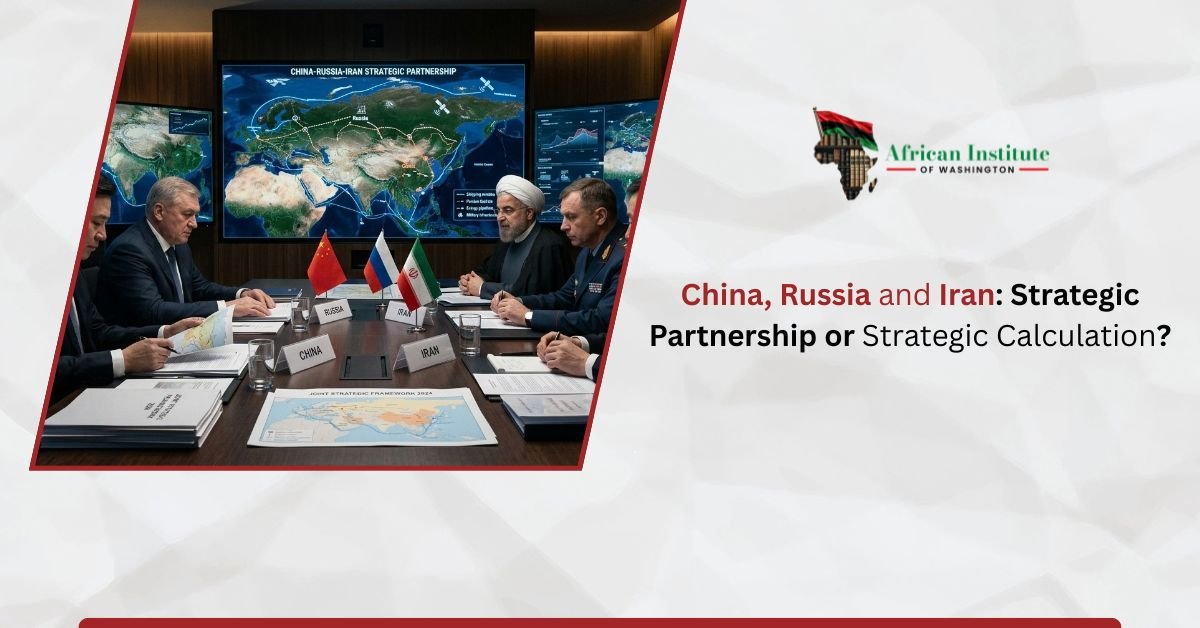
A Comparative Analysis of Great-Power Interests, Security Cooperation and the Limits of Alliance
A young student stated that “China is ignoring Iran at a moment where Iran needs China the most”. If by “ignoring Iran” it means that China has not intervened militarily on Iran’s behalf despite its strategic partnership with Tehran, the key point is that China is not actually ignoring Iran; it is supporting Iran selectively while avoiding a direct military commitment.
Recent evidence makes this distinction particularly important. Chinese entities have continued supplying Iran with oil-market access and dual-use components, while Beijing has issued diplomatic statements opposing attacks on Iran. At the same time, China has avoided a formal defense commitment or direct military intervention.
Why is China keeping its distance?
1. Iran is important to China, but not China’s most important Middle Eastern partner.
China has substantial economic relationships with Saudi Arabia, the UAE and other Gulf states. Beijing therefore has an incentive to preserve relationships on both sides of the Persian Gulf, rather than openly aligning itself with Tehran. The U.S.-China Economic and Security Review Commission describes the relationship as asymmetric: Iran depends heavily on China, while Beijing has much broader regional interests to protect.
2. China does not want a war with the United States.
This is probably the most important factor. A direct Chinese military intervention on Iran’s behalf could turn a U.S.–Iran conflict into a much larger U.S.–China confrontation.
China has much more at stake in its relationship with Washington than in defending Iran militarily. Recent analysis from Brookings similarly concludes that Beijing has been cautious about allowing the Iran conflict to damage U.S.–China relations.
3. China benefits from Iran without necessarily having to defend Iran.
Iran provides China with access to relatively inexpensive oil and serves as a strategic partner in challenging aspects of the U.S.-led international system.
China can therefore obtain strategic benefits from Iran while avoiding the costs of a formal military alliance.
The relationship is consequently closer to:
economic partnership + diplomatic support + selective technology cooperation
than:
mutual-defense alliance.
The U.S.-China Economic and Security Review Commission specifically notes that Beijing has avoided a formal defense commitment to Tehran.
4. China wants Iran to survive—but does not necessarily want Iran to win a war.
This distinction is crucial.
From Beijing’s perspective, the collapse of the Iranian government could create major instability across the Middle East, disrupt energy markets and potentially strengthen U.S. influence.
But an Iranian military victory that dramatically destabilizes the Gulf could also threaten China’s economic interests.
Therefore, Beijing has an incentive to support Iran’s survival and sovereignty without necessarily supporting every Iranian military action.
5. China prefers diplomatic influence to military intervention in the Middle East.
China has repeatedly emphasized negotiations, ceasefires and diplomatic solutions rather than sending Chinese forces to fight.
Reuters reported in July that Gulf Arab states themselves were asking Beijing to use its economic leverage over Tehran, while China resisted assuming a military role in reopening the Strait of Hormuz.
That is consistent with China’s broader foreign-policy model: economic influence first, diplomatic influence second, military intervention only when core Chinese interests are directly threatened.
But there is an important contradiction
It would be inaccurate to say that China is simply standing aside.
Recent reporting indicates that Chinese suppliers sent roughly 1,300 shipments of dual-use components to Iran’s defense ministry during the first half of 2026, including components potentially useful for drones and missile systems.
The U.S.-China Economic and Security Review Commission has also documented Chinese involvement in supplying dual-use technologies and facilitating Iranian access to components relevant to drone and missile programs.
There have even been recent U.S. allegations concerning Chinese satellite imagery being obtained by Iran and subsequently associated by U.S. officials with an Iranian strike against a U.S. base. Those allegations are significant but should be treated as U.S. officials’ assessment rather than an independently established fact.
So the better description is:
China is helping Iran indirectly while avoiding becoming Iran’s military protector.
The deeper geopolitical calculation
There is a broader lesson here for understanding China’s world strategy.
China does not necessarily organize its international relationships around the same alliance model that the United States uses.
Washington has historically built formal security alliances involving defense commitments. Beijing often prefers strategic partnerships that provide economic, diplomatic and political benefits without automatically creating an obligation to fight a war for the partner.
That explains why China can simultaneously:
- buy Iranian oil;
- maintain diplomatic relations with Tehran;
- oppose attacks on Iranian sovereignty;
- provide or tolerate access to dual-use technology;
- cooperate with Iran through BRICS and the Shanghai Cooperation Organisation;
- maintain relations with Saudi Arabia and the UAE;
- cooperate economically with Israel and Gulf states;
- and maintain a major relationship with the United States.
This is strategic hedging.
What this means for Iran
Iran’s experience demonstrates an important limitation of its relationship with China: a strategic partnership is not necessarily a security guarantee.
Iran may expect China and Russia to counterbalance American power, but Beijing ultimately makes its decisions according to Chinese national interests.
That is why Iran can receive meaningful Chinese economic and diplomatic support while still finding itself largely responsible for its own military defense.
The current BRICS experience illustrates the same problem. At the September 2026 BRICS summit, the organization called for restraint and a political solution but avoided directly condemning the United States, Israel, Iran, or the Gulf states, reflecting significant differences among its members.
The strategic paradox
There is therefore a fascinating paradox:
Iran needs China more than China needs Iran.
China values Iran because Iran provides:
- energy;
- geographic access to the Middle East;
- a partner opposed to aspects of U.S. dominance;
- access to regional networks;
- and strategic leverage.
But China has alternatives for most of these interests.
Iran has far fewer alternatives.
That asymmetry gives Beijing considerable leverage over Tehran.
And this may be the most important explanation for what appears to be China’s “ignoring” of Iran: Beijing is not abandoning Iran; it is deliberately maintaining enough support to protect Chinese interests without assuming the risks of becoming responsible for Iran’s war.
If you’re examining this for an African Institute of Washington geopolitical article, a strong title would be “China and Iran: Strategic Partnership or Strategic Calculation?” The subject would fit particularly well with your broader work on multipolarity, U.S.–China competition, and the changing international order.
Russia’s attitude toward Iran
Not exactly. Russia’s attitude toward Iran during the 2026 war has been somewhat more supportive than China’s, but Moscow has also avoided entering the war directly. The key distinction is that Russia appears willing to provide certain forms of military/intelligence assistance while still avoiding a formal commitment to fight alongside Iran.
Russia vs. China: the main difference
| Issue | Russia | China |
|---|---|---|
| Diplomatic support for Iran | Strong | Strong |
| Condemnation of U.S./Israeli actions | Yes | Yes |
| Direct military intervention | No | No |
| Military/technical assistance | Reportedly more substantial | More limited/indirect |
| Intelligence assistance | Reportedly provided targeting information | Some dual-use technology reported |
| Mutual-defense treaty | No | No |
| Willingness to risk direct war with U.S. | Limited | Very limited |
| Main strategic concern | Ukraine, U.S. pressure, regional influence | Trade, Gulf stability, U.S.-China competition |
Carnegie reported in March 2026 that neither Moscow nor Beijing initially offered Iran unmistakable military intervention, but noted reports that Russia may have provided targeting data for Iranian attacks on U.S. forces.
More recent analysis from the Middle East Institute goes further, reporting that Russia provided satellite targeting data and fiber-optic drone technology while still stopping short of direct intervention. These are reported assessments, rather than a Russian admission that it participated directly in Iranian attacks.
Why Russia is more involved than China
There is an important strategic reason: Russia and Iran have developed a much deeper military relationship since the Ukraine war. Iran supplied Russia with Shahed drones and other military assistance, while Russia has provided Iran with military technology and other forms of cooperation.
But Russia’s partnership with Iran is not a NATO-style alliance. The 20-year strategic partnership signed in 2025 did not create an automatic Russian obligation to defend Iran militarily. Analysts emphasize that Moscow has deliberately preserved this freedom of action.
Russia has its own calculation
One particularly important factor is Ukraine.
Russia has enormous military demands of its own. Carnegie notes that many Russian air-defense systems, aircraft and missiles that could potentially help Iran are needed for the war in Ukraine. Moscow therefore faces a practical limit on how much military capability it can transfer to Tehran.
There is also an economic dimension. The war has disrupted energy markets, and higher oil prices can benefit Russia. Carnegie reported that the conflict generated additional Russian oil-and-gas revenues, while the disruption also diverted international attention and some U.S. resources away from Ukraine.
Chatham House similarly describes Russia’s approach as carefully calibrated involvement: supporting Tehran diplomatically and through selected forms of cooperation while avoiding direct confrontation with U.S. and Israeli forces.
So is Russia “abandoning” Iran?
The evidence does not support that simple conclusion.
A better description is:
Russia is supporting Iran without becoming Iran’s co-belligerent.
Moscow wants Iran to remain an important strategic partner, but it also wants to preserve its own freedom of action, avoid a direct war with the United States, maintain relationships with Gulf countries, and concentrate significant military resources on Ukraine.
This is why Russia can simultaneously condemn attacks on Iran, provide certain forms of assistance, cooperate militarily and diplomatically with Tehran, and still refuse to send Russian forces into the war.
The larger geopolitical lesson
This actually makes the Russia-China comparison very interesting for your African Institute of Washington geopolitical work.
Neither Moscow nor Beijing appears to treat Iran as an ally whose security automatically requires them to fight the United States. Instead, both relationships are characterized by strategic cooperation without automatic military protection.
The difference is primarily in the instruments:
Russia → more military/intelligence-oriented support.
China → more economic, diplomatic and technological support.
And both countries appear to be calculating how much they can support Iran without paying the price of becoming directly involved in the war.
A strong AIW article could therefore be titled “Russia, China and Iran: Strategic Partners or Calculated Allies?” and examine why the so-called Russia-China-Iran alignment has limits despite their shared opposition to aspects of U.S. power.
Bibliography: China, Russia and Iran
A. China–Iran relations
1. U.S.-China Economic and Security Review Commission.
(2026). China-Iran Fact Sheet: A Short Primer on the Relationship. Washington, DC: U.S. Congress.
This is particularly useful for China’s economic relationship with Iran, oil purchases, sanctions, dual-use technology, military cooperation, BRICS and the Shanghai Cooperation Organization.
2. Wright, Thomas.
(2026). “Beijing’s Approach to the Conflict in Iran and Its Implications for China.” Brookings Institution, May 5, 2026.
Useful for analyzing China’s cautious response to the war and the relationship between Iran policy and China’s broader foreign-policy priorities.
3. Washington Institute for Near East Policy.
(2026). Tracking Chinese and Russian Statements on the Iran War. Washington, DC.
Particularly valuable for comparing Chinese and Russian official statements throughout the conflict. The tracker was updated September 9, 2026.
4. China and Iran.
(2021). China–Iran Comprehensive Cooperation Plan. Beijing–Tehran, 25-year strategic cooperation framework.
5. U.S.-China Economic and Security Review Commission.
(2025). Axis of Autocracy: China’s Revisionist Ambitions with Russia, Iran, and North Korea. In 2025 Annual Report to Congress. Washington, DC: U.S. Congress.
6. International Crisis Group.
Publications on Iran, China, sanctions and Middle Eastern geopolitics. Brussels: International Crisis Group.
B. Russia–Iran relations
7. Smagin, Nikita.
(2025). “New Russia-Iran Treaty Reveals the Limits of Their Partnership.” Carnegie Endowment for International Peace, January 21, 2025.
This is an important source because it explains why the 2025 Russia-Iran treaty should not be interpreted as a mutual-defense alliance.
8. Firmian, Federico Manfredi.
(2026). “Russia and Iran: The Axis of Transactions Unraveled.” Middle East Policy, 33(3), e70081.
Particularly relevant to analyzing how the 2026 war exposed limitations in the Russia-Iran strategic partnership.
9. Gabuev, Alexander, & Umarov, Temur.
(2026). “Why Are China and Russia Not Rushing to Help Iran?” Carnegie Endowment for International Peace, March 10, 2026.
Useful for understanding why both powers have supported Tehran diplomatically while stopping short of unmistakable direct military intervention.
10. Russian Federation & Islamic Republic of Iran.
(2025). Treaty on Comprehensive Strategic Partnership between the Russian Federation and the Islamic Republic of Iran. Moscow/Tehran, January 17, 2025.
11. CSIS—Center for Strategic and International Studies.
(2025). “CRINK Security Ties: Growing Cooperation, Anchored by China and Russia.” Washington, DC: CSIS.
Useful for placing Russian-Iranian and Chinese-Iranian military cooperation within the broader China–Russia–Iran–North Korea security network.
C. Comparative Russia–China–Iran studies
12. CNA.
(2026). “War in Iran Tests the Limits of the ‘No-Limits Partnership’ Between China and Russia.” Arlington, VA: CNA.
Particularly useful for examining where Chinese and Russian approaches converge and where their interests diverge during the Iran war.
13. Washington Institute for Near East Policy.
(2025/2026). Iran’s Failing Eastward Pivot? The Limits and Risks of Russia-China Alignment. Washington, DC.
Examines Iran’s attempt to orient its foreign policy toward Moscow and Beijing and the absence of formal mutual-defense guarantees.
14. Katz, Mark N.
Various works on Russia, Iran and Middle Eastern geopolitics. Washington, DC: Middle East Institute.
15. Schelling, Thomas C.
(1966). Arms and Influence. New Haven, CT: Yale University Press.
16. Mearsheimer, John J.
(2001). The Tragedy of Great Power Politics. New York: W. W. Norton.
17. Waltz, Kenneth N.
(1979). Theory of International Politics. Reading, MA: Addison-Wesley.
18. Kissinger, Henry.
(2014). World Order. New York: Penguin Press.
19. Nye, Joseph S.
(2004). Soft Power: The Means to Success in World Politics. New York: PublicAffairs.
20. Acharya, Amitav.
(2014). The End of American World Order. Cambridge: Polity Press.
Claude Kisuka, PhD
African Institute of Washington
African Studies
