Rwanda, Paul Kagame and the Great Lakes Region: Power, Sovereignty, and International Controversies
Introduction
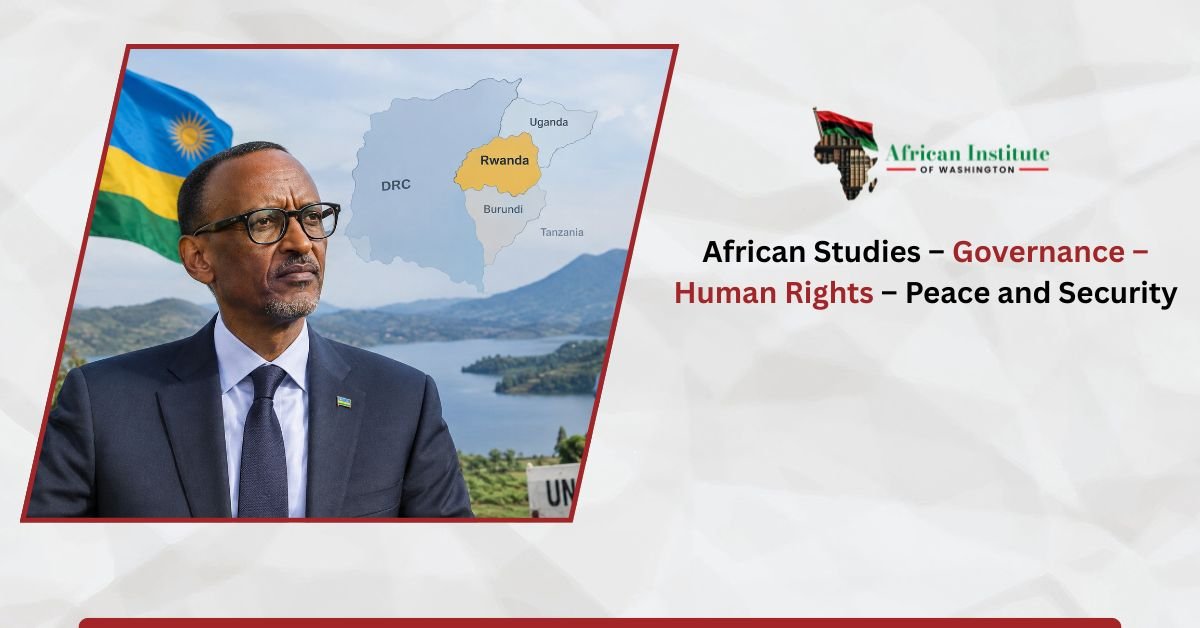
Since the end of the 1994 genocide against the Tutsi, Rwanda has occupied a distinctive position in debates concerning African state reconstruction, governance, development, and regional security. Under the leadership of Paul Kagame, who became President of the Republic in 2000, Rwanda has undergone significant institutional and economic transformation. At the same time, the Rwandan government has faced persistent criticism concerning the political space within the country, human rights, and Rwanda’s role in conflicts in the eastern Democratic Republic of Congo (DRC).
An analysis of Rwanda therefore requires a careful methodological approach. It is important to distinguish between facts documented by international institutions, allegations or assessments made by international organizations and other actors, and the official positions of the Rwandan government. Such a distinction is essential for avoiding both an exclusively favorable and an exclusively accusatory interpretation of contemporary Rwanda.
This article examines three principal dimensions: Rwanda’s political and institutional trajectory, controversies concerning human rights and political space, and Rwanda’s role in the security crisis in eastern DRC.
1. Rwanda’s Reconstruction after 1994
The 1994 genocide is an essential starting point for understanding contemporary Rwanda. The victory of the Rwandan Patriotic Front (RPF) was followed by a broad process of state reconstruction, institutional reorganization, and rehabilitation of infrastructure.
Rwanda gradually developed an international reputation based on institutional stability, economic performance, infrastructure modernization, and participation in international peacekeeping operations. The United States, in particular, developed substantial cooperation with Kigali in the areas of development, health, and security. The source document examined by the African Institute of Washington describes this evolution and portrays the U.S.–Rwanda relationship as having gradually become more complex.
These elements are important facts in the analysis of contemporary Rwanda. They do not, however, by themselves establish an overall assessment of the country’s political system. Economic development, stability, and questions concerning civil and political liberties must be examined as distinct dimensions.
2. Governance and Political Space: Facts and Controversies
One of the principal controversies surrounding Rwanda concerns the exercise of political power and the conditions under which opposition parties, journalists, and civil society organizations operate.
Human Rights Watch reported that during 2025, members of the political opposition and journalists continued to face prosecution or detention and that the space available for publicly criticizing the government remained significantly restricted. The organization, for example, reported the arrest of opposition figure Victoire Ingabire in June 2025 in connection with proceedings involving members of her political organization.
These observations should be presented as findings and assessments of Human Rights Watch, rather than as an independent conclusion of the African Institute of Washington. The Rwandan government has repeatedly rejected allegations of political repression and maintains that its political system is based on national unity, stability, and the prevention of a return to the divisions that contributed to the 1994 genocide.
This divergence of interpretation is central to the academic debate. On one side, human rights organizations emphasize political freedoms, freedom of expression, and political pluralism. On the other, Rwandan authorities emphasize national security, the prevention of genocide ideology, and the preservation of state stability.
3. Rwanda and the Crisis in Eastern Democratic Republic of Congo
The most sensitive issue in Rwanda’s relations with its neighbors concerns the situation in the DRC. In February 2025, the United Nations Security Council adopted Resolution 2773, condemning the M23 offensive and calling on the Rwanda Defence Force to cease support for the M23 and withdraw its forces from Congolese territory.
The United Nations Group of Experts on the DRC has also documented the involvement of the Rwanda Defence Force alongside the AFC/M23 and described the humanitarian and security consequences associated with the movement’s territorial expansion in North Kivu and South Kivu.
A report of the United Nations Secretary-General published in October 2025 further stated that AFC/M23, with support from Rwandan forces, had consolidated control over several areas of eastern DRC.
These documents constitute important international sources for understanding the conflict. They should nevertheless be distinguished from political accusations made by the various governments and actors involved in the conflict.
4. The Official Position of the Rwandan Government
The Rwandan government disputes allegations concerning its role in violence committed by the M23 and rejects the interpretation that Kigali is the principal cause of instability in eastern DRC.
According to Kigali’s official position, a central issue is the security threat posed by the Democratic Forces for the Liberation of Rwanda (FDLR), an armed group that includes elements associated with those responsible for the 1994 genocide. The Rwandan government has also argued that certain authorities in the DRC have cooperated with the FDLR and other armed groups opposed to the M23.
In August 2025, Kigali explicitly rejected allegations made by Human Rights Watch and United Nations-related bodies concerning alleged massacres of civilians in Binza. The Rwandan government argued that the allegations had not been sufficiently verified and called for an independent investigation.
This position is important to include in an academic analysis. Reporting the Rwandan government’s response does not establish that international allegations are invalid; rather, it ensures that the debate is presented in its broader context and that disagreements among the relevant sources are clearly identified.
5. An Evolving U.S.–Rwanda Relationship
The relationship between Washington and Kigali is another important element in understanding contemporary Rwanda. Following 1994, the United States provided substantial support for reconstruction, health, development, and security programs. Rwanda subsequently became an important partner in certain international peacekeeping operations.
However, the relationship has not been free of tensions. U.S. concerns regarding the situation in eastern DRC, the activities of the M23, and certain human rights issues have increasingly introduced criticism into the bilateral relationship.
The source material examined by the African Institute of Washington therefore describes a transition from a relationship based primarily on cooperation toward a more complex partnership in which Washington has sought both to maintain cooperation with Kigali and to exert pressure concerning certain regional and political issues.
Conclusion
The Rwandan experience cannot be understood through a single analytical framework. The country simultaneously presents elements of institutional reconstruction, development, and stability that have received international recognition, as well as significant controversies concerning political pluralism, civil liberties, and Rwanda’s role in the conflict in eastern DRC.
For contemporary African studies, the challenge is precisely to move beyond simplified interpretations. Facts documented by the United Nations should be distinguished from allegations made by human rights organizations, while the responses and justifications of the Rwandan government should also be documented and examined.
The African Institute of Washington maintains that the study of African affairs should promote an approach grounded in knowledge, documentation, dialogue, and critical inquiry. In the case of Rwanda, this approach requires examining simultaneously the consequences of the 1994 genocide, state reconstruction, economic transformation, political governance, human rights concerns, and the geopolitical dynamics of the Great Lakes region.
The purpose of academic research is therefore not to construct an exclusively positive or negative image of a state or political leader. Rather, it is to provide readers with the evidence necessary to understand a complex reality, compare sources, identify areas of agreement and disagreement, and form their own informed conclusions. In an Africa facing continuing challenges of sovereignty, security, development, and governance, such an approach is an essential foundation for responsible intellectual debate.
Professor Claude Kisuka
African Institute of Washington
African Studies, Development, human rights, and sovereignty
