The Case of Laurent Gbagbo and the Ivorian Crisis of 2010–2011
Introduction
The postcolonial political history of Africa raises a persistent question: to what extent do Western powers respect the political sovereignty of African states when governments in those states pursue nationalist, sovereignist, or Pan-Africanist policies in their domestic and international affairs?
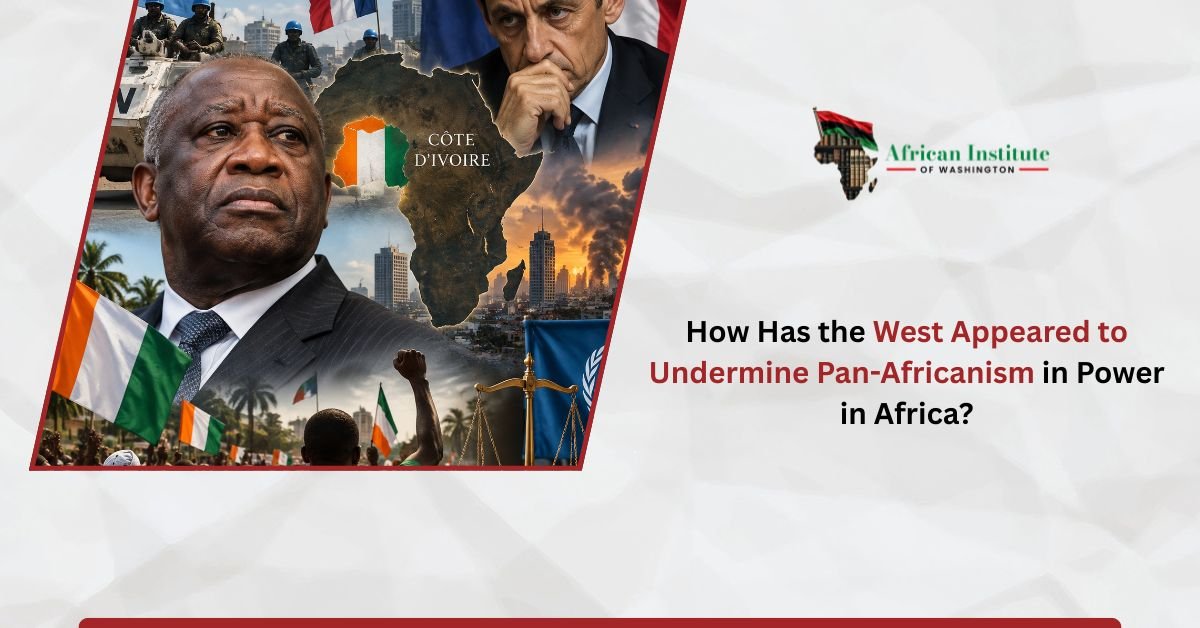
The 2010–2011 crisis in Côte d’Ivoire is one of the most controversial cases through which this question can be examined. The presidential election opposing incumbent Laurent Gbagbo and Alassane Ouattara developed into an institutional, political, and ultimately military crisis. Both camps claimed victory. The Ivorian Constitutional Council declared Laurent Gbagbo the winner with 51.45 percent of the vote after annulling results from several northern regions. The Independent Electoral Commission (CEI), however, had announced Ouattara as the winner with 54.10 percent against 45.90 percent for Gbagbo. The United Nations subsequently certified the CEI’s results in favor of Ouattara.
The central question, therefore, is not simply who was legally entitled to claim victory. It is also necessary to examine why the international community, and particularly France under President Nicolas Sarkozy, exerted such strong pressure on Gbagbo and ultimately contributed militarily to the collapse of his government.
A Pan-Africanist interpretation of the crisis can consequently ask a broader question: was Western intervention exclusively motivated by the defense of democracy and civilians, or did it also reflect a geopolitical preference for a leader considered more compatible with French and Western interests?
This question deserves serious examination, even though it should not automatically be transformed into an established factual conclusion.
1. An Election That Became a Crisis of Sovereignty
The second round of Côte d’Ivoire’s presidential election took place on November 28, 2010. Laurent Gbagbo faced Alassane Ouattara after both candidates had obtained the strongest results in the first round.
On December 2, 2010, the Independent Electoral Commission announced Ouattara as the winner with 54.10 percent of the vote against 45.90 percent for Gbagbo. The Constitutional Council challenged this proclamation and annulled results from several northern regions before declaring Gbagbo the winner with 51.45 percent.
The situation therefore created two competing institutional claims to legitimacy:
- the Independent Electoral Commission declared Ouattara the winner;
- the Constitutional Council declared Gbagbo the winner;
- both men were sworn in as president;
- the United Nations certified the result in favor of Ouattara;
- the African Union, ECOWAS, the European Union, the United States, and France ultimately recognized Ouattara.
It would therefore be historically inaccurate to describe the crisis simply as a confrontation between the West and Gbagbo. Several African institutions also ultimately recognized Ouattara.
However, this observation does not resolve the central question:
Did the French military intervention go beyond simply recognizing an electoral result?
2. Laurent Gbagbo and the Question of Pan-Africanism
Laurent Gbagbo represented an Ivorian political tradition strongly associated with nationalism, national sovereignty, and resistance to certain forms of continued French influence.
For decades, Gbagbo had criticized what many African intellectuals describe as Françafrique—the political, economic, military, and diplomatic networks through which France historically maintained substantial influence over its former African colonies.
From this perspective, Gbagbo could be presented as a representative of Africa’s sovereignist political tradition. This does not mean that every policy of Gbagbo or his government should automatically be characterized as Pan-Africanist. Nevertheless, his political discourse placed considerable emphasis on Ivorian sovereignty and on the right of the Ivorian people to determine their own political future.
This is precisely what gives the Ivorian crisis a significance beyond an ordinary electoral dispute.
3. French Military Presence and the Ivorian Crisis
France already maintained a substantial military presence in Côte d’Ivoire through Operation Licorne.
Following the outbreak of the post-election crisis, the French role became increasingly visible. In March 2011, the United Nations Security Council adopted Resolution 1975, imposing sanctions against Gbagbo and calling for an end to violence. The resolution also authorized the UN Operation in Côte d’Ivoire (UNOCI) to use “all necessary means” to protect civilians and prevent the use of heavy weapons against them.
On April 4, 2011, UN Secretary-General Ban Ki-moon ordered UNOCI to act against heavy weapons being used against civilians, with French forces supporting the operation within the framework of the UN mandate.
There was therefore an international legal basis for the intervention.
But another political question remains:
Did the manner in which this mandate was implemented create a decisive military imbalance in favor of Ouattara?
This is where the controversy begins.
4. The Military Offensive and the Fall of Gbagbo
In early April 2011, forces supporting Ouattara launched an offensive to seize Abidjan. At the same time, French and UN forces attacked positions and heavy weapons belonging to Gbagbo’s forces.
On April 11, 2011, Laurent Gbagbo was captured at his residence in Abidjan. He was reportedly found in a bunker with his wife, Simone Gbagbo.
The precise circumstances of his capture generated competing accounts, particularly concerning which forces physically entered the residence and arrested him. Nevertheless, there is little doubt that French and international military action had significantly weakened the military capabilities of the Gbagbo camp.
Contemporary reporting indicated that French armored vehicles advanced toward Gbagbo’s residence and that French helicopters participated in operations against heavy weapons. Forces loyal to Ouattara subsequently entered the residence and captured Gbagbo.
The Le Monde reported at the time that French and UN forces had participated in the destruction of heavy weapons belonging to Gbagbo’s forces while Ouattara’s forces advanced toward Abidjan.
Thus, even though France argued that its actions were based on the protection of civilians and the UN mandate, its military intervention objectively contributed to changing the military balance of power. What was done here to Gbagbo and Cote d Ivoire was not faire because Cote d Ivoire would never done that in France.
5. “I Will Vaporize Laurent Gbagbo”: An Allegation That Requires Caution
One particularly serious allegation concerns Nicolas Sarkozy.
Years after the events, Franco-African political intermediary Robert Bourgi claimed that Sarkozy had told him, regarding Gbagbo:
“I will vaporize Laurent Gbagbo.”
According to Bourgi’s account, the statement allegedly followed an unsuccessful attempt to persuade Gbagbo to leave office.
This allegation is politically significant, but it must be presented as a statement attributed to Sarkozy by Robert Bourgi, rather than as an independently established historical fact. There is insufficient independent evidence to establish conclusively that Sarkozy actually used those words.
Nevertheless, Sarkozy’s public position toward the Ivorian crisis was unmistakably favorable to Ouattara. On January 4, 2011, Sarkozy stated explicitly:
“The president of Côte d’Ivoire is Alassane Ouattara.”
This demonstrated France’s political position regarding the legitimacy of the Ivorian presidency.
The important point is therefore not necessarily the unverified quotation, but the broader political reality: Paris was not neutral in the Ivorian political crisis.
6. The Problem of “Double Standards”
One of the strongest criticisms that can be directed toward Western powers does not necessarily require claiming that they “stole” an election from Laurent Gbagbo.
Instead, the deeper question is:
Why does the application of democratic principles, human rights standards, and political accountability sometimes appear much more forceful when certain African leaders are involved than when their opponents or allies are involved?
Human Rights Watch documented serious violations committed by Gbagbo’s forces. However, it also documented abuses committed by forces supporting Ouattara and raised concerns about the subsequent concentration of judicial proceedings on the Gbagbo camp.
This asymmetry is politically important.
If international principles are genuinely universal, they should apply equally to:
- pro-Gbagbo forces;
- pro-Ouattara forces;
- government officials;
- former rebel forces;
- leaders supported by Western powers;
- and leaders who oppose Western interests.
Otherwise, democracy risks becoming not a universal principle but an instrument for selecting governments considered politically acceptable by powerful external actors.
7. Gbagbo’s Acquittal by the International Criminal Court
An important element often overlooked in simplified narratives of the Ivorian crisis is Laurent Gbagbo’s subsequent judicial history.
The International Criminal Court prosecuted Gbagbo for crimes against humanity allegedly committed during the post-election violence. After a lengthy trial, the Trial Chamber acquitted him in January 2019. The Appeals Chamber confirmed his acquittal on March 31, 2021. The ICC now lists the case as “Acquitted, Case closed.”
This acquittal does not mean that the violence of 2010–2011 did not occur. Approximately 3,000 people were killed according to widely cited estimates, and serious violations were committed by forces on different sides of the conflict.
However, the acquittal requires us to qualify any narrative that presents Gbagbo as having been judicially established as personally responsible for the crimes for which he was prosecuted.
The distinction is important:
Political responsibility, military responsibility, and criminal responsibility are not necessarily the same thing.
8. The Gbagbo–Kadhafi Connection and the Sarkozy Question
The political history of Nicolas Sarkozy and Muammar Gaddafi adds another controversial dimension to this discussion.
Allegations were made that Gaddafi’s Libyan regime had contributed to the financing of Sarkozy’s 2007 presidential campaign. Sarkozy consistently denied receiving illegal Libyan campaign funds.
However, the matter subsequently became the subject of a major French criminal investigation and trial. In September 2025, a French court convicted Sarkozy and sentenced him to five years in prison for criminal conspiracy in connection with the alleged effort to obtain Libyan financing for his 2007 presidential campaign. The court did not establish that Libyan money had actually reached Sarkozy’s campaign accounts. Sarkozy has continued to deny wrongdoing, and his appeal opened in March 2026.
This distinction is essential.
It would be inaccurate to state categorically:
“Gaddafi financed Sarkozy’s campaign.”
The more accurate formulation is:
Sarkozy was convicted in 2025 in the Libyan financing case for criminal conspiracy connected to efforts to obtain illicit Libyan financing for his 2007 campaign, while the court did not establish that Libyan funds actually reached his campaign accounts.
The political question nevertheless remains striking.
How should we understand the transformation of France’s relationship with Gaddafi—from diplomatic engagement and cooperation before 2011 to military intervention against his regime in 2011?
This question does not, by itself, prove that alleged campaign financing caused the intervention. Such a causal connection would require additional evidence.
But it deserves examination within any serious analysis of French foreign policy in Africa and North Africa.
9. The Paradox of Humanitarian Intervention
French intervention in Côte d’Ivoire was primarily justified in terms of protecting civilians.
This argument cannot simply be dismissed. Civilians were genuinely exposed to severe violence. Heavy weapons were used, and serious human rights violations were documented. UN Security Council Resolution 1975 gave UNOCI an enhanced mandate to protect civilians.
However, an intervention can simultaneously possess an international legal justification and geopolitical consequences.
That is precisely where the Pan-Africanist debate becomes important.
The question is therefore not simply:
“Did France have a legal basis to intervene?”
It can also be:
“Should an external power possess the military capacity to determine, through superior force, which African political faction ultimately controls the state?”
The second question goes directly to the heart of contemporary African sovereignty.
10. Africa and the Problem of Sovereignty
The Ivorian crisis illustrates a fundamental paradox of contemporary Africa.
African states are legally sovereign, but their sovereignty can be heavily constrained by:
- economic dependence;
- military dependence;
- foreign military bases;
- international financial institutions;
- diplomatic alliances;
- transnational economic networks;
- international sanctions;
- and the ability of powerful states to recognize or isolate governments.
The Ivorian crisis also demonstrates that sovereignty cannot simply be proclaimed in a constitution.
It must be supported by credible national institutions, a professional republican military, an independent judiciary, credible elections, and autonomous African diplomatic capacity.
Without these foundations, a national election can quickly become an international crisis.
11. The Real Challenge of Pan-Africanism
Contemporary Pan-Africanism should not limit itself to condemning Western intervention.
It must also answer a more difficult question:
How can African institutions become strong enough for African political crises to be resolved by Africans themselves?
If Africa possesses the African Union, regional organizations, African courts, mediation mechanisms, and subregional institutions, why should a major political crisis ultimately depend upon the military capabilities of a former colonial power?
True independence does not simply mean the departure of colonial rulers.
It means having the capacity to:
- conduct credible elections;
- resolve electoral disputes domestically;
- prevent militaries from becoming political instruments;
- protect civilians without dependence on foreign military powers;
- guarantee impartial justice for all political factions;
- protect African economic resources and strategic interests;
- develop an independent continental diplomatic strategy;
- and prevent external powers from determining who should govern an African state.
Conclusion: Gbagbo—A Defeat of Pan-Africanism or a Lesson for Its Future?
The Ivorian crisis of 2010–2011 cannot responsibly be reduced to the statement that “the West stole the election from Laurent Gbagbo.”
The available evidence demonstrates a more complicated reality.
The CEI announced Ouattara as the winner with 54.10 percent, while the Constitutional Council proclaimed Gbagbo the winner with 51.45 percent after invalidating results from several regions. The United Nations certified the results favoring Ouattara. The African Union and ECOWAS ultimately recognized Ouattara. At the same time, serious human rights violations were committed by forces on both sides, with significant abuses attributed to Gbagbo’s forces.
Nevertheless, the asymmetry of international power remains a legitimate subject of political inquiry.
France under Nicolas Sarkozy clearly supported Ouattara. French forces, acting alongside the United Nations, participated in military operations that destroyed heavy weapons belonging to the Gbagbo camp. The offensive by Ouattara’s forces ultimately resulted in Gbagbo’s capture on April 11, 2011.
For Gbagbo’s supporters and for some Pan-Africanist currents, this sequence represents more than an ordinary presidential transition. It symbolizes the continuing capacity of former colonial powers to influence the political destiny of African states.
But the deeper Pan-Africanist lesson may lie elsewhere.
Africa’s problem is not simply that foreign powers intervene.
It is also that African institutions remain sufficiently fragile to allow external powers to intervene effectively.
The Pan-Africanism of the twenty-first century must therefore move beyond denunciation toward institutional construction, strategic sovereignty, continental integration, and political accountability.
The objective should not be to replace Western dependence with dependence on Russia, China, or another external power. The objective should be to build an Africa capable of choosing its partners freely, resolving its own political crises, and defending its interests without asking an external power to determine who should govern.
This may be the most important historical lesson of the Gbagbo–Ouattara crisis:
African sovereignty cannot be considered complete as long as the political legitimacy of an African government can ultimately be consolidated or overturned through the military, economic, or diplomatic power of external actors.
The challenge for contemporary Pan-Africanism is therefore not merely to oppose the West.
It is to build an Africa that cannot be politically controlled by anyone outside the continent.
Selected APA Bibliography
- African Union. (2011). Report on the situation in Côte d’Ivoire following the presidential election of 28 November 2010. African Union.
- Carter Center. (2011). International election observation mission to Côte d’Ivoire: 2010–2011 elections final report. The Carter Center.
- Human Rights Watch. (2011). Côte d’Ivoire: Crimes against humanity by Gbagbo forces. Human Rights Watch.
- Human Rights Watch. (2012). World report 2012: Côte d’Ivoire. Human Rights Watch.
- International Criminal Court. (2021). The Prosecutor v. Laurent Gbagbo and Charles Blé Goudé. International Criminal Court.
- International Crisis Group. (2011). Côte d’Ivoire: Is war the only option? Africa Report No. 171. International Crisis Group.
- International Crisis Group. (2011). Une période critique pour stabiliser la Côte d’Ivoire. Africa Report No. 176. International Crisis Group.
- United Nations Security Council. (2011). Resolution 1975 (2011): Côte d’Ivoire. United Nations.
- United Nations Operation in Côte d’Ivoire. (2010). Presidential elections: UNOCI resources. United Nations.
- United Nations. (2011). Statement by the Secretary-General on the situation in Côte d’Ivoire. United Nations.
- U.S. Department of State. (2011). 2010 human rights report: Côte d’Ivoire. U.S. Department of State.
Claude Kisuka, PhD
African Institute of Washington
