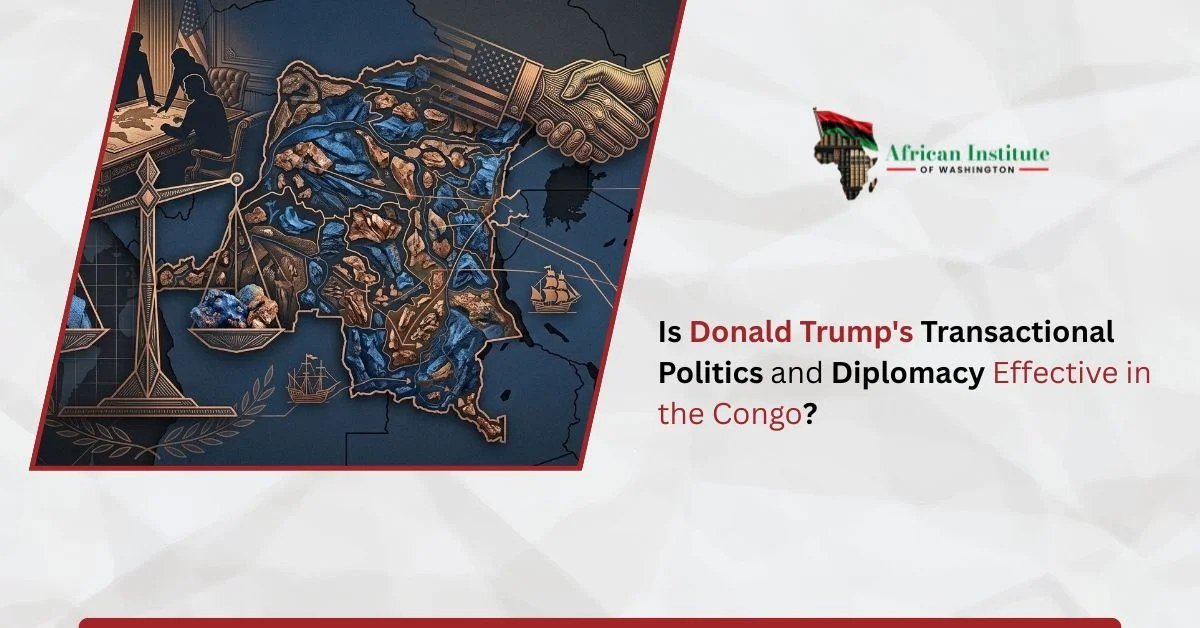
The Case of the “Congo Deal,” Strategic Minerals, and Peace Between the Democratic Republic of Congo and Rwanda
Introduction
The foreign policy of Donald Trump is frequently characterized by a transactional approach to international relations. Rather than placing traditional alliances, multilateral institutions, and long-term diplomatic commitments at the center of foreign policy, this approach emphasizes measurable and immediate national interests. The central question becomes: What does the United States gain from a particular relationship, agreement, alliance, or diplomatic initiative?
This approach is closely associated with the broader “America First” doctrine. In January 2025, President Donald Trump formally directed that U.S. foreign policy should “champion core American interests” and put America and American citizens first. His administration’s trade policy similarly emphasized national security, reciprocal treatment, bilateral negotiations, and economic advantages for the United States.
This article examines the application and limitations of this transactional approach in the Democratic Republic of Congo (DRC), particularly in relation to the Washington agreements between the DRC and Rwanda, the war in eastern Congo, and the strategic mineral resources of the country.
The central argument is that the United States has succeeded in creating important diplomatic and economic frameworks, but the ultimate test of transactional diplomacy in Congo remains unresolved: Can an agreement produce durable peace, respect for Congolese sovereignty, and an equitable economic partnership that benefits the Congolese population?
The question is particularly important because Congo occupies a unique position in the history of American strategic power. From uranium used during the Manhattan Project to cobalt and other critical minerals essential to today’s technological economy, Congo has repeatedly supplied resources of major strategic importance to the United States and the wider industrial world.
The issue, therefore, is not simply whether Washington can negotiate a “deal.” The deeper question is whether Congo is being treated as a sovereign strategic partner—or primarily as a geographical space containing resources necessary for the strategic interests of more powerful states.
1. What Is Transactional Diplomacy?
Transactional diplomacy can be understood as a foreign-policy approach in which international relationships are evaluated largely according to concrete and measurable benefits.
Its principal characteristics include:
- immediate and measurable returns;
- bilateral rather than multilateral negotiations;
- reciprocal concessions;
- the use of economic and political leverage;
- pressure through tariffs, sanctions, military commitments, or reductions in assistance;
- emphasis on national interest rather than institutional continuity;
- and a preference for negotiated agreements that can demonstrate visible results.
This approach differs from classical diplomacy, which traditionally emphasizes alliances, institutions, international law, collective security, and long-term strategic relationships.
Trump’s approach does not necessarily reject diplomacy. Rather, it attempts to redefine diplomacy as a form of negotiation in which every party must demonstrate what it contributes and what it receives.
The strength of such an approach is speed. It can break diplomatic deadlocks and produce agreements that traditional negotiations sometimes fail to achieve.
Its weakness is that international conflicts are not always commercial transactions. Some conflicts involve historical trauma, identity, sovereignty, security dilemmas, institutional weakness, and competing national narratives that cannot be resolved simply through an exchange of concessions.
The Congo-Rwanda conflict provides an important example.
2. Congo’s Strategic Value to the United States
The Democratic Republic of Congo is one of the world’s most strategically important countries.
Its importance is not simply geographic. Congo possesses extraordinary quantities of natural resources, including:
- cobalt;
- copper;
- tantalum;
- gold;
- uranium;
- lithium;
- tin;
- and other critical minerals.
The country is particularly important for the global energy and technology transition. The U.S. Geological Survey has identified the DRC as the world’s dominant cobalt-producing country. In recent years, Congo has accounted for roughly three-quarters of global cobalt mine production, making the country indispensable to supply chains involving batteries, electric vehicles, electronics, and other advanced technologies.
Cobalt is therefore not merely a mineral. It has become a strategic component of the global technological economy.
The geopolitical importance of Congo must consequently be understood in historical perspective.
Congo has repeatedly supplied strategic resources during periods of major international competition.
3. Congo and the Manhattan Project
One of the most important examples is uranium.
During World War II, uranium from the Belgian Congo became a critical component of the American nuclear program. The uranium deposit at Shinkolobwe, in present-day Katanga, was exceptionally rich.
Historical documentation from the U.S. Department of Energy and the Office of Scientific and Technical Information confirms that the United States obtained major quantities of uranium ore from the Belgian Congo for the Manhattan Project.
By late 1944, approximately two-thirds of the uranium accumulated for the Manhattan Project had come from high-grade Belgian Congo ore.
This history is particularly important because the strategic relationship between Congo and the United States did not begin with cobalt or today’s critical-minerals competition.
Congo’s strategic resources contributed to the development of one of the most consequential military technologies of the twentieth century.
The Congolese contribution to the American strategic project was therefore substantial, even though the Congolese population itself did not exercise meaningful control over the resource or its strategic use.
This historical contradiction deserves attention:
Congo possessed the resource, but other powers controlled the strategic benefits generated by the resource.
That pattern would reappear during the Cold War and, in different forms, continues today.
4. Congo During the Cold War
The strategic importance of Congo continued after World War II.
During the Cold War, the Congo became one of the most important geopolitical battlegrounds in Africa.
The crisis surrounding Patrice Lumumba’s government, the intervention of Western powers, the emergence of Joseph-Désiré Mobutu, and the broader confrontation between the United States and the Soviet Union cannot be separated from Congo’s strategic geographical and mineral importance.
Congo was viewed not simply as an African country undergoing political transformation but as a strategically important territory in the global struggle between competing geopolitical systems.
Mobutu subsequently became a major Western anti-communist ally.
The Cold War demonstrated another characteristic of Congo’s strategic history:
The country’s internal political order was repeatedly influenced by external strategic calculations.
The Congolese population paid a substantial price for these geopolitical struggles.
This history provides important context for understanding contemporary American engagement with Congo.
5. From Uranium to Cobalt: The New Strategic Congo
The strategic value of Congo has changed, but it has not disappeared.
During the twentieth century, uranium was central to military power.
Today, cobalt, copper, tantalum, lithium, and other critical minerals are central to technological power.
The United States, China, the European Union, and other industrial powers are competing to secure reliable access to strategic minerals.
China has established a particularly strong position in Congo’s cobalt and copper sectors.
This creates a new geopolitical reality.
The strategic competition over Congo is no longer primarily about nuclear weapons.
It is increasingly about:
- electric vehicles;
- batteries;
- telecommunications;
- artificial intelligence;
- renewable energy;
- military technology;
- advanced manufacturing;
- semiconductor-related supply chains;
- and industrial security.
The United States therefore has a legitimate strategic interest in developing alternative critical-mineral supply chains.
The Lobito Corridor is one example of this effort.
The corridor seeks to connect Angola, the DRC, and Zambia to international markets and improve access to copper and cobalt from Central Africa.
The DRC-U.S. Strategic Partnership Agreement also demonstrates that critical minerals have become an important component of contemporary bilateral relations.
This creates an important question:
Is the current American engagement with Congo fundamentally different from earlier relationships based on strategic resources—or is the historical pattern simply taking a new form?
6. The Washington “Congo Deal”: Peace, Security, and Minerals
The Washington agreements between the DRC and Rwanda represent an important attempt by the United States to use diplomacy to address one of Africa’s most persistent conflicts.
The agreements seek to connect several issues:
- security;
- regional stability;
- territorial sovereignty;
- disarmament;
- Rwanda’s security concerns;
- the neutralization of armed groups;
- economic cooperation;
- and access to strategic minerals.
This is precisely where transactional diplomacy becomes attractive.
Instead of addressing the conflict exclusively through traditional peacekeeping mechanisms, Washington attempts to create a framework in which peace, security, economic integration, and investment reinforce one another.
The logic is straightforward:
Peace creates economic opportunity, and economic opportunity creates incentives for peace.
The problem is that this equation works only if the parties actually implement their commitments.
7. Signing an Agreement Is Not the Same as Implementing It
One of the central challenges facing the Washington process is implementation.
A peace agreement is not successful because it is signed.
It is successful when:
- armed groups stop fighting;
- foreign forces withdraw;
- territorial sovereignty is restored;
- civilians are protected;
- illegal exploitation of natural resources declines;
- displaced populations can return safely;
- and political institutions regain control over territory.
This distinction is crucial in evaluating Trump’s transactional diplomacy in Congo.
The United States has demonstrated that it can bring the parties to the negotiating table.
But the deeper question is whether Washington possesses sufficient leverage to compel all parties to implement their commitments.
This is where the limits of transactional diplomacy become visible.
8. Rwanda, M23, and the Evidence of the United Nations
The situation involving Rwanda and the M23/AFC movement must be addressed carefully and based on available evidence.
United Nations investigations have documented extensive military and logistical support by elements of the Rwandan Defence Force to M23/AFC and have described RDF involvement in military operations in eastern DRC.
The UN Group of Experts has also documented the capture of strategic and mineral-rich territories by M23/AFC and described the establishment of parallel administrative structures.
The United States has itself taken sanctions against senior Rwandan officials and entities connected to the conflict.
In March 2026, the U.S. Treasury Department stated that the Rwandan Defence Force had supported, trained, and fought alongside M23 and that M23, with RDF support, had captured major cities and mining areas in eastern Congo.
The U.S. Treasury subsequently sanctioned a Rwandan gold-refining network over alleged illicit conflict-minerals trade connected to eastern Congo.
These developments are important because they demonstrate that Washington’s own policy has moved beyond diplomatic engagement toward the use of economic sanctions and pressure.
At the same time, Rwanda has presented its own security concerns, particularly regarding the presence of the FDLR and threats allegedly originating from Congolese territory.
An academically responsible analysis must therefore distinguish between:
- documented UN findings;
- U.S. government findings;
- accusations made by the Congolese government;
- Rwanda’s stated security position;
- and interpretations by independent scholars and analysts.
The evidence nevertheless demonstrates that the implementation of the peace process remains incomplete.
9. Minerals and the War Economy
The relationship between armed conflict and mineral resources is one of the most important dimensions of the Congolese crisis.
Eastern Congo contains important deposits of:
- gold;
- coltan;
- cassiterite;
- tungsten;
- and other valuable minerals.
The UN Group of Experts has documented mineral routes linking areas under armed-group control with regional trading networks.
The question is therefore not simply who controls territory.
It is also:
Who controls the economic value generated by that territory?
Territorial control can create control over mines, transportation routes, taxation, trading networks, and export channels.
This means that peace cannot be separated from the political economy of the conflict.
If armed groups can continue to derive economic benefits from territory, the financial incentives for war remain.
Therefore, any successful peace agreement must address the mineral economy.
10. Charles Onana’s Critical Perspective
The writings of Charles Onana provide a particularly critical interpretation of the Great Lakes conflicts.
In works such as Ces tueurs tutsi au cœur de la tragédie congolaise, Europe, crimes et censure au Congo, Rwanda: La vérité sur l’opération Turquoise, and Holocauste au Congo, Onana challenges conventional narratives concerning Rwanda, the international community, and the wars in Congo.
His work emphasizes the role of international political interests, geopolitical alliances, historical narratives, and what he presents as the marginalization of Congolese victims in international discourse.
His arguments are controversial and should therefore be read critically and compared with UN investigations, academic research, governmental documents, and other independent sources.
Nevertheless, Onana’s work raises an important question:
Why has the international community repeatedly treated Congo’s security crisis without adequately addressing the international political and economic structures that sustain it?
This question remains relevant to the current diplomatic process.
11. Patrick Mbeko’s Critical Perspective
Patrick Mbeko’s writings provide another critical perspective on the Great Lakes region.
In Le Canada dans les guerres en Afrique centrale, Le Canada et le pouvoir Tutsi du Rwanda, and his other works, Mbeko examines the relationship between geopolitical interests, Rwanda, Western governments, mining interests, and the conflicts of Central Africa.
Mbeko places considerable emphasis on the economic and geopolitical dimensions of the Congo wars.
His work is particularly useful for understanding the argument that Congo’s conflict cannot be explained solely through ethnic divisions or internal political failures.
However, as with Onana, Mbeko’s interpretations should be examined alongside primary documentation and independent research.
His writings are best understood as part of a broader critical literature challenging dominant explanations of the Great Lakes conflicts.
12. Is Congo Being Treated as a Sovereign Partner or as a Resource Space?
This is perhaps the most important question raised by the current diplomatic process.
The DRC possesses enormous natural wealth.
The United States needs strategic minerals.
China has established major positions in the Congolese mining sector.
Europe wants reliable critical-mineral supply chains.
Rwanda has historically been deeply involved in the political and economic dynamics of eastern Congo.
The question is therefore whether Congo can transform its strategic mineral wealth into genuine national power.
A country can possess extraordinary resources and remain economically weak if it lacks:
- effective institutions;
- transparent contracts;
- control over its territory;
- industrial capacity;
- infrastructure;
- technological capabilities;
- and negotiating power.
Natural resources do not automatically produce national development.
Institutions determine whether natural resources become national wealth or become a source of dependency.
13. The Risk of a New Dependency
There is a danger that Congo’s strategic importance could produce another form of dependency.
Historically, Congo supplied uranium while foreign governments controlled the strategic benefits.
During the Cold War, Congo’s political sovereignty was constrained by external geopolitical competition.
Today, Congo risks becoming primarily a supplier of critical minerals for foreign industrial strategies.
The names of the resources have changed.
The geopolitical logic may not have changed as much.
This is why the Congolese government must negotiate from a position of sovereignty.
A strategic partnership should not mean:
Congo supplies the minerals; others control the technology, financing, processing, transportation, and final value.
A genuine partnership should create value inside Congo.
That means developing:
- local processing;
- refining;
- manufacturing;
- infrastructure;
- technology transfer;
- professional training;
- employment;
- environmental protection;
- and transparent public revenues.
14. The Peace–Minerals Equation
The current diplomatic approach implicitly connects peace and minerals.
The reasoning is understandable:
If peace produces economic investment, and economic investment creates jobs and infrastructure, then peace becomes economically valuable.
But there is another possibility.
If mineral wealth becomes the principal motivation for international engagement, peace can become subordinate to economic interests.
This is why Congo must ensure that economic agreements do not weaken the political objective of peace.
Peace should be the foundation of economic cooperation—not the price paid for access to resources.
15. Congo Must Not Be Reduced to Its Subsoil
One of the greatest dangers facing Congo is the reduction of its national identity to its natural resources.
Congo is not cobalt.
Congo is not copper.
Congo is not uranium.
Congo is not gold.
Congo is a nation of more than one hundred million people with:
- intellectual capital;
- agricultural potential;
- forests;
- rivers;
- energy resources;
- young people;
- universities;
- entrepreneurs;
- cultural diversity;
- and enormous geographic potential.
The purpose of international partnerships should therefore be to help Congo transform its resources into human development.
The Congolese people should not remain poor while their country becomes increasingly important to the global economy.
16. The Question of “Balkanization”
The term “balkanization” is frequently used in Congolese political discourse to describe fears of the fragmentation of the country.
It is important, however, to distinguish between a documented secret plan to divide Congo—which would require specific evidence—and the de facto territorial fragmentation that has occurred in parts of eastern DRC.
The existence of parallel administrations, armed-group control, displacement, and foreign military involvement can weaken the effective sovereignty of the Congolese state even without a formally declared partition.
Therefore, the more academically precise question is:
Does prolonged territorial fragmentation create conditions under which Congo’s sovereignty can gradually become weakened or fragmented?
This question deserves serious attention.
17. “Congolizing” a Regional War
Another important concept is the possibility of transforming a regional conflict into what appears to be primarily an internal Congolese conflict.
The presence of Congolese armed groups, political factions, local militias, and competing elites can make a conflict increasingly difficult to understand from the outside.
The danger is that external actors can disappear from the visible narrative while local Congolese actors become the public face of the conflict.
This does not mean that Congolese actors have no responsibility.
They do.
The Congolese state must confront corruption, military failures, political divisions, and weak governance.
But internal responsibility does not eliminate external responsibility.
The conflict must therefore be analyzed simultaneously at three levels:
- local Congolese political dynamics;
- regional Great Lakes security dynamics;
- international geopolitical and economic interests.
Reducing the conflict to only one of these levels produces an incomplete analysis.
18. Why Has Rwanda Not Fully Implemented Its Commitments?
One of the central questions for Washington is how to convert diplomatic commitments into actual behavior.
If Rwanda has security concerns regarding the FDLR, those concerns cannot simply be dismissed.
But Rwanda’s security concerns cannot automatically justify military operations or support for armed movements inside Congolese territory.
The same principle applies to Congo.
The DRC has obligations concerning armed groups operating from its territory, including commitments relating to the FDLR.
A durable peace therefore requires reciprocal implementation.
The United States faces a difficult diplomatic challenge:
How can Washington maintain sufficient leverage over both Kigali and Kinshasa without appearing to sacrifice Congolese sovereignty or legitimate Rwandan security concerns?
This is precisely where transactional diplomacy encounters the complexity of regional conflicts.
19. The Limits of Deal-Making
A transaction can produce a signature.
It cannot automatically produce trust.
A transaction can produce an investment agreement.
It cannot automatically produce institutions.
A transaction can produce a ceasefire.
It cannot automatically eliminate the causes of war.
This is the fundamental limitation of the transactional model.
Diplomacy is sometimes transactional.
But peace is institutional.
Peace requires:
- institutions;
- accountability;
- justice;
- verification;
- political legitimacy;
- security-sector reform;
- economic development;
- and public trust.
If these elements are absent, a diplomatic agreement can become temporary rather than transformative.
20. The Paradox of Trump’s Congo Policy
There is a paradox at the heart of Trump’s engagement with Congo.
On the one hand, transactional diplomacy can give Congo greater international attention.
The DRC’s strategic importance has become more visible because of the global competition over critical minerals.
On the other hand, the same strategic importance creates a risk.
The United States may become primarily interested in Congo because of its minerals.
This creates a difficult question:
Is Congo important because of the Congolese people, or because of what Congo possesses?
The answer should be both.
A genuinely strategic partnership must place Congolese development at the center of economic cooperation.
21. Does the Deal Primarily Benefit the United States and Rwanda?
This question must be approached carefully.
It would be difficult to establish as a factual matter that the Washington agreements were designed primarily to enrich the United States and Rwanda at Congo’s expense without evidence demonstrating such an intention.
However, the distribution of benefits must be examined.
The United States has a clear strategic interest in:
- critical minerals;
- supply-chain diversification;
- regional stability;
- and reducing strategic dependence on China.
Rwanda has significant economic and security interests in eastern Congo.
Congo has an even more fundamental interest:
the restoration of its territorial sovereignty and the transformation of its natural wealth into national development.
The relevant question is therefore not simply:
“Who wins the deal?”
It is:
Does the Congolese population receive a fair and measurable share of the political, economic, security, and developmental benefits?
That should be one of the principal criteria for evaluating the agreement.
22. The True Winner Must Be the Congolese People
A successful Congo agreement should produce measurable improvements in the lives of Congolese citizens.
These improvements should include:
- restoration of territorial integrity;
- reduction of armed violence;
- return of displaced populations;
- improved security;
- transparent mining contracts;
- increased public revenues;
- local employment;
- infrastructure development;
- technology transfer;
- environmental protection;
- and industrialization.
If Congo continues to export raw minerals while importing finished products, then the fundamental economic structure remains unchanged.
If peace exists only on paper while armed groups continue controlling territory, then the security problem remains unresolved.
If foreign investors profit while Congolese communities remain impoverished, then the economic partnership is incomplete.
23. What Congo Should Negotiate
Congo should not approach the United States merely as a recipient of assistance.
It should negotiate as a strategic partner.
A stronger Congolese negotiating position should include:
1. Sovereignty
Any strategic partnership must recognize the territorial integrity and constitutional sovereignty of the DRC.
2. Security
Foreign military support to armed groups must cease, and mechanisms for independent verification must be strengthened.
3. Mineral processing
Congo should seek greater domestic processing and refining capacity.
4. Infrastructure
Mining agreements should contribute to roads, railways, electricity, telecommunications, and industrial infrastructure.
5. Technology transfer
Strategic partnerships should include technology and skills transfer.
6. Employment
Congolese citizens should benefit directly through skilled employment and professional development.
7. Transparency
Major mining and infrastructure agreements should be subject to strong transparency and accountability mechanisms.
8. Revenue
The Congolese state and local communities must receive a fair share of the value generated by natural resources.
9. Environmental protection
Mining development must include environmental safeguards and community protections.
10. Human development
Economic agreements must ultimately contribute to education, health, housing, and broader human development.
24. Peace Must Become a Congolese Peace
The international community can facilitate peace.
It cannot permanently create peace on behalf of the Congolese people.
The ultimate responsibility for rebuilding Congo belongs to the Congolese state and society.
This requires national reconciliation, institutional reform, military reform, judicial accountability, and political inclusion.
Congo must also confront its internal weaknesses.
External actors cannot be blamed for every failure.
Corruption, poor governance, military indiscipline, political fragmentation, and institutional weakness are real Congolese problems that require Congolese solutions.
But acknowledging internal responsibility does not mean ignoring external responsibility.
The conflict is both internal and international.
Therefore, the solution must also be both internal and international.
25. The Need for Another Diplomacy
Congo requires diplomacy—but not diplomacy based exclusively on transactions.
It needs a diplomacy combining:
- national sovereignty;
- economic realism;
- regional security;
- international law;
- human rights;
- development;
- and strategic partnerships.
The United States can play an important role.
But Washington should not attempt to substitute economic agreements for political solutions.
Nor should Congo allow mineral diplomacy to replace national development.
The objective should be a partnership in which American strategic interests and Congolese national interests are compatible rather than mutually exclusive.
26. From a “Deal” to a Strategic Partnership
The concept of a “deal” is useful because it emphasizes reciprocity.
But Congo needs something deeper than a transaction.
It needs a strategic partnership.
A strategic partnership would include:
Security + Infrastructure + Industrialization + Technology + Education + Governance + Minerals + Human Development.
This model would be more sustainable than simply exchanging access to minerals for diplomatic support.
The United States has the financial, technological, and institutional capacity to contribute to such a transformation.
Congo has the resources, geography, population, and development potential.
The challenge is creating an agreement that combines these assets fairly.
27. The Real Test of Trump’s Transactional Diplomacy
The real test of Trump’s Congo diplomacy should not be whether an agreement was signed in Washington.
The test should be whether five years from now:
- Congo is more secure;
- Rwanda’s security concerns are addressed without violating Congolese sovereignty;
- armed groups no longer control strategic territories;
- displaced Congolese populations can return safely;
- illegal mineral trafficking has declined;
- Congo processes more of its own resources;
- Congolese citizens receive greater economic benefits;
- and the country has stronger institutions.
If these objectives are achieved, transactional diplomacy will have demonstrated that it can produce transformative results.
If the agreement produces primarily mineral access, investment opportunities, and geopolitical advantages while the underlying conflict remains unresolved, then the limitations of the transactional model will become evident.
The ultimate measure is therefore not the ceremony.
It is the outcome.
28. Conclusion: Congo Must Not Become the Bargaining Chip for Its Own Wealth
The history of Congo demonstrates a recurring paradox.
Congo has repeatedly possessed resources that were strategically essential to powerful countries.
Uranium contributed to the American nuclear project.
During the Cold War, Congo became a major geopolitical battleground.
Today, cobalt, copper, tantalum, gold, and other minerals place Congo at the center of global technological competition.
Yet enormous natural wealth has not automatically produced prosperity for the Congolese people.
This is the fundamental challenge facing the current Washington diplomatic process.
The United States has legitimate strategic interests.
Rwanda has legitimate security concerns.
Congo has legitimate sovereignty and development interests.
The challenge is to construct a framework in which these interests can coexist without sacrificing Congolese territorial integrity or reducing Congo to a supplier of strategic resources.
The Washington agreements may represent an important diplomatic opportunity.
But an agreement is only the beginning.
The real measure of success will be whether peace becomes durable, sovereignty becomes effective, mineral wealth becomes development, and the Congolese population becomes the principal beneficiary of its country’s extraordinary strategic value.
Congo should therefore not reject international partnerships.
It should negotiate them from a position of dignity, sovereignty, transparency, and strategic intelligence.
The objective should not simply be:
“What can Congo obtain from America?”
Nor should it be:
“What can America obtain from Congo?”
The more appropriate question is:
“What can Congo and the United States build together in a relationship that respects Congolese sovereignty and produces mutual and measurable benefits?”
That is the difference between a transaction and a genuine strategic partnership.
The future of Congo should not be negotiated merely as a commodity.
Congo First—in an equitable partnership with the world.
References / Bibliography
Charles Onana
Onana, C. (2009). Ces tueurs tutsi au cœur de la tragédie congolaise. Duboiris.
Onana, C. (2012). Europe, crimes et censure au Congo: Les documents qui accusent. Duboiris.
Onana, C. (2014). La France dans la terreur rwandaise. Duboiris.
Onana, C. (2019). Rwanda: La vérité sur l’opération Turquoise. L’Artilleur.
Onana, C. (2021). Enquêtes sur un attentat: Rwanda 6 avril 1994. L’Artilleur.
Onana, C. (2023). Holocauste au Congo: L’omerta de la communauté internationale. L’Artilleur.
Patrick Mbeko
Mbeko, P. (2012). Le Canada dans les guerres en Afrique centrale: Génocides et pillages des ressources minières du Congo par le Rwanda interposé. Le Nègre éditeur.
Mbeko, P. (2014). Le Canada et le pouvoir Tutsi du Rwanda: Deux décennies de complicité criminelle en Afrique centrale. Éditions de l’Érablière.
Mbeko, P. (2014). Stratégie du chaos et du mensonge: Poker menteur dans l’Afrique des Grands Lacs (with Honoré Ngbanda Nzambo). Éditions de l’Érablière.
Mbeko, P. (2016). Objectif Kadhafi. Libre-Pensée.
Mbeko, P. (2024). Malheur aux vaincus. Éditions Duboiris.
Africa, Congo, and International Relations
Cooper, F. (2002). Africa since 1940: The past of the present. Cambridge University Press.
Nzongola-Ntalaja, G. (2002). The Congo from Leopold to Kabila: A people’s history. Zed Books.
Prunier, G. (2009). Africa’s world war: Congo, the Rwandan genocide, and the making of a continental catastrophe. Oxford University Press.
Reyntjens, F. (2009). The great African war: Congo and regional geopolitics, 1996–2006. Cambridge University Press.
Stearns, J. K. (2011). Dancing in the glory of monsters: The collapse of the Congo and the great war of Africa. PublicAffairs.
Young, C. (1994). The African colonial state in comparative perspective. Yale University Press.
United Nations Economic Commission for Africa. (2011). Minerals and Africa’s development. UNECA.
Strategic Minerals and the Democratic Republic of Congo
U.S. Geological Survey. (2025). A database of artisanal, small-scale, and large-scale mining in the Copperbelt region of the Democratic Republic of Congo and Zambia. U.S. Department of the Interior. https://doi.org/10.5066/P9LWU4FT
U.S. Geological Survey. (2026). Mineral commodity summaries 2026: Cobalt. U.S. Department of the Interior.
U.S. Geological Survey. (2026). Congo (Kinshasa). National Minerals Information Center.
Congo, the United States, and the Cold War
Kalb, M. (1982). The Congo cables: The Cold War in Africa—from Eisenhower to Kennedy. Macmillan.
Weissman, S. R. (1974). American foreign policy in the Congo, 1960–1964. Cornell University Press.
Williams, S. (2016). Freeing the freed: The politics of the Congo. University of Chicago Press.
United Nations and Conflict in Eastern Congo
United Nations Security Council. (2025). Final report of the Group of Experts on the Democratic Republic of the Congo (S/2025/446). United Nations.
United Nations Security Council. (2025). Resolution 2773 (2025). United Nations.
United Nations Security Council. (2026). The situation concerning the Democratic Republic of the Congo. United Nations.
United Nations Organization Stabilization Mission in the Democratic Republic of the Congo. (2026). UN envoy urges parties to stay the course towards peace in eastern DR Congo. United Nations.
United States Policy
The White House. (2025, January 20). America First policy directive to the Secretary of State. Executive Office of the President.
The White House. (2025, January 20). America First trade policy. Executive Office of the President.
U.S. Department of the Treasury. (2025, August 12). Treasury sanctions entities linked to violence and illegal mining in the Democratic Republic of the Congo.
U.S. Department of the Treasury. (2026, March 2). Treasury sanctions Rwanda officials, condemns blatant violations of Washington Peace Accords.
U.S. Department of the Treasury. (2026, June 25). Treasury sanctions Rwandan gold refinery and network enabling illicit conflict minerals trade.
International Energy Agency. (2026). DRC-US Strategic Partnership Agreement.
Claude Kisuka
African Institute of Washington
