
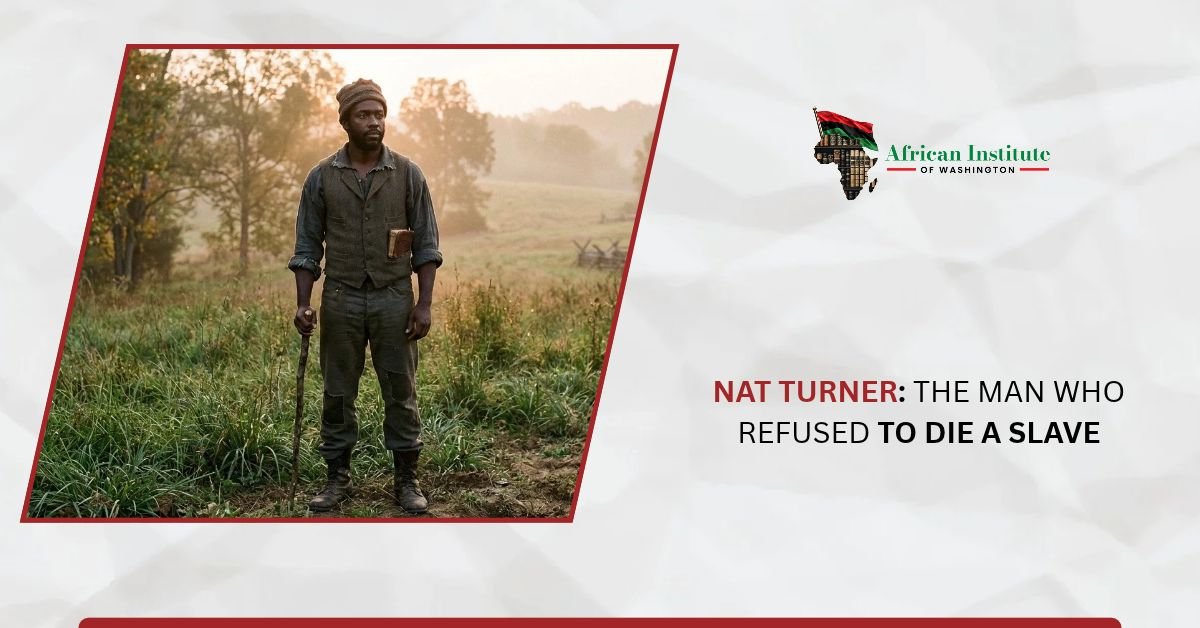
The Rebellion of 1831, the Price of Freedom, and the Unfinished Struggle for Liberation
By Dr. Claude Kisuka
“Freedom is never free. Those who enjoy it today must remember those who were willing to sacrifice everything so that others might live as human beings.”
Introduction: Before Lincoln, There Was Nat Turner
Who liberated Black people from slavery in America? Was it Abraham Lincoln? Was it the abolitionists? Was it the Union Army? Or was it the millions of enslaved Africans and their descendants who resisted, rebelled, escaped, organized, and refused to accept the condition imposed upon them?
American history often places President Abraham Lincoln at the center of the story of emancipation. Lincoln’s leadership during the Civil War and his issuance of the Emancipation Proclamation were unquestionably important. Yet, long before Lincoln entered the White House, enslaved Black people were already fighting for their freedom, sometimes at the cost of their lives.
Among them was a man whose name continues to challenge America’s understanding of slavery, resistance, and liberation: Nat Turner, the enslaved preacher who led the Southampton Rebellion in Virginia in August 1831.
Turner did not wait for a president to recognize his humanity. He did not wait for Congress to grant him rights. He did not accept the idea that the people who enslaved him possessed the moral authority to determine whether he deserved to be free.
He acted.
His rebellion was defeated. He was captured, tried, and executed. Yet his actions sent shockwaves throughout the American South, exposed the instability of the slave system, intensified the struggle over slavery, and became one of the most consequential acts of armed resistance in American history.
Nat Turner did not single-handedly abolish slavery, and his rebellion did not immediately liberate Black Americans. Indeed, the immediate aftermath brought terrible violence against Black communities and stricter restrictions on their freedoms.
Nevertheless, his story raises a fundamental question:
Can a people truly become free if they never challenge the structures that deny them their humanity?
To understand the significance of Nat Turner, we must look beyond the rebellion itself. We must examine the world that produced him, the violence inflicted upon his body, the political consequences of his actions, and the lessons his struggle offers to people and nations still fighting for liberation.
1. Who Was Nat Turner?
Nathaniel Turner, commonly known as Nat Turner, was born into slavery on October 2, 1800, in Southampton County, Virginia.
He entered a world in which Black people could be bought and sold, families could be separated, physical punishment was used to enforce obedience, and enslaved people were denied fundamental legal and political rights.
Turner grew up under a system that treated human beings as property. His enslaved status meant that other people claimed authority over his labor, movement, and life.
Yet Turner developed intellectual and spiritual capacities that would profoundly influence his future.
He learned to read and write, an unusual accomplishment for an enslaved person in the Virginia of his time. He also became deeply religious and emerged as a preacher among enslaved Black people in his community.
According to the account published by the white lawyer Thomas R. Gray in 1831, Turner believed that he received divine revelations and was called to fulfill a special purpose.
Turner’s spirituality was central to his understanding of the world. He interpreted religious experiences and certain natural phenomena as signs that the time had come to act against slavery.
He was not simply a man reacting to his personal circumstances. He became a man who interpreted his condition as part of a larger moral and spiritual struggle.
For Turner, the contradiction was unbearable: how could a society claim to be Christian while permitting one human being to own another?
How could people speak of liberty while denying freedom to millions?
How could a nation celebrate independence while maintaining slavery?
These questions were not merely philosophical. They concerned life, death, dignity, and the future of his people.
Turner began discussing rebellion with a small group of trusted enslaved men. Together, they planned an uprising against the system that held them in bondage.
On the night of August 21, 1831, their plans became reality.
Nat Turner was not born a liberator.
He became one through his refusal to accept the permanent legitimacy of slavery.
His life demonstrates that education, religious conviction, political consciousness, and the desire for dignity can transform an oppressed individual into a figure of historical significance.
2. August 1831: The Day Enslaved People Challenged the Slave System
The rebellion began in Southampton County, Virginia, on August 21, 1831.
Turner and his initial followers launched their uprising at the home of his enslaver, Joseph Travis. They moved from plantation to plantation, gathering additional participants and attacking white households.
The uprising expanded as the rebels sought weapons, recruits, and the means to continue their revolt.
Over approximately a day, the insurgents killed about 55 white people, including men, women, and children. The precise total varies among historical accounts.
The rebellion was eventually defeated by armed resistance from local white men and organized militia forces.
Turner escaped capture and remained at large for more than two months before he was discovered and arrested on October 30, 1831.
We must confront this history honestly.
The rebels killed civilians, including women and children. These deaths were real human tragedies. Recognizing the brutality of slavery does not require denying the suffering of those who died during the uprising.
At the same time, understanding the rebellion requires examining the larger system in which it occurred: a society that systematically deprived Black people of liberty, treated their bodies as property, separated families, and used violence to maintain racial domination.
The uprising was an extraordinary act of resistance against that system. It was also a violent revolt whose consequences extended far beyond its immediate participants.
Turner and his followers were not fighting a conventional army with equal resources. They confronted a powerful social order backed by laws, armed citizens, militias, and institutions dedicated to preserving slavery.
Their defeat was therefore unsurprising.
But military defeat and historical defeat are not the same thing.
The rebellion failed to overthrow slavery in Virginia, but it destroyed the comforting illusion that slavery could guarantee the unquestioned submission of the enslaved.
That was one of its most enduring consequences.
3. Did Nat Turner Free Himself and His People?
To answer this question, we must distinguish between three forms of freedom.
The first is personal freedom: escaping enslavement and gaining control over one’s own life.
The second is collective freedom: ending the system that enslaves an entire population.
The third is political freedom: creating institutions, laws, and social conditions that protect the rights and dignity of formerly enslaved people.
Turner did not achieve these three forms of freedom.
He did not permanently escape slavery. He did not liberate Virginia’s enslaved population. Nor did his rebellion establish a political system in which Black people enjoyed equal rights.
Nevertheless, his actions expressed a powerful principle: enslaved people were not merely passive recipients of emancipation. They were historical actors who challenged slavery through rebellion, escape, resistance, and the preservation of their communities.
Turner made that resistance impossible to ignore.
His rebellion demonstrated that enslaved people possessed political agency. They could organize, make decisions, take risks, and challenge the authority of those who claimed ownership over them.
This is essential to understanding the history of emancipation.
Black Americans did not simply wait for freedom to arrive.
Some escaped to free states. Others helped people escape through networks such as the Underground Railroad. Abolitionists published testimonies exposing slavery’s brutality. Enslaved people resisted forced labor, maintained family and cultural traditions, and seized opportunities to undermine the system.
During the Civil War, hundreds of thousands of Black men served in the Union Army and Navy. Their participation contributed directly to the Union war effort and the destruction of slavery.
The National Museum of American History documents this broader history of Black resistance, including the role of formerly enslaved people in challenging slavery through personal testimony and military service.
Therefore, it would be historically inaccurate to say that Nat Turner alone freed Black Americans.
But it would be equally inaccurate to tell the story of emancipation as though enslaved people themselves played no decisive role.
Lincoln signed the Emancipation Proclamation, but the struggle for emancipation was much larger than Lincoln.
It was a struggle in which enslaved people asserted their humanity, challenged their oppressors, escaped bondage, and helped transform a war over the Union into a war that destroyed slavery.
Turner belongs to that history of resistance.
4. What Happened to Nat Turner After His Capture?
Nat Turner was captured on October 30, 1831.
He was imprisoned, interrogated, tried, convicted, and sentenced to death.
On November 11, 1831, he was hanged in Jerusalem, Virginia, now known as Courtland.
His execution was intended to end his life and demonstrate the authority of the slaveholding state.
But execution was not the end of the punishment inflicted upon him.
What did they do to his body?
Historical accounts describe the mutilation of Turner’s body after his execution. His remains were subjected to the brutal treatment that authorities and others inflicted on some executed Black rebels during this period.
The Smithsonian’s historical account confirms that Turner was hanged and that his body was mutilated. More broadly, its National Museum of African American History and Culture explains that enslavers sometimes displayed the bloodied, dismembered bodies of Black people in public as a means of intimidating other enslaved people.
It is important, however, to distinguish what is documented specifically about Turner from what happened to other Black people.
Historical sources do not always agree or provide equally reliable details about the precise disposition of his remains. Accounts of the period describe the dismemberment and mutilation of executed rebels, but not every detail commonly repeated about Turner’s body can be established with equal confidence.
What is clear is that his death occurred within a broader system of racial terror designed to discourage resistance.
His body had been treated as property during his life. After his execution, his remains became part of a violent spectacle intended to reinforce the authority of the slaveholding order.
The objective was larger than killing one man.
It was to send a message to thousands of enslaved people:
This is what happens to anyone who challenges the system.
Yet the message did not have the intended finality.
Turner’s execution could not erase the rebellion. It could not restore the unquestioned legitimacy of slavery. It could not eliminate the desire for freedom among the people who remained enslaved.
His body could be destroyed, but the historical question he raised survived him.
Who has the moral authority to decide whether another human being deserves freedom?
That question remains at the center of his legacy.
5. The White South’s Revenge: When Resistance Was Met With Terror
The consequences of the rebellion were devastating for Black communities.
After the uprising was suppressed, white vigilantes and armed groups retaliated against enslaved and free Black people, including individuals who had not participated in the revolt.
Historical accounts describe dozens of Black people being killed without trial in Southampton County. Estimates of the wider death toll vary, and some accounts report much larger numbers when killings across the region are included.
Suspected participants and other Black people faced interrogation, torture, imprisonment, and execution.
The terror extended beyond the immediate area of the rebellion.
White slaveholders throughout the South feared that other enslaved people might organize similar uprisings. Their response included increased surveillance, restrictions on Black movement, and new efforts to prevent enslaved people from gathering or obtaining education.
Virginia’s authorities also tightened restrictions on Black religious activity and literacy.
The objective was to prevent enslaved people from developing the networks, knowledge, and collective consciousness that might enable further resistance.
This is one of the most painful lessons of the rebellion.
Resistance does not always produce immediate liberation. Sometimes, the first response of a threatened system is to intensify repression.
Those who challenge entrenched power may pay a terrible price, and innocent members of their communities may suffer retaliation.
Yet this does not mean that oppression becomes legitimate simply because resistance is dangerous.
It means that the cost of liberation must be understood honestly.
The rebellion forced Americans to confront the violence at the heart of slavery, even as defenders of slavery used the rebellion to justify further repression.
The same historical event could therefore become two different arguments.
For slaveholders, it was evidence that enslaved people needed tighter control.
For abolitionists, it was evidence that slavery created profound injustice and that enslaved people were not reconciled to their condition.
The rebellion’s legacy emerged from this conflict over its meaning.
6. Did Nat Turner Cause the American Civil War?
Nat Turner did not directly cause the American Civil War. The war began in 1861, almost thirty years after his rebellion.
Nevertheless, his uprising exposed the explosive contradictions of American slavery and contributed to the political climate in which the conflict over slavery continued to develop.
Understanding that connection requires looking at what happened in Virginia after 1831.
The Virginia emancipation debate
In the aftermath of the rebellion, Virginia’s legislators confronted the question of whether slavery should continue.
More than 2,000 Virginians signed petitions urging the legislature to address slavery, and the General Assembly debated possible approaches to emancipation during its 1831–1832 session.
Some reformers argued that slavery should eventually end. Others proposed colonization schemes intended to remove free Black people from Virginia.
The debate revealed that slavery was not simply a stable institution accepted without question. It was a political and moral problem capable of generating intense conflict within white society itself.
However, the effort to move Virginia toward emancipation failed.
Rather than establish a path toward freedom, the state strengthened restrictions on Black education, religious gatherings, and collective activity. Proslavery arguments subsequently gained greater political influence.
Turner’s rebellion therefore had contradictory consequences.
It reopened debate about the future of slavery, but it also helped harden opposition to emancipation in Virginia.
From rebellion to secession
The Civil War emerged from a much wider conflict involving the expansion of slavery into western territories, the political power of slaveholding states, the growth of antislavery movements, and the election of Abraham Lincoln in 1860.
The secession crisis followed Lincoln’s election. Southern states seceded to protect the slaveholding order, and the attack on Fort Sumter in April 1861 marked the beginning of the war.
Nat Turner was not the sole cause of any of these developments.
However, his rebellion belongs to the longer history of resistance and conflict that made slavery an increasingly dangerous and divisive institution.
It demonstrated that the people subjected to slavery would not necessarily remain submissive. It also revealed the extent to which slaveholders feared losing control of the population they claimed to own.
His uprising was one part of a much larger history that included earlier conspiracies, subsequent resistance, abolitionist organizing, the Underground Railroad, and John Brown’s 1859 raid on Harpers Ferry.
Nat Turner did not start the Civil War, but his rebellion exposed the human conflict that slavery had created decades before the war began.
His story reminds us that major historical transformations rarely begin on the day a government formally recognizes them.
They often emerge from years of resistance, confrontation, political struggle, and sacrifices made by people whose names may never appear in official declarations.
7. Nat Turner and Abraham Lincoln: Who Really Freed the Slaves?
A serious historical discussion must avoid replacing one oversimplification with another.
Abraham Lincoln did not single-handedly free enslaved people. But neither did Nat Turner.
The abolition of slavery in the United States resulted from the interaction of many forces, including the resistance of enslaved people, abolitionist activism, the Civil War, Black military service, federal legislation, and constitutional change.
Lincoln’s role was nevertheless decisive in several respects.
The Emancipation Proclamation, issued in preliminary form in September 1862 and taking effect on January 1, 1863, declared enslaved people in designated areas still in rebellion against the United States to be free. It did not immediately free every enslaved person in the country, and it did not apply to all areas where slavery remained legal.
Its implementation depended on Union military power.
Black men subsequently served in the Union armed forces in substantial numbers, helping the Union defeat the Confederacy.
The Thirteenth Amendment, ratified in December 1865, abolished slavery throughout the United States, except as punishment for a crime after due conviction.
These developments were essential to the legal destruction of slavery.
But a complete account must also recognize the actions of enslaved people themselves.
During the Civil War, enslaved people escaped to Union lines, undermined the Confederacy’s labor system, supplied intelligence, and joined the military struggle. Their actions helped change the war’s political and military character.
The distinction is important.
Lincoln was a president operating within a political and military crisis. Nat Turner was an enslaved man who challenged slavery directly through rebellion.
Their historical roles were different, but both belong to the history of slavery and emancipation.
Turner acted decades before Lincoln’s presidency. He did not secure universal emancipation, but he demonstrated that enslaved people were prepared to risk their lives rather than accept bondage.
Lincoln’s presidency helped transform the Civil War into a struggle that destroyed slavery through military action and constitutional change.
The liberation of Black Americans cannot be credited to one man. It must be understood as the outcome of a long struggle in which enslaved people were participants, not merely beneficiaries.
To erase Nat Turner is to diminish the agency of enslaved people.
To erase Lincoln is to disregard the political leadership and federal action that helped make nationwide abolition possible.
History requires us to recognize both the people who challenged the system from below and the political developments that ultimately dismantled it.
8. What Does Nat Turner’s Rebellion Teach Us About Freedom Today?
The relevance of Nat Turner extends beyond nineteenth-century America.
His story raises questions that confront communities struggling against political oppression, racial discrimination, colonial domination, economic exploitation, and the denial of fundamental rights.
The details differ from one society to another. Not every injustice is equivalent to slavery, and historical comparisons must be made carefully.
Nevertheless, several lessons remain important.
Lesson One: Oppression Does Not Eliminate the Human Desire for Freedom
Slaveholders built laws, economic arrangements, and systems of punishment intended to preserve slavery.
Yet enslaved people continued to resist.
Their actions demonstrated that a system may exercise enormous power over people’s lives without gaining their moral consent.
This is a central lesson for nations and communities living under repressive conditions.
Governments may restrict speech, suppress political opposition, discriminate against minorities, or use coercion to preserve their authority.
Such measures can intimidate people and delay change. They cannot establish that the system is morally legitimate.
Nat Turner’s rebellion reminds us that human beings are more than the conditions imposed upon them.
Lesson Two: Education Can Become an Instrument of Liberation
Turner’s ability to read and write distinguished him from many enslaved people who were deliberately denied literacy.
After the rebellion, Virginia strengthened restrictions on teaching enslaved people to read and write.
The connection between literacy and resistance was not accidental. Knowledge could help enslaved people understand religious texts, communicate ideas, interpret the world around them, and question the legitimacy of their condition.
For contemporary communities, education remains an essential instrument of liberation.
Education helps people understand their history, recognize manipulation, evaluate public claims, develop professional skills, and participate more effectively in public life.
But education must be accompanied by critical thinking.
A person can possess academic credentials and remain intellectually dependent upon others. Liberation requires the ability to question inherited assumptions, examine evidence, and think independently.
Lesson Three: Spirituality Can Challenge Injustice
Turner’s religious convictions helped shape his understanding of his struggle.
His example also reveals a historical contradiction: Christian language was used both to defend slavery and to challenge it.
Some Christians interpreted scripture to justify racial hierarchy and enslavement. Others drew upon religious ideas of human dignity, moral responsibility, and equality to oppose slavery.
Religion therefore cannot be understood as a single, uniform force in the history of emancipation.
The question is how spiritual beliefs are interpreted and put into practice.
Do they encourage obedience to injustice, or do they inspire people to confront it?
Do they sanctify the authority of the powerful, or do they defend the dignity of the vulnerable?
Turner’s story invites contemporary religious communities to consider whether their faith is compatible with systems that deny people their humanity.
Lesson Four: Political Independence Does Not Automatically Produce Liberation
A nation can possess a flag, a constitution, a government, and international recognition while many of its people remain deprived of meaningful freedom.
Political independence is important, but it is not the same as social justice.
A nation may be formally independent while suffering from corruption, extreme poverty, unequal access to education, political repression, or the exploitation of its natural resources.
Likewise, individuals may possess formal civil rights while confronting discrimination, economic exclusion, unequal treatment, or barriers to political participation.
These conditions are not identical to chattel slavery, but they demonstrate why freedom must be evaluated in more than one dimension.
The central question is not simply whether a people have been declared free. It is whether they possess the practical ability to exercise their rights and shape their future.
For countries struggling with the legacies of colonialism, the lesson is that independence must be accompanied by institutions that protect citizens, distribute opportunities fairly, and make public power accountable.
For communities confronting racial inequality, the lesson is that legal recognition matters, but implementation and equal access to opportunity matter too.
Lesson Five: Liberation Requires Organization, Not Only Courage
Nat Turner demonstrated extraordinary determination, but the rebellion lacked the resources necessary to overcome the forces assembled against it.
It was suppressed within days.
This does not diminish the courage of those involved. It does, however, reveal the limitations of a rebellion that cannot sustain its operations or establish a durable political alternative.
For contemporary movements, the lesson is not that courage is unimportant. It is that courage alone is insufficient.
Lasting liberation generally requires a combination of:
- Historical and political education.
- Collective organization and leadership.
- Clear objectives and a credible strategy.
- Economic resources and institutional capacity.
- Public participation and solidarity.
- Protection of human rights and civilian life.
- Institutions capable of sustaining gains after a movement achieves its immediate goals.
These principles apply to peaceful political movements, democratic reform campaigns, civil-rights organizations, and national liberation movements.
They also help explain why some movements achieve lasting reforms while others are defeated or followed by new forms of domination.
Nat Turner’s rebellion offers a warning against confusing the willingness to sacrifice with the capacity to build a durable alternative.
9. Are Black Americans Really Free Today?
This question requires a distinction between legal freedom and the broader social conditions in which freedom is exercised.
Black Americans are not legally enslaved under the system of chattel slavery that existed in the United States before the Civil War.
The Thirteenth Amendment abolished slavery, the Fourteenth Amendment established constitutional citizenship and equal protection, and the Fifteenth Amendment prohibited denying voting rights on the basis of race, subject to a long and contested history of implementation and enforcement.
The civil-rights movement of the twentieth century helped dismantle major elements of legally enforced racial segregation and discrimination.
These achievements are real and must not be dismissed.
However, the abolition of slavery did not immediately create equality.
After Reconstruction, Black Americans faced racial terror, segregation, voter suppression, discriminatory housing practices, unequal educational opportunities, and exclusion from many areas of economic and political life.
Some of these practices were maintained by law; others operated through private institutions, social conventions, and unequal access to power.
The question of freedom today must therefore be approached through evidence rather than slogans.
What does freedom mean in the present?
Freedom includes the right to vote, speak, worship, organize, obtain an education, pursue employment, own property, and participate in political life without unjust discrimination.
It also requires that these rights be meaningfully protected.
A person who has the legal right to vote but faces unlawful barriers to registration does not enjoy that right in practice.
A person who is formally entitled to equal treatment but is denied an opportunity because of racial discrimination faces a gap between legal principle and lived experience.
A community whose members possess civil rights but lack fair access to essential institutions may still confront serious structural disadvantages.
At the same time, racial inequality alone does not establish that Black Americans remain enslaved, nor does every disparity have a single cause.
Contemporary conditions must be examined individually, using reliable evidence and attention to historical, economic, social, and institutional factors.
The proper conclusion is neither that nothing has changed nor that every problem has been solved.
It is that legal emancipation was a historic achievement, but the work of securing equal rights, opportunity, and dignity continues.
Should Black people continue to fight for liberation?
Yes, if by liberation we mean the lawful, organized, and sustained effort to overcome discrimination, defend civil rights, expand opportunity, and hold institutions accountable.
That struggle need not mean armed rebellion.
In a democratic society, it can take the form of voting, litigation, peaceful protest, education, journalism, community organizing, economic cooperation, public service, and participation in political institutions.
It can also mean building independent institutions that strengthen communities through education, health, employment, entrepreneurship, and civic engagement.
The objective should not be to reproduce the domination of one group over another.
It should be to establish conditions in which all people enjoy equal rights and meaningful opportunities, without racial hierarchy or unjust exclusion.
The enduring lesson of Nat Turner is not that violence must be repeated. It is that the denial of human dignity cannot be treated as an acceptable or permanent condition.
10. Lessons for Africa and Nations Struggling for Their Own Liberation
Nat Turner’s history also offers a framework for thinking about African political independence and the continuing struggle for self-determination.
African countries have different histories, political systems, and economic conditions. Their challenges cannot all be explained through one historical model.
Nevertheless, the distinction between formal freedom and substantive liberation is relevant to many postcolonial societies.
Political independence may end direct colonial rule without automatically eliminating economic dependency, weak institutions, external interference, corruption, or unequal access to public resources.
A country may be internationally recognized as sovereign while its citizens have limited influence over decisions affecting their lives.
Similarly, the existence of abundant natural resources does not guarantee that a population will enjoy prosperity, security, or effective public services.
The Democratic Republic of the Congo offers an important example of the questions raised by this distinction.
The country possesses enormous mineral wealth, including resources that are important to global industrial and technological supply chains. Yet the existence of these resources has not prevented severe challenges involving armed conflict, displacement, poverty, governance, and the equitable distribution of economic benefits.
Understanding these problems requires examining both domestic institutions and the international economic and political relationships that shape the country’s development.
It would be too simplistic to attribute all of the DRC’s difficulties to foreign powers alone. Domestic governance, armed groups, regional rivalries, institutional weaknesses, and international commercial interests all require examination.
The broader lesson is that sovereignty must be accompanied by the capacity to protect citizens, manage resources responsibly, provide public services, and determine national priorities through legitimate institutions.
The difference between replacing rulers and transforming systems
One of the most important lessons from liberation movements around the world is that changing political leadership does not automatically transform the structures through which power operates.
A country may replace a colonial administration with a national government while retaining economic arrangements that benefit a narrow elite.
A revolutionary movement may overthrow an authoritarian regime only to establish another authoritarian system.
A movement that begins in the name of popular freedom may eventually restrict the very freedoms it promised to protect.
Consequently, liberation must be judged not only by who holds power but also by how that power is exercised.
Does the new system protect citizens’ rights?
Does it provide equal protection under the law?
Can citizens criticize their leaders without fear of arbitrary punishment?
Are public resources managed for the common good?
Can women and marginalized communities participate fully in public life?
Are political institutions accountable to the population?
These questions help distinguish the achievement of political independence from the establishment of a just political order.
Nat Turner’s story does not provide a complete answer to the problems of postcolonial development. But it invites us to consider a principle that applies across historical settings:
Freedom must change the conditions under which people live, not merely the identity of those who govern them.
For African nations, lasting liberation requires education, institutional reform, economic capacity, responsible leadership, and the protection of human rights.
For African citizens, it requires meaningful participation in shaping their own future.
And for international partners, it requires respect for national sovereignty, transparent cooperation, and accountability in relationships involving political influence and natural resources.
11. Freedom Is Never Free: But What Does Sacrifice Require?
The phrase freedom is never free captures an important historical truth: rights and liberties have often been secured through struggle and sacrifice.
Nat Turner paid with his life.
Other enslaved people suffered imprisonment, beatings, family separation, and execution because they resisted bondage.
Abolitionists faced threats and violence for opposing slavery. Black soldiers risked their lives during the Civil War. Generations of civil-rights activists endured intimidation, imprisonment, and physical attacks while challenging racial discrimination.
Their sacrifices helped change American society.
But sacrifice should not be romanticized for its own sake.
Suffering does not automatically produce progress. Death does not automatically create justice. Courage does not guarantee victory.
A movement may lose many lives without achieving its objectives. A successful campaign may require years of patient organization rather than a single dramatic confrontation.
The value of sacrifice depends partly on whether it contributes to a meaningful and lasting improvement in human freedom.
This is why contemporary movements must consider both their goals and their methods.
They must ask whether their strategies protect the people they claim to represent, whether they respect civilian life, whether they build durable institutions, and whether their achievements can survive changes in leadership.
Nat Turner’s life reminds us of the cost of resisting oppression. The defeat of his rebellion also reminds us that determination must be accompanied by organization, political understanding, and a realistic assessment of power.
For people living under democratic systems, the pursuit of freedom can include peaceful protest, voting, legal challenges, journalism, education, and civic organization.
For people living under authoritarian systems, nonviolent resistance and international human-rights advocacy may offer ways to challenge abuses while minimizing harm to civilians.
Different circumstances require different assessments. No single method guarantees success.
The essential principle is that the purpose of liberation should be to expand human dignity, not to create another system of domination.
12. The Most Important Question: What Happens After Liberation?
Nat Turner was executed before he could see the end of American slavery.
He did not witness the Emancipation Proclamation, the Thirteenth Amendment, Reconstruction, or the later civil-rights movement.
He could not know how his actions would be remembered by subsequent generations.
Yet his story raises a question that remains important long after the destruction of a system of oppression:
What should people do with their freedom once they obtain it?
Liberation is not simply the removal of an oppressor.
It also involves creating the conditions in which people can live with dignity and exercise their rights.
For formerly enslaved people in the United States, emancipation created possibilities that had previously been denied. But Reconstruction’s collapse, the rise of Jim Crow, racial violence, and economic exclusion demonstrated that freedom could be restricted and undermined.
Formal emancipation did not prevent subsequent generations from having to fight for voting rights, educational access, fair employment, housing equality, and protection against racial violence.
This history demonstrates that achievements in freedom require protection.
The same principle applies to nations emerging from colonialism, authoritarian rule, or armed conflict.
Winning independence is one task. Building accountable institutions is another.
Overthrowing a dictatorship does not guarantee democracy. Holding elections does not guarantee justice. Possessing natural resources does not guarantee prosperity.
Lasting liberation requires systems that allow people to participate in public life, resolve conflicts peacefully, obtain education, pursue economic opportunity, and hold leaders accountable.
It requires a political culture that recognizes the dignity of opponents as well as supporters.
And it requires citizens who understand that freedom is both a right and a responsibility.
Nat Turner’s rebellion reminds us why people fight to escape oppressive conditions. The subsequent history of emancipation reminds us why the work of building a just society must continue after the immediate struggle ends.
Conclusion: Nat Turner Lives in the Question He Left Behind
Nat Turner was an enslaved man who refused to accept that his condition represented the natural or permanent order of human society.
He organized a rebellion in August 1831, challenged the authority of slaveholders, and became one of the most consequential symbols of resistance to slavery in American history.
His rebellion was suppressed. He was captured, convicted, and hanged. His body was mutilated, and Black communities suffered terrible retaliation.
The immediate result was not emancipation. In Virginia, the rebellion contributed to harsher restrictions on Black people and the abandonment of meaningful legislative efforts toward ending slavery.
Nevertheless, the rebellion remains an important part of the history of Black resistance.
It exposed the instability and violence of slavery, demonstrated the political agency of enslaved people, and became a lasting reference point for those who challenged the legitimacy of human bondage.
Nat Turner did not free Black Americans by himself. Neither did Abraham Lincoln.
The destruction of slavery resulted from a much broader struggle involving enslaved people’s resistance, abolitionist organizing, Black military service, the Union’s victory in the Civil War, and constitutional change.
But Turner’s place in that history should not be diminished simply because he did not live to see the outcome.
His actions belong to a tradition of people who refused to accept that their freedom depended entirely upon the goodwill of those who oppressed them.
For contemporary Black communities, his legacy is not an instruction to reproduce the violence of 1831. It is an invitation to confront injustice with courage, knowledge, organization, and a commitment to human dignity.
For African nations, his story offers a reminder that political independence must be accompanied by institutions that protect citizens, distribute opportunities fairly, and safeguard national sovereignty.
For all people struggling against oppression, his life raises an enduring question: What is the meaning of freedom if people cannot exercise it in practice?
Nat Turner did not live to see emancipation. He did not see the end of slavery or the generations that would continue the struggle for equal rights.
But his story remains part of the historical record that challenges the idea that enslaved people were merely waiting to be liberated.
They resisted. They escaped. They organized. They fought. They testified. They endured.
And they helped change the course of history.
The deepest lesson of Nat Turner is not that freedom can be achieved through violence alone. It is that no system of oppression should be mistaken for an unquestionable or permanent condition of human life.
Freedom requires courage, but it also requires wisdom.
It requires resistance, but it also requires institution-building.
It requires sacrifice, but it must ultimately produce a society in which fewer people are forced to sacrifice their lives simply to be treated as human beings.
Nat Turner died in 1831. The struggle over the meaning of freedom did not die with him.
And the question his life leaves for every generation remains:
If freedom is a human right, what responsibility do we bear when that right is denied to others?
Bibliography
Selected Sources in APA 7th Edition
The following sources provide historical context for Nat Turner, the 1831 rebellion, its aftermath, and the wider history of slavery and emancipation.
Aptheker, H. (1943). American Negro slave revolts. Columbia University Press.
Breen, P. H. (2015). The land shall be deluged with blood: A new history of the Nat Turner revolt. Oxford University Press.
Breen, P. H. (2020, December 7). Nat Turner’s revolt (1831). Encyclopedia Virginia. Encyclopedia Virginia: Nat Turner’s Revolt
Davis, D. B. (2006). Inhuman bondage: The rise and fall of slavery in the New World. Oxford University Press.
Douglass, F. (1845). Narrative of the life of Frederick Douglass, an American slave. Anti-Slavery Office.
Foner, E. (1988). Reconstruction: America’s unfinished revolution, 1863–1877. Harper & Row.
Gray, T. R. (1831). The confessions of Nat Turner, the leader of the late insurrection in Southampton, Va. Thomas R. Gray.
Greenberg, K. S. (Ed.). (2003). Nat Turner: A slave rebellion in history and memory. Oxford University Press.
Oates, S. B. (1975). The fires of Jubilee: Nat Turner’s fierce rebellion. Harper & Row.
National Museum of African American History and Culture. (n.d.). Nat Turner’s rebellion. Smithsonian Institution. National Museum of African American History and Culture: Nat Turner’s Rebellion
National Museum of American History. (n.d.). Resistance. Smithsonian Institution. National Museum of American History: Resistance and Nat Turner’s Rebellion
Virginia Humanities. (n.d.). The Virginia slavery debate of 1831–1832. Encyclopedia Virginia. Encyclopedia Virginia: The Virginia Slavery Debate of 1831–1832
Author Biography
Dr. Claude Kisuka is a retired senior U.S. Army officer, educator, and humanitarian leader whose work focuses on African development, human rights, leadership, and the historical and political challenges confronting African societies. His professional experience includes military service, international advisory work, education, and humanitarian initiatives. Through his academic and public-interest writing, he examines the relationships between history, power, human dignity, political independence, and the continuing struggle for social justice and human liberation.
