
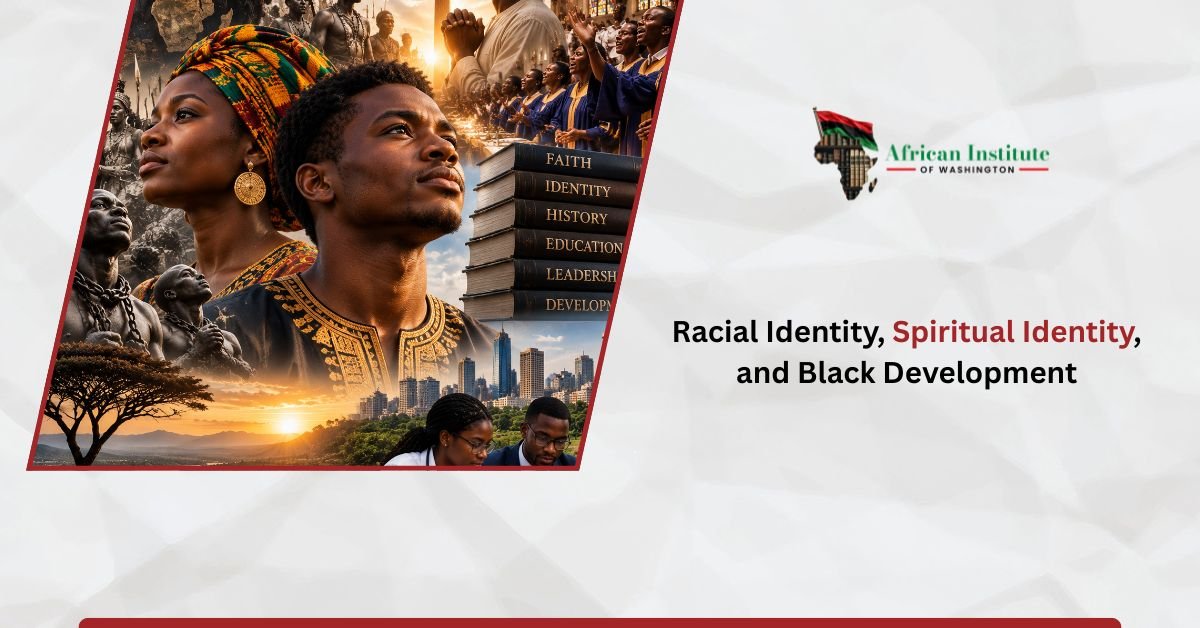
Toward an Integrated Framework of Dignity, History, and Faith
Abstract
Identity is a fundamental dimension of human development. It shapes how individuals understand themselves, their history, their communities, and their place in the world. Among Black populations, racial identity and religious or spiritual identity have historically interacted in complex ways. Christianity, in particular, has played a significant role in the social, cultural, psychological, and political development of Black communities. At the same time, an excessive emphasis on spiritual identity at the expense of historical, cultural, and racial consciousness may create risks for collective development. This article examines the relationship between racial pride and spiritual identity and asks whether religious identity can sometimes displace or weaken racial and historical consciousness. Drawing on psychological research on racial identity, scholarship on African American religious identity, historical studies of the Black Church, and selected Christian teachings, the article argues that racial identity and spiritual identity should not be treated as mutually exclusive. Positive racial identity can provide dignity, historical consciousness, belonging, and resilience, while spiritual identity can provide meaning, moral orientation, community, and hope. The central challenge is therefore not to choose between race and faith but to develop an integrated identity capable of preserving historical memory while promoting universal human dignity. The article also examines Jesus’ teaching concerning self-denial and argues that “losing oneself” in the Christian sense should not automatically be interpreted as abandoning one’s history, culture, or people.
Keywords: racial identity, Black identity, spiritual identity, religious identity, racial pride, Christianity, Black Church, African development, historical consciousness, identity development
Introduction
Identity is one of the most important foundations of individual and collective development. It answers fundamental questions: Who am I? Where do I come from? To whom do I belong? What is the history of my people? What values do I inherit, and what responsibility do I have toward future generations?
For Black communities, these questions are particularly significant because African and African-descended peoples have experienced slavery, colonialism, racial discrimination, cultural disruption, political domination, and struggles for recognition and dignity. Consequently, the development of a healthy racial identity has often been connected to psychological resilience, cultural belonging, historical consciousness, and collective empowerment.
At the same time, religion—particularly Christianity—has occupied a central place in the lives of many Black communities. Religious institutions have provided education, social organization, moral guidance, mutual assistance, political mobilization, and spiritual meaning. Research among African American adults demonstrates the continuing importance of religious and spiritual identity, while historical scholarship shows the importance of the Black Church as a social and community institution.
The question, therefore, is not whether spirituality is beneficial or whether racial identity is preferable to religious identity. The more important question is how these dimensions of identity interact and what happens when one dimension becomes so dominant that it weakens the others.
This article explores a particular concern: Can an excessive emphasis on spiritual identity, especially when understood primarily through religious affiliation, contribute to the weakening of racial, cultural, and historical consciousness among Black people?
This question requires caution. It would be inaccurate to claim that Black people generally identify more strongly with spiritual identity than racial identity. Recent research on Black Christians and Muslims in the United States suggests considerable variation. For example, Bonilla and Melles (2026) found that among Black Christians in their study, 46.8% ranked race as their primary identity, while 14.3% ranked religion as primary. Among Black Muslims, 30.1% ranked race as primary and 25.3% ranked religion as primary. These findings demonstrate that racial and religious identities do not necessarily compete with one another.
The issue is therefore better understood as a question of identity balance and integration rather than identity replacement.
1. Understanding Racial Identity
Racial identity refers to the ways individuals understand, interpret, and relate to their racial or ethnic group. It includes perceptions of group membership, history, culture, collective experience, and attitudes toward one’s own group.
William E. Cross Jr.’s work on Black racial identity has been particularly influential in demonstrating that Black identity is multidimensional. Racial identity is not simply a matter of biological classification. It can involve psychological development, historical consciousness, cultural identification, and one’s interpretation of the social environment (Cross, 1991; Cross & Vandiver, 2001).
A healthy racial identity does not mean believing that one’s racial group is superior to others. There is an important distinction between racial pride and racial supremacy.
Positive racial pride may involve:
- appreciation of one’s history;
- knowledge of cultural traditions;
- respect for one’s ancestors;
- awareness of historical injustice;
- confidence in one’s collective dignity;
- commitment to community development; and
- resistance to internalized inferiority.
Racial supremacy, by contrast, involves the belief that one’s racial group is inherently superior to other groups. The two concepts should not be confused.
Research on racial identity has demonstrated that positive racial identification can provide psychological resources for dealing with discrimination and can strengthen belonging and self-esteem. Cross’s scholarship, for example, demonstrates the importance of racial identity in the psychological development of African Americans.
Consequently, racial consciousness should not automatically be interpreted as racism. A person can affirm the dignity and history of a racial group while simultaneously affirming the equal dignity of all human beings.
2. Spiritual and Religious Identity
Spiritual identity concerns how individuals understand themselves in relation to God, transcendence, faith, moral values, and ultimate meaning. Religious identity may additionally involve membership in a particular religious tradition, community, denomination, or institutional structure.
These forms of identity can provide important psychological and social resources.
For many African Americans, religion has historically provided:
- spiritual meaning;
- moral guidance;
- emotional support;
- community belonging;
- social networks;
- education;
- mutual assistance;
- leadership development; and
- a framework for interpreting suffering and hope.
Pope and Johnson (2016), studying religious and spiritual identity among African American adults, found that religious and spiritual identity can change over time. Their research also emphasizes the role of faith communities in providing belonging, cohesion, and social support.
Religion, therefore, should not be presented simply as an obstacle to racial consciousness. In many historical circumstances, it has been one of the institutions through which racial consciousness itself was preserved.
3. The Black Church and the Convergence of Race and Faith
The history of the Black Church demonstrates that racial and religious identities have often reinforced rather than contradicted each other.
During slavery and segregation, Black churches became important spaces for community organization, education, leadership development, mutual assistance, and resistance. During the Civil Rights Movement, religious institutions and religious leaders played major roles in organizing communities and articulating demands for racial justice.
The Black Church therefore represents an important example of how religious identity can become a vehicle for racial dignity and social transformation.
Du Bois (1903) recognized the importance of the Black church in African American social life. Later scholarship by Lincoln and Mamiya (1990), McKinney (1971), Gates (2022), and others has further documented the institutional and historical significance of Black religious life.
This history complicates any argument that Christianity necessarily causes Black people to abandon racial identity. Historically, Black Christians have frequently used Christian teachings to defend human dignity and challenge racial oppression.
The relationship is therefore more accurately described as dynamic and sometimes contradictory.
Christianity has been used at different historical moments both to justify systems of domination and to challenge them. Black communities did not simply receive Christianity passively; they interpreted, transformed, and incorporated Christianity into their own struggles for dignity and freedom.
4. When Spiritual Identity Becomes a Substitute for Historical Identity
Although religious identity can reinforce racial consciousness, a different problem can emerge when spirituality becomes disconnected from history and culture.
A person may develop a strong religious identity while knowing very little about:
- African history;
- African civilizations;
- African philosophy;
- African contributions to science and culture;
- the history of slavery and colonialism;
- African independence movements;
- Pan-Africanism;
- Black intellectual traditions; or
- the historical struggles of African-descended peoples.
When this occurs, religious identity may become detached from historical consciousness.
The problem is not faith itself. The problem is identity reduction—the tendency to reduce the complexity of human identity to a single dimension.
For example, a person may think:
“My identity is primarily religious; therefore, my African history is secondary.”
Such a position may unintentionally produce historical amnesia.
Historical consciousness matters because communities that do not understand their past may struggle to interpret their present circumstances or formulate long-term strategies for their future.
5. The Psychological Consequences of Weak Racial and Historical Consciousness
If racial and historical consciousness are weakened, several possible consequences may arise.
5.1 Loss of Historical Memory
Historical memory allows communities to understand how present conditions emerged. Without historical knowledge, contemporary inequalities can appear disconnected from historical processes.
The study of colonialism, slavery, segregation, economic exploitation, and political domination therefore becomes part of understanding contemporary development.
5.2 Cultural Insecurity
When individuals lack knowledge of their cultural history, they may become dependent on external definitions of their identity.
Fanon (1952) examined the psychological consequences of colonial domination and the internalization of racial hierarchies. His work remains relevant to discussions of identity because colonialism did not simply control territory; it also affected perceptions of self, culture, language, and human worth.
5.3 Weak Collective Consciousness
Development requires cooperation. Cooperation is strengthened when individuals perceive themselves as members of communities with shared interests and responsibilities.
A highly individualized understanding of spirituality may sometimes weaken attention to collective problems if social suffering is interpreted exclusively as an individual spiritual problem.
This does not mean that spirituality necessarily produces individualism. Religious communities can create powerful forms of collective action. The issue concerns the particular interpretation and practice of spirituality.
5.4 Intellectual Dependence
A population that knows little about its own intellectual traditions may become dependent on external institutions to define its history, philosophy, values, and possibilities.
African development therefore requires not only economic resources but also intellectual self-confidence.
5.5 Fragmentation of Identity
Identity becomes fragile when individuals experience different aspects of themselves as mutually contradictory.
An African Christian, for example, should not necessarily have to choose between being African and being Christian.
The historical record itself demonstrates that Christianity has deep African roots.
6. Africa and the Historical Roots of Christianity
One important dimension often overlooked in discussions of Black Christian identity is the African history of Christianity itself.
Christianity developed very early in Africa. Egypt became one of the major centers of early Christianity. Ethiopia developed one of the world’s oldest Christian traditions. North Africa produced influential Christian thinkers and theologians.
Among the major African Christian intellectual figures were:
- Tertullian of Carthage;
- Cyprian of Carthage;
- Athanasius of Alexandria;
- Augustine of Hippo; and
- Origen of Alexandria.
Consequently, Christianity cannot historically be understood solely as a European religion imposed upon Africa.
At the same time, the later history of European colonialism and missionary Christianity in Africa was complex. Christianity was sometimes associated with colonial structures, while African Christians simultaneously appropriated Christian ideas for education, liberation, community organization, and resistance.
This history should be taught in a manner that avoids both romanticization and rejection.
African Christians should be able to understand Christianity as part of a religious tradition with significant African intellectual and historical roots.
7. Jesus and the Question of “Losing Oneself”
The teachings of Jesus introduce an important theological dimension to the discussion.
In Matthew 16:24–26, Mark 8:34–37, and Luke 9:23–25, Jesus teaches his disciples to deny themselves, take up their cross, and follow him. In John 12:24–25, the Gospel uses the language of losing one’s life in order to find it.
These passages can be misunderstood if “self-denial” is interpreted as the destruction of one’s identity.
Jesus does not explicitly teach his followers to abandon their ethnic history, culture, or people. The context is primarily concerned with discipleship, sacrifice, ego, attachment, and commitment to God’s purposes.
Therefore:
Losing oneself is not necessarily losing one’s history.
Renouncing egoism is not the same as renouncing one’s people.
Rejecting prideful superiority is not the same as rejecting cultural dignity.
This distinction is particularly important when discussing racial pride.
Christianity can challenge racial arrogance without requiring cultural self-erasure.
A Christian may reject racial supremacy while still affirming African history, culture, dignity, and collective responsibility.
8. From Racial Pride to Human Dignity
The concept of racial pride itself may benefit from greater precision.
Instead of understanding racial pride as the belief that one’s group is better than others, it can be understood as affirmation of dignity, history, and cultural worth.
This distinction allows racial identity to coexist with Christian universalism.
A person can say:
“I am proud of African history.”
without saying:
“Africans are superior to other peoples.”
Similarly, a Christian can affirm:
“Every human being is created with dignity.”
while also saying:
“African people have a particular history that deserves to be remembered and understood.”
Universal human dignity does not require historical uniformity.
9. Identity and Collective Development
Development is not simply economic growth. It includes psychological, cultural, intellectual, institutional, social, political, and moral dimensions.
A community’s development may be weakened if its members lack confidence in their historical identity.
For African and African-descended communities, development therefore requires investment in:
- Historical education – learning African and Black history beyond colonial narratives.
- Cultural education – preserving languages, traditions, literature, philosophy, and artistic expression.
- Psychological development – overcoming internalized inferiority and developing healthy self-esteem.
- Intellectual development – producing knowledge rather than simply consuming knowledge produced elsewhere.
- Institutional development – building schools, organizations, businesses, and civic institutions.
- Economic development – developing productive capacity and sustainable economic systems.
- Moral and spiritual development – cultivating responsibility, service, justice, compassion, and ethical leadership.
- Global human solidarity – connecting African identity with the dignity of humanity as a whole.
This model avoids the false choice between racial identity and spiritual identity.
10. Toward an Integrated Identity
The most constructive approach may be to understand identity as multidimensional.
An individual can simultaneously possess:
- a personal identity;
- a family identity;
- an African or African-descended identity;
- a national identity;
- a cultural identity;
- a religious or spiritual identity;
- a professional identity; and
- a universal human identity.
These identities do not necessarily have to compete.
The objective should be integration rather than replacement.
A Black Christian can be deeply Christian and deeply conscious of African history.
An African Muslim can be deeply Muslim while maintaining a strong African cultural identity.
A secular African can affirm African history and human dignity without a religious identity.
Identity becomes healthy when individuals can integrate their different dimensions without being forced into unnecessary contradictions.
11. Implications for African Development and Education
African educational institutions have an important role in addressing this question.
Education should not merely prepare students for employment. It should help them understand who they are, where they come from, and what responsibilities they have toward their communities.
An education that teaches mathematics, science, economics, and technology while ignoring history, philosophy, culture, and identity may produce technically skilled individuals without sufficient historical consciousness.
Similarly, religious education that teaches faith without history may produce believers who know their religious traditions but have limited knowledge of their cultural and historical heritage.
A comprehensive educational model should therefore bring together:
faith + history + culture + ethics + science + leadership + economic development.
Such an approach can produce individuals who are spiritually grounded, historically conscious, intellectually confident, and committed to community development.
Conclusion
The relationship between racial identity and spiritual identity among Black people is more complex than a simple choice between race and religion.
Research does not support the broad claim that Black people generally place spiritual identity above racial identity. Instead, racial and religious identities vary across individuals and communities and can reinforce one another.
The historical experience of the Black Church demonstrates that Christianity has often served as a source of racial consciousness, community organization, education, resistance, and social transformation. At the same time, an exclusive or poorly integrated spiritual identity can potentially weaken historical and cultural consciousness when it causes individuals to neglect their history, culture, and collective responsibilities.
The solution is not to reject Christianity or spirituality. Nor is it to promote racial identity as a substitute for spiritual identity.
The challenge is to develop an integrated identity.
Black people can know their African history without rejecting Christianity. They can affirm racial dignity without embracing racial superiority. They can follow Jesus without abandoning their cultural memory. They can pursue universal human dignity without becoming historically disconnected from their own people.
Jesus’ call to “deny yourself” should therefore be understood primarily as a call to overcome egoism, selfishness, and attachment to power—not as a command to erase one’s history or cultural identity.
For African development, the fundamental question is not:
“Should we choose racial identity or spiritual identity?”
Rather, it is:
“How can racial, cultural, historical, spiritual, intellectual, and human identities be integrated into a form of consciousness capable of producing dignity, responsibility, and sustainable development?”
A people who know their history, understand their spirituality, value their culture, develop their intellectual capacities, and recognize the dignity of others possesses a stronger foundation for collective development.
The ultimate objective is therefore not racial pride against spiritual identity, nor spiritual identity against racial identity. It is human dignity rooted in historical consciousness, cultural confidence, ethical responsibility, and spiritual meaning.
References
American Psychological Association. (2021). The impact of race on psychological processes. Translational Issues in Psychological Science, 7(4).
Bonilla, T., & Melles, E. (2026). Examining religious and racial identity for Black Christians and Muslims in the United States. Journal of Race, Ethnicity, and Politics. https://doi.org/10.1017/rep.2026.10064
Cone, J. H. (1969). Black theology and Black power. Seabury Press.
Cone, J. H. (2011). The cross and the lynching tree. Orbis Books.
Cross, W. E., Jr. (1991). Shades of Black: Diversity in African-American identity. Temple University Press.
Cross, W. E., Jr., & Vandiver, B. J. (2001). Nigrescence theory and measurement: Introducing the Cross Racial Identity Scale (CRIS). In J. G. Ponterotto, J. M. Casas, L. A. Suzuki, & C. M. Alexander (Eds.), Handbook of multicultural counseling (2nd ed., pp. 371–393). Sage.
Du Bois, W. E. B. (1903). The souls of Black folk. A. C. McClurg
