From Strategic Minerals to the Contributions of the Congolese Diaspora
An African Institute of Washington Perspective on Congo’s Contribution to America’s Industrial, Technological, Military, and Social Development
Abstract
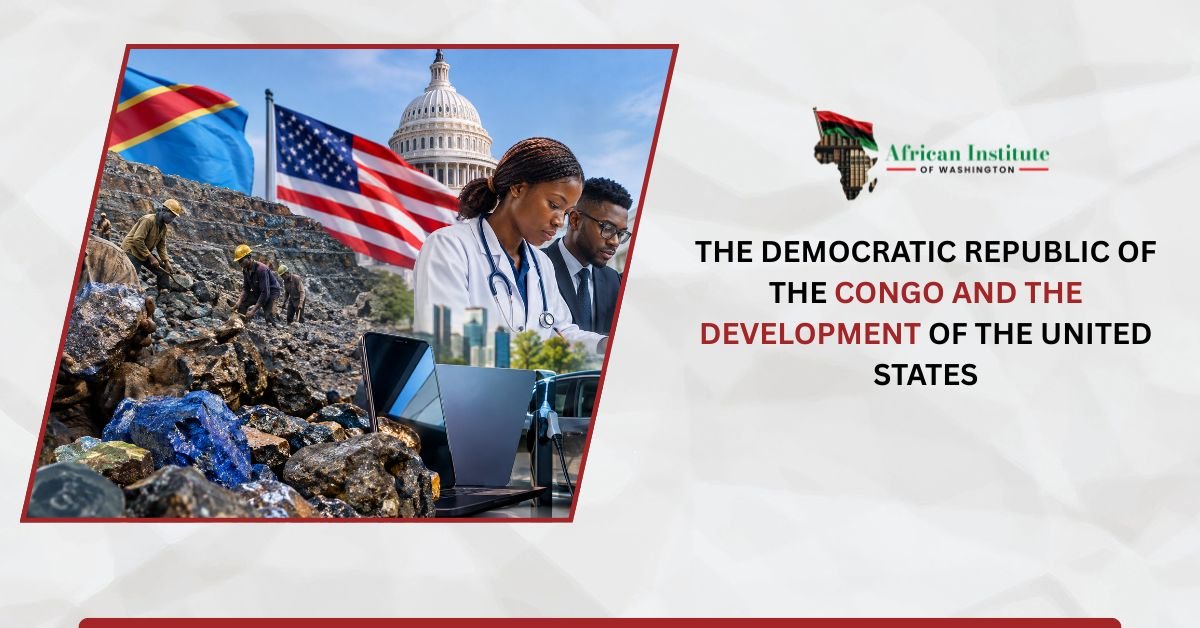
The history of the United States as a global industrial, technological, and military power is connected in important ways to resources and human contributions originating from around the world. Among the countries whose resources have played a significant role is the Democratic Republic of the Congo (DRC). From the uranium of Shinkolobwe that became strategically important to the American atomic program during World War II to the cobalt and other critical minerals that support contemporary technologies, the Congo has contributed materials of exceptional importance to modern industrial civilization.
Today, the contribution of the Congo to the United States is no longer limited to natural resources. Congolese Americans and other members of the Congolese diaspora contribute to American society through medicine, education, entrepreneurship, research, public service, community development, and other professions.
This article examines two dimensions of this relationship: the historical contribution of Congolese natural resources to American power and the contemporary contribution of Congolese people to American society. It argues that the history of Congo-U.S. relations should be understood not only through the extraction of resources, but also through the knowledge, skills, professional achievements, and civic contributions of Congolese people themselves.
Keywords: Democratic Republic of the Congo, United States, Shinkolobwe, uranium, cobalt, critical minerals, Congolese diaspora, African development, human capital, technology
1. Introduction: Congo and the American Century
The United States did not become a global superpower through American resources alone. Its rise depended on international networks of raw materials, labor, scientific knowledge, trade, immigration, and technological exchange.
The Democratic Republic of the Congo occupies a particularly important place in this history because of the extraordinary concentration of strategic minerals found within its territory.
The relationship is therefore larger than a simple question of mineral exports. Congo has contributed to American power through natural resources in the past and through human capital in the present.
The historical record of the Manhattan Project provides one of the clearest examples.
2. Shinkolobwe and the Birth of the Atomic Age
During World War II, the Belgian Congo possessed one of the world’s most strategically important uranium deposits at Shinkolobwe, in present-day Haut-Katanga Province.
The U.S. Department of Energy’s historical account states that, on September 18, 1942, General Leslie Groves acquired approximately 1,250 tons of uranium mined from the Belgian Congo for the Manhattan Project.
The significance of this material cannot be separated from the development of the first atomic weapons.
The Manhattan Project required large quantities of uranium. According to the U.S. Department of Energy’s historical documentation, the most important sources available at the beginning of the war included uranium mines in northern Canada and the Belgian Congo.
The Congo’s contribution was therefore not symbolic. Uranium from the Belgian Congo became part of the material foundation of an American program that ultimately produced the first nuclear weapon.
On July 16, 1945, the United States conducted the Trinity nuclear test in New Mexico, inaugurating the nuclear age.
The history is extraordinary:
African mineral resources → uranium procurement → American scientific and industrial mobilization → Manhattan Project → nuclear age.
This does not mean that Congolese uranium alone created the American atomic bomb. The Manhattan Project depended upon thousands of scientists, engineers, soldiers, industrial workers, institutions, factories, and enormous American financial and technological resources.
But it does demonstrate that a strategic resource extracted from the Congo became an important component of the American wartime atomic program.
3. From Uranium to the Modern Technology Economy
The strategic importance of Congo’s natural resources did not end with uranium.
The DRC possesses extraordinary deposits of copper, cobalt, tantalum, tin, lithium and other minerals that are important to contemporary industry.
According to the U.S. Geological Survey, in 2024 the DRC was the world’s leading producer of cobalt, accounting for an estimated 75 percent of global cobalt production and approximately 55 percent of global reserves. It was also the world’s leading producer of tantalum, with an estimated 51 percent of global production.
Cobalt is particularly important because it is used in rechargeable battery technologies. USGS identifies cobalt as a critical mineral and notes its importance to lithium-ion batteries used in mobile phones, electric vehicles and personal computers.
This creates a direct connection between Congolese mineral production and the global technological economy.
A modern smartphone, computer, electric vehicle or energy-storage system may involve supply chains that ultimately depend upon minerals originating in the Congo.
The relationship is complex because Congolese minerals often pass through several countries for processing, refining, manufacturing and assembly. Nevertheless, the underlying resource base remains an important component of the global technology system.
4. Congo and America’s Energy and Industrial Future
The strategic importance of Congolese minerals is likely to remain significant as the world moves toward electrification and renewable energy.
The United States and other industrial countries increasingly identify cobalt, copper, lithium, nickel, graphite and rare earth elements as strategically important to energy and technology supply chains.
The U.S. Geological Survey projects continued growth in demand and production capacity for critical minerals, particularly minerals associated with batteries and advanced technologies.
In 2023, the United States, the DRC and Zambia also announced a memorandum of understanding concerning development of an electric-vehicle battery value chain. The U.S. State Department described the DRC as producing more than 70 percent of the world’s cobalt at that time and emphasized the importance of building a supply chain extending from mining to battery production.
This represents an important change in the discussion about African resources.
The question is no longer simply:
“What minerals does Africa possess?”
The more important question is:
“Where will the value created from those minerals be captured?”
For the Congo, this raises the possibility of moving from the export of raw materials toward processing, manufacturing, technology development, employment creation and local industrialization.
5. From Natural Resources to Human Resources
There is another Congo contribution to the United States that deserves greater attention.
It is the contribution of Congolese people themselves.
The history of Africa’s relationship with the United States is often discussed in terms of minerals, trade, humanitarian assistance and foreign policy. Less attention is sometimes given to the African immigrant who becomes a physician, nurse, professor, engineer, entrepreneur, researcher, business owner, military professional or community leader in America.
The Congolese diaspora demonstrates that Africa’s greatest resource is not only beneath the ground.
It is also above the ground: the African human being.
Congolese Americans contribute to the United States every day through professional expertise, entrepreneurship, healthcare, education, research, cultural life, community organizations and civic participation.
Their contribution represents a second chapter in the relationship between Congo and America:
Yesterday, Congo contributed strategic minerals.
Today, Congolese people contribute knowledge, skills, institutions and professional service.
6. A Contemporary Example: Dr. Mapendo Karen Safari and Access Psychiatry
A powerful example of contemporary Congolese-American contribution can be found in the field of mental healthcare.
Dr. Mapendo Karen Safari, DNP, APRN, PMHNP-BC, is the founder and medical director of Access Psychiatry, serving patients in the Washington metropolitan region. Her professional profile identifies her as a psychiatric mental-health nurse practitioner and describes her practice as providing both in-person and online services.
Her professional work addresses an important challenge in American society: access to quality mental-health care.
Access Psychiatry describes its approach as patient-centered and culturally sensitive, with an emphasis on providing high-quality mental-health services without barriers related to race, background, faith or gender orientation.
Dr. Safari’s professional journey illustrates an important dimension of diaspora contribution.
She is not simply an immigrant living in America.
She is a healthcare professional creating an institution, providing services to American communities, and contributing to the wellbeing of patients.
Her work demonstrates how members of the Congolese diaspora can participate directly in solving problems within American society.
Mental health is particularly important because emotional and psychological wellbeing affects families, workplaces, schools, veterans, communities and the broader public-health system.
Through professional healthcare practice, Congolese-American professionals such as Dr. Safari become part of America’s human-capital infrastructure.
Their contribution is therefore measured not only by income or taxes, but also by:
- patients served;
- professional expertise;
- institutions created;
- employment generated;
- knowledge transmitted;
- communities strengthened; and
- human lives improved.
7. Service Beyond Professional Practice
The contribution of members of the Congolese diaspora can extend beyond their professions.
Dr. Mapendo Karen Safari is also associated with the African Development Association (ADA), a humanitarian initiative focused on supporting disadvantaged communities in Africa and assisting members of the broader community in the United States.
This type of engagement illustrates another dimension of diaspora citizenship.
A Congolese-American can simultaneously contribute to:
America through professional service
and
Africa through humanitarian and development activities.
The diaspora therefore becomes a bridge between two worlds.
A physician can treat patients in the United States while supporting health or education initiatives in Africa.
An engineer can work for an American company while transferring knowledge to African institutions.
A professor can teach in America while mentoring African students.
An entrepreneur can establish an American business while investing in Africa.
A community organization can mobilize American resources for African development.
This is the potential of the diaspora as transnational human capital.
8. The Congolese Diaspora as a Bridge Between Congo and America
The Congolese diaspora should not be understood simply as a population that left Congo.
It can also be understood as a network of people connecting Congo to the United States through:
Education
Congolese students and professionals acquire knowledge from American universities and institutions.
Healthcare
Congolese medical professionals contribute to American healthcare while potentially supporting health initiatives in Congo.
Entrepreneurship
Congolese-American entrepreneurs create businesses, jobs and economic activity.
Science and Technology
Professionals contribute to America’s research and technological ecosystem.
Humanitarian Service
Diaspora organizations mobilize resources for vulnerable communities in Congo and elsewhere.
Cultural Diplomacy
Congolese Americans introduce Congolese culture, languages, history and perspectives to American society.
Knowledge Transfer
Professionals can establish partnerships between American and Congolese universities, hospitals, businesses and civil-society organizations.
9. A Relationship That Should Move Beyond Extraction
The history of Congo and America also raises a broader development question.
For generations, Africa’s contribution to the world economy has frequently been measured through the extraction of natural resources.
But minerals have a limited ability to transform societies when countries remain primarily exporters of raw materials.
The long-term challenge is to transform:
minerals into industries,
industries into jobs,
jobs into prosperity,
education into innovation,
and
diaspora relationships into development partnerships.
The U.S.-DRC-Zambia battery initiative illustrates the possibility of moving toward value-added production rather than focusing exclusively on extraction. The U.S. government has stated that the initiative was intended to support a supply chain extending from the mine to the assembly line while encouraging investment and greater value addition in Africa.
Such approaches require transparency, environmental responsibility, worker protections, local participation and mechanisms through which mineral-producing communities benefit from the value generated by their resources.
10. Congo’s Contribution: Past and Present
The story can therefore be divided into two major chapters.
The First Chapter: Natural Resources
Congo contributed resources that became important to major developments in modern industry and national security.
Shinkolobwe uranium became part of the material supply supporting the American atomic program during World War II.
Today, Congolese cobalt and other critical minerals remain important to global technology and energy supply chains.
The Second Chapter: Human Capital
Today, Congolese people contribute directly to American society through professional excellence, entrepreneurship, healthcare, education, research, public service and humanitarian activity.
Dr. Mapendo Karen Safari and Access Psychiatry provide one concrete example of this second chapter.
The first contribution came largely from what Congo possesses.
The second comes from what Congolese people know, create and accomplish.
The second contribution may ultimately be even more important because human capital can reproduce itself through education, mentorship, innovation and institution-building.
11. Toward a New Congo-American Partnership
The future of Congo-American relations should therefore not be based exclusively on access to Congolese minerals.
It should also be based on:
- education;
- technology transfer;
- healthcare partnerships;
- scientific cooperation;
- responsible investment;
- value-added manufacturing;
- entrepreneurship;
- professional exchanges;
- diaspora investment;
- university partnerships;
- humanitarian cooperation; and
- institutional development.
The Congolese diaspora can play a particularly important role in this transformation because its members understand both societies.
They know the opportunities and challenges of the United States.
They also understand the realities of Congo.
That position can make the diaspora a bridge for investment, knowledge, professional networks and development.
12. Conclusion: Congo Is More Than Its Minerals
The history of the Democratic Republic of the Congo and the United States contains a profound paradox.
Congo has supplied resources that have helped support some of the technologies associated with modern American power, yet the Congolese people themselves have often received far less recognition for their contribution than the minerals extracted from their land.
The uranium of Shinkolobwe became part of the history of the American atomic age.
Cobalt and other Congolese minerals remain important to the modern global technology economy.
But Congo’s contribution does not end underground.
It continues in hospitals, universities, businesses, laboratories, community organizations and professional institutions throughout the United States.
The story of Dr. Mapendo Karen Safari and Access Psychiatry represents this new dimension of Congo’s contribution: the Congolese diaspora is not simply a source of labor or a community of immigrants. It is a reservoir of professional knowledge, entrepreneurship, creativity, humanitarian commitment and human capital.
The African Institute of Washington therefore proposes a broader understanding of the Congo-American relationship:
Congo has contributed to America through its resources, but Congolese people contribute to America through their knowledge, skills, institutions and service.
The challenge for the future is to build a relationship in which Congo is not valued only for what can be extracted from its soil, but also for what can be developed through its people.
The future of Congo-American relations should consequently move from extraction toward partnership, from raw materials toward value creation, and from dependency toward shared human development.
Selected References
U.S. Department of Energy. (2025). The Army and the origins of the nuclear security enterprise. U.S. Department of Energy.
U.S. Department of Energy. (n.d.). Manhattan Project: Procuring and processing uranium. Office of Scientific and Technical Information.
U.S. Department of State. (2023). The United States releases signed memorandum of understanding with the Democratic Republic of Congo and Zambia to strengthen electric vehicle battery value chain.
U.S. Geological Survey. (2026). Congo (Kinshasa): National Minerals Information Center.
U.S. Geological Survey. (2025). A database of artisanal, small-scale, and large-scale mining in the Copperbelt region of the Democratic Republic of Congo and Zambia.
U.S. Geological Survey. (2025). USGS projects world production capacity for seven critical minerals and helium from 2025 to 2029.
Access Psychiatry. (n.d.). Meet Dr. Mapendo Karen Safari, DNP, APRN, PMHNP-BC.
Psychology Today. (n.d.). Dr. Mapendo K. Safari, DNP, APRN, PMHNP-BC.
African Institute of Washington
“Africa’s contribution to the world should be measured not only by what is extracted from Africa, but also by what Africans create, discover, teach, heal, and build.”
Professor Claude Kisuka
African Institute of Washington
African Studies
